
Urban regeneration and heritage enhancement
The reuse of a degraded monumental area in the historic centre of Spoleto
by Alessandro Monti* and Bruno Toscano**
 Aggiungi Il Sole 24 Ore
ai preferiti su Google
5' min read
5' min read
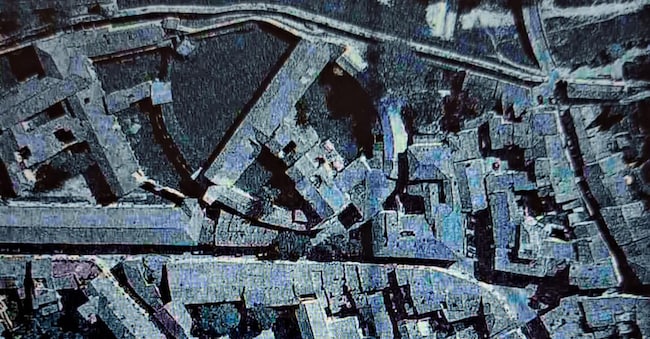
It is not uncommon to find the case of an old disused building that, left unmaintained for a long time, goes into gradual decay amid general disinterest. More rare is the case that an entire monumental urban area finds itself in the same condition. This is what happens in Spoleto in a vast area within the mediaeval city walls, comprising a building of significant historical, artistic and architectural interest, dating from the Roman age to the 18th century. It includes the 2nd century amphitheatre, three churches and two large monasteries with three cloisters. A history spanning fifteen centuries explains the uniqueness of the place: the plurality of spatial situations, the coexistence of different dimensional scales, materials and formal solutions. The longest lasting use, the monastic one, was the cause of the insularity of the entire area with respect to the urban fabric. If for an isolated monument, the recovery intervention can be limited to 'rescue restoration', for an ensemble such as that of Spoleto, destinations must be identified that can be harmonised with the permeability between the place and the city, with respect to which the multiple identities of the complex are equivalent to as many 'opportunities' for new functions and balances. For over a century used as barracks (Minervio), then decommissioned and left unused for a long time, the area has recently been cleared of demesnes and ceded to the Municipality of Spoleto. The necessary consolidation and restoration work, involving an estimated cost of over 50 million euro, has only been carried out to a minimal extent. Yet the desirable recovery and reuse of the area - further degraded by the seismic events of 2009 and 2016 - would be exemplary of the urban regeneration that the City's international culture has long indicated as a fundamental aspect of the revitalisation of historic centres. Unfortunately, discontinuities in the political line of the municipal administrations that have succeeded one another in Spoleto over the last two decades, bureaucratic red tape in the disbursement of funds for post-earthquake reconstruction, and disputes between public bodies over the manner and timing of the use of resources - allocated for the recovery of the area and then dispersed in the maze of public finances - have so far prevented a decisive start to the redevelopment work, thus losing the benefits of its profitable reuse. And this despite the fact that an innovative project was available - formulated in 2005 by a technical-scientific commission appointed by the municipality and composed of the writer - that envisaged the opening of a 'Polo di Alta Formazione Integrata' (PAFI) for the knowledge, protection, conservation and valorisation of cultural heritage. The project, despite having received the support of citizens and public institutions, first and foremost the Central Institute for Restoration and the Diocese of Spoleto, and the patronage of the Presidency of the Republic, has not yet been implemented.
Faced with the continuing state of neglect of the area, it is worth relaunching the project, which retains its topicality by having as its pivot a strategic vision oriented at restoring vitality to degraded spaces through their dynamic re-aggregation with the rest of the city.
Verifying the continued viability of the project and updating its feasibility plan are indispensable fulfilments to start the regeneration of the sites. Fulfilments that go hand in hand with the updating of the costs for the restoration and recovery of the buildings and their functional reconversion to the needs of reuse, and with the verification of the ability to cover them with available public means and with those that can be mobilised with forms of project financing. The feasibility of the project depends first and foremost on a renewed appreciation of its originality, not only by the organs of the new Spoleto municipal administration, but above all by the citizenship, to be ascertained, if necessary, also by means of referendums. With regard to the Municipal Council's orientation, significant is the commitment underway for the restoration of a portion (8,000 cubic metres) of the building that is part of the Monastero della Stella, to be used as the definitive headquarters of the University of Perugia's 'Inter-University Centre for the Digitisation of Cultural and Environmental Heritage'. Being a public research facility that provides indispensable cognitive elements to monitor the state of the cultural heritage and landscape, the Centre can be a valuable aid precisely for the operation of the Polo di Alta Formazione Integrata (PAFI) and the strengthening of its capacity for creative impulse. The circumstance that the restoration initiative is being promoted by the Department for the 'Enhancement of Urban Identity Regeneration', authorises us to believe that this may not be an isolated act, but a first step in the start of the overall restoration of the area. Considering the significant size of its surface area (17 thousand square metres) and its cubature (over 200 thousand cubic metres) and its vocation linked to singular morphological characteristics, the usefulness of integrating the proposals for reuse that have been put forward so far (seismic risk) with the PAFI project, projected on the entire range of causes of degradation of the cultural heritage that require coordinated actions and new operational capacities, seems increasingly evident. The Pole's priority aim is still to respond to the growing need for tertiary level channels to train/update professionals in the care of cultural heritage through the recomposition of theoretical approaches with pragmatic ones and a didactics based on the integration of scientific methods and multidisciplinary contents, delivered through residential courses and interactive workshops. A didactics open to legal and political-economic disciplines useful for the correct application of the principles of protection and valorisation. The figure to be trained is a professional who, engaged in the intervention on a monument or on a complex of historic buildings, acts in a 'regime' of cooperation between art historians, archaeologists, architects, restorers, moving at ease in a wide range of functions. Including administrative and management tasks related to relations with other institutions and private individuals. The activation of courses and internships in a monumental area under restoration offers the advantage of verifying in the field the functionality of the "critical" survey and the effectiveness of consolidation and recovery procedures with new generation anti-seismic techniques, consistent with the principles of "planned conservation". Setting up spaces for educational and research activities, scientific and cultural initiatives, and offering additional services open to the public will result in the progressive participation of local craftsmen and businesses and an increase in the 'attractiveness' of the area, making it a driving force for the development of the entire city.
A project, therefore, articulated and modular whose involving rationale can be repeated in similar situations. A project that is only apparently unique. Symbolic instead of practicable solutions in the processes of urban regeneration of areas degraded by the passage of time and/or affected by the earthquake, provided that the physical recovery of places is accompanied by the revitalisation of the social and economic fabric of the territory.
* Professor of Development Theory and Policy, formerly University of Camerino (MC)
** Professor Emeritus of Art History, University of Roma Tre

