
The 'historic' cars of the Urbe? Old vans and off-roaders
5,594 vehicles of 'certified historicity' circulate in Rome

3' min read
3' min read
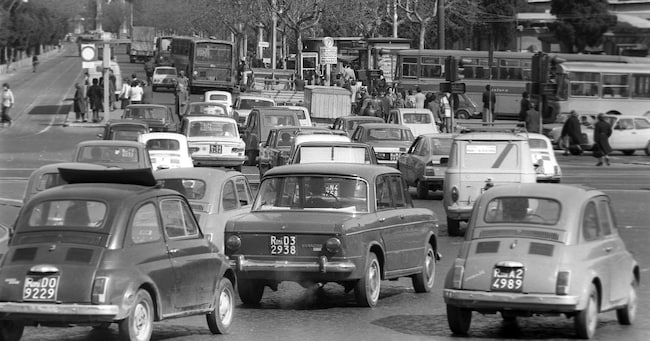
In the Eternal City, amidst treasures of art, history and architecture that all mankind envies, there also stands out a heritage that - at least on paper - seems completely integrated with the Rome-sounding: that of vintage cars. That's right, because every single day between the Imperial Forums, the Campidoglio, Piazza del Popolo and Via della Conciliazione - and in any case within the perimeter of what is probably Europe's busiest traffic zone - as many as 5,594 vehicles of 'certified historicity' whizz past. In short, it would be enough to draw up a postcard, perhaps in sepia-toned black and white, for devotees of the Dolce Vita, useful for branding the cradle of civilisation even more, if it is needed, and that includes motoring.
Certificates of Historical Significance
.The enchantment is shattered, however, by scrolling through the file of 'Analysis of the Certificates of Historical Significance of Cars' 'domiciled' - and probably used on a daily basis - in Urbe. One passes for the 32 Fiat Cinquecento of the 1990s (an industrial accident that has nothing to do with the iconic model produced from 1957 to 1975, that walking witness to the history of the country) and patience for the 27 Panda registered at the turn of the millennium (not even cousins of the legendary '4x4', '30' and '45' of the early 1980s, 'mundial' versions of the revolutionary and spartan little car). The problems of adequacy, or at least of consistency, begin with the list of old, exhausted and highly polluting off-roaders, from the 70 Mitsubishi Pajero to the 75 Jeep Cherokee and Grand Cherokee, up to the 45 Land Rover Discovery and 20 Opel Frontera: all with supercharged diesel engines of a very old generation and out of every 'green' parameter. But making it clear once and for all that something doesn't add up in Crs' 'controlled denomination' system are two dozen Fiat Ducato, Fiat Scudo and VW Transporter vans, honest and modest work vehicles still in service (one wonders in what condition), certainly not Sunday parade cabs.
Aci data
.According to ACI data, there are 553 thousand vehicles of 'certified historical relevance' in Italy, a disproportionate number that, according to these surveys, is at least five times higher than the actual value. The reason is that by way of derogation from Directive 2014/45/EU - which defines vehicles of historical interest as those at least 30 years old, no longer in production, preserved and maintained historically in their original state and which have not undergone substantial changes in their technical characteristics - the Highway Code allows cars ('auto') to be considered historical with only the requirement of 20 years of age and without any particular assessment of 'relevance'. The certifying bodies envisaged by the Cds (Article 60) are five, two associations and three (strict) manufacturers' brands. Faced with numbers that lend themselves to the suspicion of serial abuse of the right - considering that the certification of historical relevance opens the door to exemption from stamp duty (total in several regions, partial in others), transaction taxes (Ipt above all) and, in fact, liability insurance policies - two amendments on the subject had appeared in the reform of the Highway Code. Amendments that were promptly rejected in the passage through the House, with total disregard for the 30 million euro/year loss to the Treasury and the environmental (and safety) inconvenience put on the road every day by half a million jalopies. But 'certified' carts.


