
Ursula von der Leyen: We cannot accept China's support for Russia
'We are ready to build a more balanced and stable relationship with China'

2' min read
2' min read
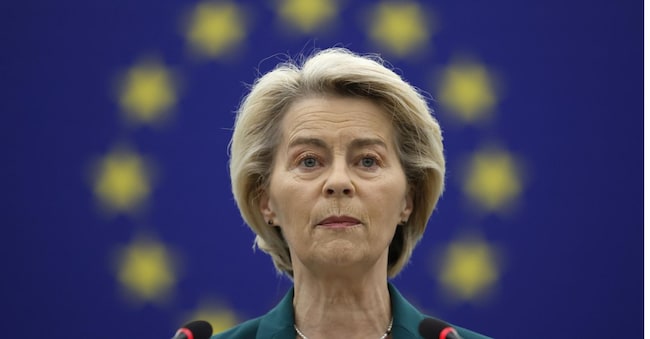
'How China continues to interact with Putin's war will be a determining factor for future EU-China relations'. The President of the European Commission, Ursula von der Leyen, was clear in representing the European position towards Beijing. During the Strasbourg plenary, von der Leyen emphasised that the EU cannot accept Chinese support for Russia because 'China's unwavering support for Russia is creating more instability and insecurity here in Europe'. Von der Leyen also called on China to 'unequivocally condemn Russia's gross violation of Ukraine's sovereignty, territorial integrity and internationally recognised borders'.
Von der Leyen continued: 'We will always defend our interests, we will reduce the risks of our economies, but we do not want to decouple. As we enter our second half-century of cooperation, China is changing, but this is also a new era for Europe: an independent Europe. We are ready to build a more balanced and stable relationship with China and to write a new chapter in this fundamental relationship'. This is the political message ahead of the EU-China summit at the end of the month. There is no specific novelty in this approach, but rather the confirmation of the 'derisking' (reduction of dependence on China) line as an alternative to an unrealistic 'decoupling' (decoupling between economies) in a context where US policies of breaking global collaboration from trade make it clear that the EU needs to defend the multilateral framework to regulate global affairs.
Only a year and a half ago, the EU considered China 'a cooperation partner, an economic competitor and a systemic rival', a term the latter not evoked today: von der Leyen merely pointed out that in relations with Beijing there are very real risks at stake for Europe, risks that are both strategic and systemic'. It is not just a question of accents.

