Big Tech

The US government halts the launch of Anthropic’s advanced AI models; alarm bells ring in Brussels

On grounds of “national security”, Washington has ordered a ban on foreign nationals, and the company has complied. The measure once again highlights Europe’s dependence on American technology

by Pierangelo Soldavini

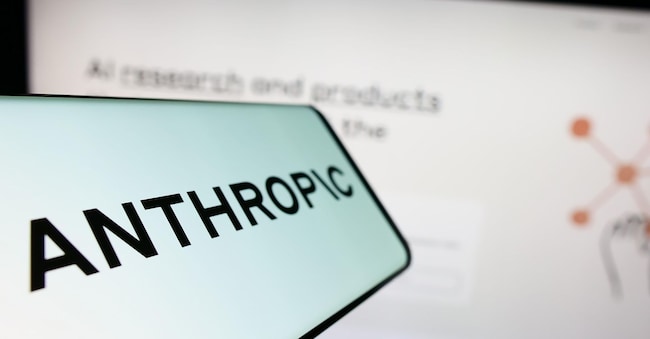
Smartphone con il logo dell'azienda statunitense di intelligenza artificiale Anthropic PBC sullo schermo, davanti a un sito web. In primo piano la parte centro-sinistra del display del telefono. Alamy Stock Photo

3' min read

Translated by AI
Versione italiana

3' min read

Translated by AI
Versione italiana

In the name of artificial intelligence sovereignty, the US government has also invoked ‘national security’. And for Europe, this opens up a new and risky front of technological vulnerability. Just three days after its commercial launch, in mid-June, Anthropic suspended access to its two most powerful artificial intelligence models, Fable 5 and Mythos 5, in order to comply with a directive from the US government citing – precisely – ‘national security’.

Washington was categorical: on the basis of export control regulations, it ordered the AI giant to block access to these models for ‘any foreign national, whether inside or outside the US’, including its ‘foreign employees’. As this was an extremely complex request, Anthropic concluded that it was impossible to filter its users by nationality and was forced to announce the suspension.

Loading...

What’s more, the US Government’s order arrived late on Friday afternoon, 12 June, on the eve of the weekend, ruling out any possibility of a response, just as Dario Amodei’s company was dealing with the issue of its listing on Wall Street. “The direct consequence of the order is that we must immediately disable Fable 5 and Mythos 5 for all our customers in order to ensure compliance,” the company stated, adding that all other models will not be affected.

Fable 5 and Mythos 5 are the two models that Anthropic has presented as cutting-edge in various sectors. Fable 5, in particular, marked the first time the start-up has made such an advanced offering publicly available, thanks to new security measures that block responses in specific high-risk areas. The models were based on the release of Claude Mythos Preview, which had impressed Wall Street and government officials in April thanks to its advanced cybersecurity capabilities.

At the time, the company had stated that it did not intend to make the model available to the general public, limiting its launch to an initial select group of companies as part of a cyber security initiative called Project Glasswing.

In its statement, Anthropic itself admitted that, ‘as we have stated publicly, we believe the Government should have the power to block unsafe applications, as part of a regulatory process that is transparent, fair, clear and based on concrete technical data’. However, it went on to note that “this action does not comply with those principles”.

The announcement therefore marks the latest clash between Anthropic and the US government. The Pentagon classified the company this year as a risk to the supply chain, believing it to pose a threat to US national security: a designation, normally reserved for foreign adversaries, which requires defence contractors to certify that they will not use Anthropic’s Claude models in work carried out for the armed forces.

But the issue has not been confined to the United States, and concerns have spread across the Atlantic. The European Commission has also initiated a series of meetings with Anthropic to agree on the terms and conditions for future access to advanced models such as Mythos, in order to ensure security. A Commission spokesperson reacted immediately, emphasising that Brussels ‘takes note’ of Anthropic’s decision and that Brussels ‘is assessing’ the matter: “A number of powerful AI models are about to come onto the market. Whilst these models offer significant computational capabilities, they also raise serious cybersecurity concerns,” the spokesperson said.

“The Commission,” added the spokesperson, “will present a comprehensive action plan on cybersecurity and AI. This further underlines the need for Europe to achieve technological sovereignty. It also demonstrates the importance of our existing legislation on cybersecurity and AI.”

The issue was also the focus of talks between the European and US delegations on the sidelines of the G7 summit in Evian, in an attempt to find a long-term solution regarding the sharing of new technological developments in artificial intelligence.

Beyond security concerns, alarm bells have therefore been ringing in Brussels over Europe’s heavy reliance on ‘US-made’ artificial intelligence models and the risk that these might be used as veritable ‘commercial weapons’ by the Trump administration. If Washington decides, as in this case, that its companies must no longer ‘export’ cutting-edge AI innovations, this creates a competitive imbalance between the two sides of the Atlantic that risks severely penalising the Old Continent. The message has come through loud and clear.

Copyright reserved ©
Loading...

Brand connect

Loading...

Newsletter

Notizie e approfondimenti sugli avvenimenti politici, economici e finanziari.

Iscriviti