
US tariffs put Lesotho's textile industry in crisis, which declares two years of national emergency
Forty per cent of the African kingdom's textile production, its largest export item, goes to the United States. Rising tariffs are causing factories to close and unemployment to hit record levels

2' min read
2' min read
It is like an island, but of land. The small kingdom of Lesotho - its surface area is 30,355 square kilometres, about the size of Belgium - is enveloped by South Africa and is one of the three African monarchies along with Morocco and eSwatini, the former Swaziland. It climbs the Dragon Mountains and its 2.3 million inhabitants are distributed between the capital Maseru, some fifteen towns and an endless network of small villages. One of the poorest countries in the world, with a per capita income of only USD 1,106 in 2024, it nonetheless boasts high public spending on education, amounting to around 7% of the state budget, and one of the highest literacy rates, especially among women, on the continent. However, other percentages make it problematic and fragile. According to Oxford Economics, 90% of Lesotho's manufacturing exports are generated by textiles, a figure that makes it one of the world's top garment-producing countries - like Bangladesh and Vietnam - where the 'CMT' formula, an acronym for 'Cut, Make, Trim', reigns supreme.
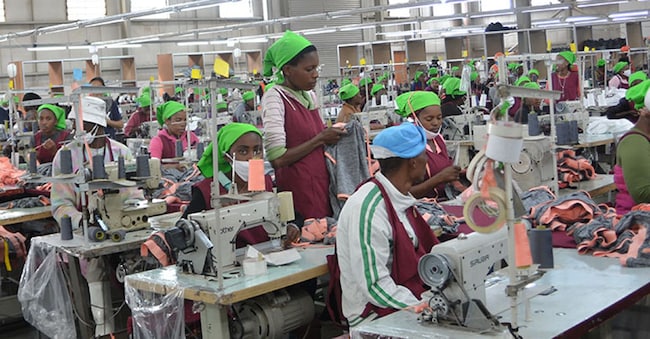
The garment factories are the country's largest private employer, employing some 40,000 people, subtracted from the huge number of those living below the poverty line. For the past 25 years, 40% of the products they manufacture have gone to the United States, thanks to the African Growth and Opportunity Act, which has favoured trade relations between the United States and Sub-Saharan African countries since 2000, with reduced or zero tariffs. The sectors that were granted the greatest benefits were textiles and clothing. But the new tariffs imposed by the Trump administration are jeopardising the social stability of the country, which last July declared two years of national emergency.
In March, at his address to Congress, Trump had justified his funding cuts for humanitarian projects in Africa by also allocating them to 'a nation that nobody has ever heard of', namely Lesotho itself. Then, in his statement-show at the White House on April's "Liberation Day", again Trump had associated the figure "50" with the new tariffs imposed on imports from Lesotho, the highest of all countries in trade relations with the US (reaction to a reported 99% tariffs imposed on the US). That announcement was enough to cause orders from US brands (including Walmart, Levi's and JC Penney) to Lesotho's factories to collapse, which thus faced a production freeze as in the Covid days. And despite the fact that the tariff charged by Washington is now at 15%, the natural and tragic consequence of this new arrangement has been the cutting of the workforce, which has thus led to a further increase in the unemployment rate, now close to 30% and affecting above all the youngest population, the largest in the kingdom. The first domestic industry in the sector, Afri-Expo Textiles, founded in 2016, had, before the announcement of the tariffs, planned an expansion plan that would have involved more than 10,000 people, but this was soon replaced by a programme of job cuts for at least 500 workers.
The African Growth and Opportunity Act, signed under the Clinton administration, has been renewed six times since 2000 and its most recent extension, signed in July 2015, has been the longest running. It has been a crucial tool for fostering economic growth in the countries involved, and according to one estimate generated 350,000 jobs between 2001 and 2011, mainly for women and especially in the textile sector. It was also seen as a channel of US soft power on the continent, to counter Chinese expansion in Africa. However, it is set to expire next 30 September and if it is not renewed, Lesotho will have to find solutions and alternatives soon in order not to end up in chaos.
Meanwhile, as Kate Bartlett writes on the independent platform Npr, crowds of women wait every morning at the gates of factories in the Maseru industrial district hoping to be called to work. Among the few factories still producing at full capacity is Precious Garments, from which Trump-branded golf shirts come out. But even there, everyone has been warned: in September, operations may cease.


