Trento Festival of Economics

US and Europe increasingly distant: this is how the world is experiencing a real revolution

Analyses by Adriana Castagnoli and Sergio Fabbrini

by Jean Marie Del Bo

3' min read

3' min read

The period we are living through is revolutionary. The US is undergoing a metamorphosis that could profoundly change its characteristics and that distances it from Europe. Increasingly ambitious powers and medium-sized powers with autocratic governments are emerging. This makes Europe the 'island continent' where liberal-democratic principles are not called into question, despite the returning wave of nationalism. And this makes it imperative not to abandon Ukraine: the future of our continent is at stake on this front.

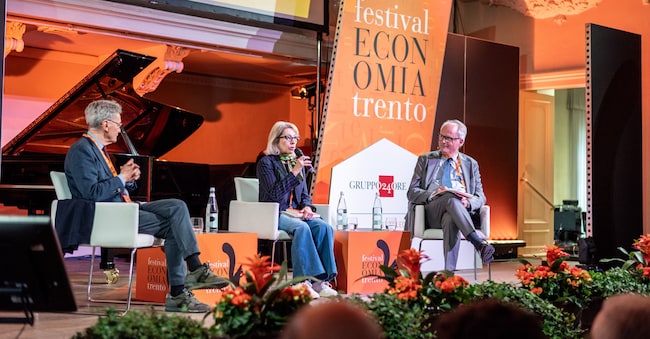
These reflections emerged during the debate on 'Europe between threats and opportunities', which took place during the Trento Festival of Economics and featured Adriana Castagnoli, lecturer at the University of Turin and member of the Festival's Scientific Committee, and Sergio Fabbrini, lecturer at the Luiss Guido Carli University.

Loading...

The news in recent weeks is overwhelming. Donald Trump's presidency has, in fact, acted as an accelerator of processes that had been underway for some time, confronting Europe with choices that had been shelved for decades and making the creation of new world balances concrete and visible to all.

'The Trump presidency,' Fabbrini explained, 'marks a structural change in the US that is moving further and further away from Europe, even in the composition of the ruling classes. With a government that has an increasingly marked techno-religious component'.

'After all,' Castagnoli emphasised, 'already in the 1990s there was a perception in American circles of Europe as a potential enemy/adversary. A perception that was reinforced by 9/11 and the advent of the euro. In this climate, the idea was reinforced that we had to make a turnaround that saw security as the focus, even at the cost of the possible sacrifice of rights'.

A climate, this, in which Vice-President JD Vance is the leading political figure. And in Peter Thiel, founder of PayPal, the grey eminence.

Europe itself, in any case, is shot through with nationalist impulses that produce political effects in every country. 'All this,' Fabbrini explained, 'with a basic contradiction. No European country can compete alone with the US or China. Those who want to defend individual national interests should, therefore, look to the European dimension as a natural instrument to achieve their own results. It is precisely the European Union, after all, that was born as an antidote to tragic and sterile nationalism and has saved us from wars and conflicts'.

"This at a time when the US," remarked Castagnoli, "sees Europeans as the ones who robbed the Americans, forgetting the US's overwhelming power in the interchange of digital services and that the EU is the main funder of the considerable US public debt. It is clear, therefore, that we are moving through a phase of transformation in which new powers, such as Turkey, are emerging and relationships that appeared to be consolidated over time are changing. Europe has, for example, the need to redefine relations with China, which is increasingly presenting itself as a reliable and respectful subject for other countries. And to position itself, precisely as Europe, as a point of reference for the global South in the construction of equal relations that, for example, we have been able to create between our countries'.

In the background is the war in Ukraine that is staining the European continent with blood and seems to have reached a crossroads between possible American disengagement and the need to avoid a Russian political-military triumph with a new European role.

'In Ukraine,' Fabbrini said, 'the future of Europe is at stake. But here the issue of European defence returns. With the need for better rules for decision-making and a decisive role for the leadership'.

'It is a matter of defending from threats,' Castagnoli explained, 'those countries that are closest to Russia and have memories of past Soviet rule. Certainly the Russian invasion of Ukraine has strengthened NATO with new entrants, but the future, given the American political evolution, really lies in a European defence'.

Copyright reserved ©
Loading...

Brand connect

Loading...

Newsletter

Notizie e approfondimenti sugli avvenimenti politici, economici e finanziari.

Iscriviti