After 6 January 2021

US, Democrats against Trump's fund to compensate those who stormed Capitol Hill

The US administration announced $1.8 billion for those who consider themselves 'victims of the government', but it is feared it will end up in the pockets of people prosecuted for attempting to overturn the 2020 election result
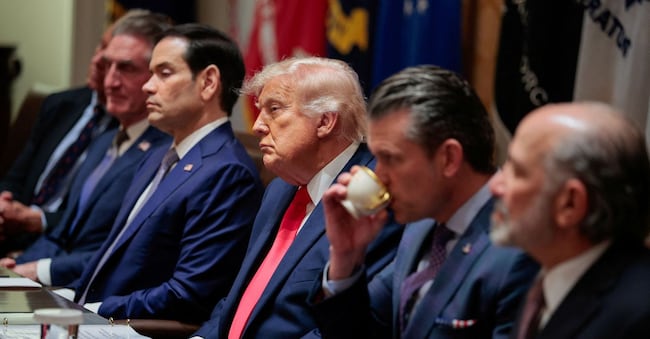
Il segretario degli Interni degli Stati Uniti Doug Burgum, il segretario di Stato Marco Rubio, il presidente degli Stati Uniti Donald Trump, il segretario alla Difesa Pete Hegseth e il segretario al Commercio Howard Lutnick partecipano a una riunione di gabinetto nella Sala del Gabinetto alla Casa Bianca, a Washington, D.C., Stati Uniti, il 27 maggio 2026. REUTERS/Evan Vucci REUTERS

3' min read

Translated by AI
Versione italiana

3' min read

Translated by AI
Versione italiana

There is a nearly two-billion-dollar fund wanted by Donald Trump in the States -$1.8 billion, to be exact - that winks at those who, on 6 January 2021, stormed Capitol Hill: it is designed to compensate those who feel they have been unfairly investigated or prosecuted by the government.

Democratic governors and legislators in several US states are now considering a strategy to block it: tax the payments 100 per cent. The Washington Post explains this today.

Loading...

The idea has already received the support of California Governor Gavin Newsom, while bills are being prepared in New York and Wisconsin. "The slush fund is a blatantly corrupt theft of taxpayer dollars, and we must do everything we can to stop it," Colorado Democratic Senator Michael Bennet, a candidate for governor, told the Washington Post.

A fund for 'government victims'

The Trump administration announced the fund in May 2026, provoking criticism among Democrats and also - to some extent - among Republicans. The fund is supposed to pay people who claim to have been victims of unfair investigations or prosecutions, in line with the US president's accusations against a judicial system 'used as a weapon'. In return for creating the fund, Trump agreed to drop a $10 billion lawsuit against the Irs - the Internal Revenue Service, the US equivalent of the Internal Revenue Service - for leaking data about his tax returns.

Usa, dentro Capitol Hill: immagini dall'assedio

On Friday 29 May, a federal judge temporarily blocked the implementation of the plan: however, several questions remain as to how the money will be distributed and the risk that it will end up mainly to Trump allies.

In California, the Democratic chairman of the state Assembly Budget Committee, Jesse Gabriel, said that the Democrats want to put a tax on payments in the state budget. "That money belongs to the taxpayers, and we will make sure it stays with the taxpayers," he assured.

New York Governor Kathy Hochul said she was interested in a similar plan. "I have no problem with there being consequences for people who accept that money," she said, calling it"obscene" to reward people who have committed crimes or injustice.

In New York, the proposal is supported by state Congressman Alex Bores, a candidate for Congress. "It's simple: if you're a New Yorker and you take money from this illegal fund, New York State will tax you 100 per cent," he said in a video posted on X.

Loading...

The risk of funding the rebels on Capitol Hill

In Wisconsin, the Democrats introduced the No Taxpayer Dollars for Insurrectionists Act, a text that addresses concerns that payments could go to people prosecuted for attempting to overturn the outcome of the 2020 elections or for storming the Capitol on 6 January 2021.

The Justice Department dismissed the criticism. Spokeswoman Natalie Baldassarre accused the Democratic governors of "loving lawfare" - that is, the stultifying use of laws to wage war on something - and of overtaxing citizens, urging them to address the fact that many residents leave Democratic states for states with lower taxes and less crime.

Doubts of legitimacy on both sides

The states' strategy could also end up before the courts. The power to tax meets constitutional limits when it is used to effectively destroy a federal benefit, several overseas tax experts point out. Trump's fund, in turn, remains at the centre of legal doubts: Federal Judge Leonie Brinkema in Virginia has scheduled a hearing on the case for 12 June.

Copyright reserved ©
Loading...

Brand connect

Loading...

Newsletter

Notizie e approfondimenti sugli avvenimenti politici, economici e finanziari.

Iscriviti