Reactions

US duties, fashion at risk relies on negotiations

by Marta Casadei

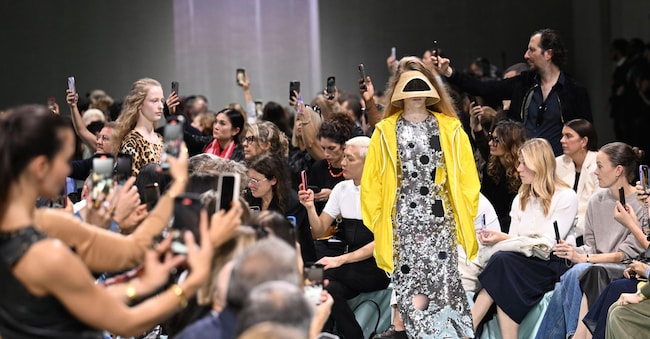
A model presents a creation by Prada during the Milan Fashion Week Spring/Summer 2025, in Milan, Italy, 19 September 2024. The Milano Moda Donna SS 2025 runs from 17 to 23 September.. ANSA/DANIEL DAL ZENNARO

4' min read

4' min read

The 20% duties on European products announced by Donald Trump on "Liberation Day" on 2 April are frightening Italian fashion. Which in the USA has an important outlet market and which already in 2024 experienced a drop in exports to this strategic country: textile-clothing interchange from Italy to the United States from January to December 2024 amounted to 2.8 billion euros, down 0.7% compared to 2023.

The day after the US president's announcement - which not even his friendship with Bernard Arnault could not dissuade from including fashion and luxury goods in the list of taxed products, at the moment all of them indiscriminately - the attitude of companies is almost a 'wait and see', to put it in the American way: wait and see what can change in negotiations.

Loading...

According to a study by Prometeia dating back to November 2024, fashion would be one of the sectors most affected by the increase in charges: at the time, the hypothesis was a 'generalised' duty of 10% and the fashion sector, in this hypothesis, would be the most impacted after mechanics with losses of up to EUR 1.5 billion.

Tamborini (Confindustria Moda): 'Tariffs will reshape the supply chain'

Now that duties towards the European Union, Trump has announced, will be 20%, the risks go beyond the effect on the value of exports to the US. Especially at a time when the sector is already suffering. Fashion in its global dimension is being called upon to redesign routes and supplies," said Sergio Tamborini, president of Confindustria Moda Federazione Tessile Abbigliamento. "For the way the supply chain is structured, what worries us is not only the American duties on European products and the direct consequences in terms of lost revenue, but also the impact of the measures on the production and distribution stages, starting with the supply of raw materials and garment manufacturing. According to Tamborini, 'Companies and brands are faced with yet another challenge: to further adjust price lists or to choose new destinations for production and trade'.

Returning to textile-clothing exports to the USA in the top-destination ranking of exports, America was the third largest market with a 7.4% share of total Textile-Clothing exports with a predominance of the Apparel sector with 2.3 billion Euro. The best performing sectors were silk spinning, home textiles and hosiery. It is inevitable that these areas will see their growth boundaries in the US shrink.

Leather and accessories, Ceolini: 'We hope in negotiations'

The other soul of Confindustria Moda, the one that brings together the leather-accessories industry, has also repeatedly sounded the alarm about duties: towards the USA in 2024, footwear for 1 billion 388 million euros (-4.9% compared to 2023); bags and small leather goods for 1 billion 216 million euros (-1.6%); leather for 162 million euros (-4.1%) and furs for 21 million euros (-11.9%). In total, therefore, approximately 2.8 billion.

"Following the Trump administration's announcement on the imposition of new 20% duties on all European exports, I express great concern for the repercussions that this decision will have on our companies and on the fashion accessories sector," said Giovanna Ceolini, president of Confindustria Moda Accessori. "The increase in costs for American consumers could, in fact, drastically reduce demand for our products, with negative consequences for our companies and for jobs, which are a fundamental resource for our sector. Ceolini appeals to the European institutions: 'Our sector, which has been severely tested by economic difficulties and geopolitical uncertainties, cannot afford a further setback: this is why we trust in the timely and effective intervention of the European institutions to protect the future of our companies and workers. We hope that, through the negotiations that Trump himself has mentioned, the situation can be resolved'.

On the other hand, the National Chamber of Italian Fashion, which brings together the main brands in the sector, has not spoken out, but President Carlo Capasa had repeatedly expressed concern about the introduction of these protectionist measures.

Premium and affordable production at risk

.

The duties might not have an excessive impact on luxury purchases, since consumers at the top of the pyramid are generally 'inelastic' to price changes - nor would they have a leverage effect on production: some workmanship is not exportable - while they might have an effect on medium and low-priced products. Moreover, on high-end products, as Luca Solca of Bernstein pointed out, import duties are already applied in the US, so if the 20 per cent incorporated the tariffs already applied, the effect would be mitigated. According to some analysts surveyed back in February, then, the increase in charges will lead to a butterfly effect in important markets such as China - whose recovery is slowing down and could slow down again - and in markets such as Germany, on which the duties on the automotive, steel and mechanical components sectors will weigh heavily.

The opposite effect on tax free: it will double

.

Among the (few) positive effects reported so far could be an increase in tax-free spending: Americans now contribute about a quarter of the total value and according to Mathieu Grac, VP Intelligence Strategy at Global Blue, Europe's leading tax-free operator, 'The price increase that could result from the tightening of tariffs would lead to a proportional increase twice as high. It remains to be seen whether Europe would be considered the closest shopping destination, or whether Americans would go to Canada'.

Copyright reserved ©
Loading...

Brand connect

Loading...

Newsletter

Notizie e approfondimenti sugli avvenimenti politici, economici e finanziari.

Iscriviti