
US, Fed lowers interest rates by 25 basis points
Rates drop from 4.25 to 4 per cent. Two more cuts planned by 2027

6' min read
6' min read
First cut in 2025. The Fed lowers interest rates by 25 basis points: the official cost of very short-term credit falls by a quarter of a point in a corridor between 4.0% and 4.25%. The decision was taken with only the dissenting vote of new advisor Stephen J. Miran, a Donald Trump loyalist, who would have preferred a more aggressive cut of 50 basis points. The two governors chosen by the US President to carry out his policies, Michelle W. Bowman and Christopher J. Waller, who had expressed their disagreement with the decision to hold rates steady in July, also voted in favour of only a gradual cut.
More risks on employment
The decision was taken, the official statement explains, because of the changed balance of risks on growth and inflation: the Fed took note of the rise in the unemployment rate (which is still judged low) and at the same time of the rise in inflation, which remains high, even though the probability that the tariffs-related price rise is a one-off and will not turn into a persistent overheating has increased. It is therefore the risks to employment that 'have increased' and this has prompted the Fed Funds rate cut. For 'additional adjustments' in the cost of credit, which are thus not ruled out, the balance of risks and incoming data will be taken into account, the statement continues.
Two more cuts planned by 2027
The 'dots', the quarterly dot plot indicating the individual governors' forecasts for future rates, not surprisingly indicates, compared to June, and on the median, an extra 25 basis points cut by year-end, when Fed funds may fall to 3.50-3.75%. One of the governors - and it is possible to assume that it is Miran - has indicated rates at 2.75-3% for the end of the year, a very aggressive manoeuvre, but the median is not weighed heavily by the extreme data: it has fallen because almost all the governors have revised their forecasts: only one, instead of the seven of June, saw rates at 4.25%-4.50% for the end of the year - before the September council, evidently -; only two, from the eight of three months ago, indicate them at 3.75%-4%.
For next year, the governors "imagine" median rates at 3.25-3.50%, confirming the cut already envisaged in June, and for 2027 Fed Funds rates at 3-3.25%, a reduction that did not appear from the data three months ago. The very first estimates for 2028 show rates at the previous year's level. The long-term rate, which can be regarded as an implicit target, remained stable at three per cent.
Growth higher, unemployment slightly down
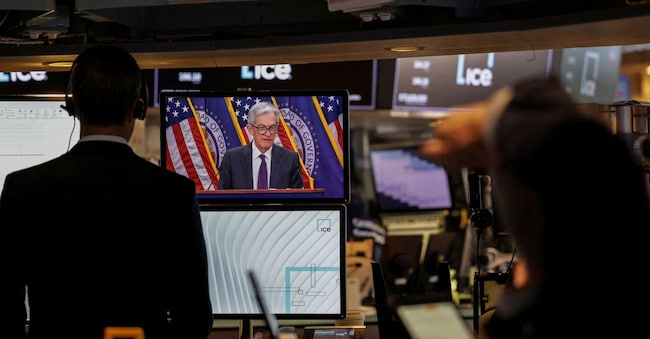
Macroeconomic projections indicate higher growth than in June: 1.6% this year (from 1.4%), 1.8% next year (1.6%), 1.9% in 2027 (1.8%) and 1.8% - which is also the long-term level - in 2028. Almost unchanged, or rather in very slight decline, despite the signs of the last few weeks, the unemployment estimates: 4.5% this year, 4.4% next year (it was 4.5% in June), 4.3% in 2027 (it was 4.4%) and 4.2% in 2028: in a press conference, President Jerome Powell pointed out that "the market slowdown in both the supply and demand for workers is unusual".
Inflation only rising in 2026
Inflation is only expected to rise in 2026: 3% this year, 2.6% next year (up from 2.4%), 2.1% in 2027 and 2% in 2028. Not much different are the projections for core inflation: 3.1% this year, 2.6% (up from 2.4%) next year, 2.1% in 2027 and 2% in 2028. These are indications that the imagined path of monetary policy is sufficient to bring prices back to the 2% target. Only at the end of the monetary policy horizon, however, in 2028: a long time suggesting caution. From a certain point of view, Powell added not surprisingly, the September cut was only decided in a 'risk management' perspective and the next decisions will continue to be made 'meeting after meeting'.


