
US, government re-launches shareholder state. Hypothesis entries into defence
The US Secretary of Commerce confirmed that the Executive is considering acquiring shares in giants such as Lockheed Martin, Boeing and Palantir,
3' min read
Key points
3' min read
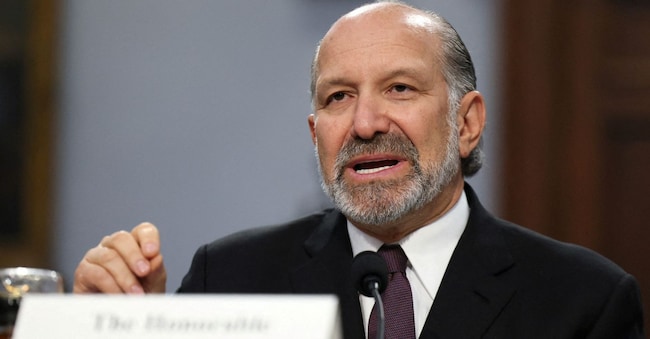
Declarations galore. Not a day goes by now that someone in the US government does not 'practice' economic policy statements. In particular, on the front of state intervention in private companies. So yesterday - after two days ago White House advisor Kevin Hasset had spoken of the hypothesis of 'a US sovereign wealth fund' - it was the turn of Howard Lutnick. The commerce secretary confirmed that the executive branch is considering acquiring shares in giants such as Lockheed Martin, Boeing and Palantir, companies that are already heavily dependent on government procurement. "There's a big debate about how to finance military procurement," Lutnick explained, recalling that Lockheed itself derives "97 per cent of its revenue" from the US government and is therefore "basically an arm of the state".
The programme
.The announcement - it should be remembered - is part of an unprecedented series of moves by which Donald Trump is expanding the US government's direct presence in the economy. Last week, the purchase of almost 10% of Intel was announced, while in June, Washington had played a decisive role in the sale of U.S. Steel to the Japanese company Nippon Steel. A transaction in which a 'golden share' was defined with strong veto powers regarding company management. Not only that. The State entered the capital of the rare earths company MP Materials and forced Nvidia and AMD to recognise to the United States 15% of the revenues on sales to China of chips that until recently were banned for export.
The Paradox
.Clearly, such moves raise questions with respect to Trump's strategy and its effects on capitalism in the stars and stripes. The occupant of the White House, on the one hand, pushes for ever greater government intervention in the economy. On the other, however, he embraces, for example, the world of cryptocurrencies, which by its very nature is anarcho-capitalist. True, there has been - and is - a good deal of cynicism and political cunning in winking at a part of America (crypto-tech) that has been - and is - an important constituency. However, they have gone a long way in Washington (the Genius Act is proof of this) in supporting the digital token industry. A project that - from an ideological point of view - is in clear contradiction with state interventionism.
The Power Takeover
.All this is topped off by the progressive and decisive 'takeover' of so many hitherto 'independent' agencies and institutions. The Sec, with the exit of Gary Gensler and the appointment of Paul Atkins, and the 'guerrilla warfare' at the Fed itself are two of the most glaring examples. However - even if one disagrees with the Trumpian approach - the contradiction dissolves, at least according to the supporters of 'TheDonald', in the idea that the means must bend to the end. Thus: at a time when a scenario in which the large global chip foundries end up in enemy territory (read Taiwan island) cannot be ruled out, it becomes - in Trump's logic - essential that the company's factories be built in America. And, consequently, the White House's support for the company is justified.
Faced with such a scenario - rather than tearing one's hair out or hypothesising cataclysms that may not happen - it is fair to ask whether these strategies will have the strength to become structural or not. Trumponomics must not be reduced, by its critics, to mere 'madness' that will self-inflate. It must be studied and, if necessary, countered with knowledge. Otherwise, it will stay with us for a long time.


