
USA, the new trouble for Trump is called Tulsi Gabbard
At the hearing before the Senate Select Committee on Intelligence, the Dni leadership read out written testimony filed for the occasion, avoiding a passage in which it emphasised that Iranian nuclear material poses no threat to the United States

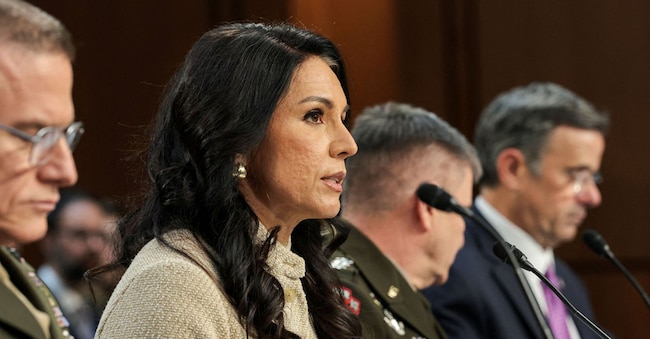
On paper, the woman in charge of US intelligence contradicts her president, Donald Trump: Iran posed no imminent nuclear threat to the US before the launch of the attacks, together with Israel, against Tehran on 28 February. However, in words, he does not admit this, referring the case back to the US president. During a parliamentary hearing, Tulsi Gabbard, the Director of National Intelligence, first avoided reading a passage from her written testimony with the excuse that time was short. Then she stated that "the only person who can determine what is or is not a threat is the president."
His tergiversation in Congress took place while on Pennsylvania Avenue, White House spokeswoman Karoline Leavitt was asked whether Gabbard's tenure was at risk. Leavitt had replied: 'Not that I know of. We haven't heard the president say that. ... So obviously this is a question for him'.
Delicate hearing in committee
Gabbard's day at the Senate Select Committee on Intelligence began by reading the written testimony filed for the occasion. She explained that "the regime in Iran appears to be intact but largely degraded" after Operation Epic Fury reached its 19th day in which the US struck over 7,700 targets and destroyed or damaged over 120 Iranian ships, Centcom recently reported. She also explained that Iran and its proxies 'remain capable of continuing to attack US and allied interests in the Middle East'.
But then he skipped a crucial passage, which did not go unnoticed by the vice-chairman of the committee, Democratic Senator Mark Warner. The offending paragraph quoted: "As a result of Operation Midnight Hammer (launched last June), Iran's nuclear enrichment programme has been annihilated. There has been no effort to try to rebuild their enrichment capacity". Pointing out the omission Warner asked her: 'You skipped that paragraph from your opening oral statement. Was it because the president had said there was an imminent threat?" Gabbard replied, "No, sir. I recognise that time was running out and I skipped some parts." At which point Warner replied: 'So, you chose to omit the parts that might contradict the president.
U.S. intelligence under pressure
Democratic Senator Jon Ossoff also returned to the subject, reading that paragraph aloud. In a series of questions Ossoff pressed her and then pointed out a White House statement dated 1 March about the 'imminent nuclear threat' posed by Tehran to the US. She initially replied that 'the US intelligence community has determined that Iran has maintained its intention to rebuild and continue to increase its nuclear enrichment capabilities'. After being pressed again on the contradiction between what the intelligence community has claimed and what the Trump administration has said, Gabbard replied: 'The only person who can determine what is or is not an imminent threat is the president'. Ossoff countered with a 'disingenuousness' and pointed out that 'it is really his responsibility to determine what constitutes a threat to the US'

