Mid-term elections

US: the split in Michigan comes as a shock – Democrat Stevens backs the Republican and drops El Sayed

The decision by the Liberal Haley Stevens has provoked strong reactions within the party and led to the resignation of her chief of staff, Justin German, along with other aides. Michigan is one of the key states in the race for control of the Senate

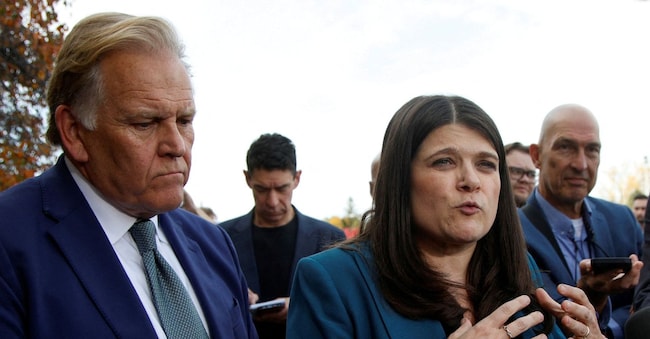
La democratica Usa Haley Stevens spiega ai giornalisti perché ha appoggiato il repubblicano Rogers  REUTERS

5' min read

Translated by AI
Versione italiana

5' min read

Translated by AI
Versione italiana

In the United States, the latest polls all showed a more or less substantial lead for the Democratic candidate Abdul El Sayed, who is standing for a Senate seat in Michigan (+11 per cent New York Times/Siena University, +7 per cent CNN, +4 per cent Data for Progress). In tomorrow’s mid-term elections on 3 November, Michigan is one of the states being most closely watched in the run-up to the final result, which could see the Senate, as well as the House of Representatives, fall to the Democratic opposition. A victory for candidate El Sayed would be particularly significant because this doctor, in his early forties, is pursuing a radical agenda by the party’s moderate standards and, above all, would be the first Muslim senator in the United States. A detail that stands out even more in Trump’s America.

It is for these reasons that the decision by the Democratic MP, Haley Stevens, is causing even more of a stir: just a few hours ago, she announced her support for the Republican candidate Mike Rogers – El-Sayed’s opponent – following a bitter internal row. According to NBC News, the rift came after Stevens had asked El-Sayed to condemn a campaign advert by a group she deemed to be anti-Semitic. In response, El-Sayed’s campaign asked her not to attend any more of his events. “Our Democratic Senate candidate, Abdul, said I was no longer welcome in his campaign. And he’s right, which is why I’m supporting Mike Rogers today,” Stevens said in a video, whilst reiterating that she remains “still a very proud Democrat”.

Loading...

Stevens’ decision has sparked strong reactions within the Democratic Party and led to the resignation of his chief of staff, Justin German, along with other aides. The Democratic leader in the Senate, Chuck Schumer, reiterated the party’s full support for El-Sayed, who just a few days ago also received a public endorsement from former President Barack Obama.

Meanwhile, Donald Trump is celebrating, having described Stevens’s endorsement of the Republican candidate Rogers as ‘huge news’ on Truth Social. “Congresswoman Haley Stevens, a highly respected Democrat who narrowly lost the primary to Abdul Mohamed El-Sayed, has just thrown her support behind Mike Rogers for the Senate!” wrote the tycoon, emphasising that Stevens enjoys ‘a huge following’ and great respect amongst Michigan voters, ‘especially in the African-American and Jewish communities’. “Haley has said what few are willing to say. She has shown extraordinary, almost unprecedented, loyalty to the great people of Michigan. That’s what you call courage, and few have as much as Congresswoman Haley Stevens has just demonstrated,” added Trump.

I Republicans have, of course, sought to capitalise on Stevens’ move. “When you see a party, or at least a section of it, sliding towards the virulent hatred it is directing at a particular group of people, the situation becomes dangerous,” said Rogers, who thus highlighted the reasons for the split, linked to the Democratic candidate’s alleged anti-Semitic views.

El-Sayed, a Muslim of Egyptian origin born in Michigan, has been targeted by Trump and other Republican figures who have repeatedly questioned his loyalty to the United States, going so far as to label him – without any evidence – a terrorist sympathiser and claiming that his election would provoke attacks against Americans. El-Sayed has described the doubts raised about his loyalty to his country as ‘shameful’.

Now Trump has even gone so far as to say that he would like Stevens to ‘join’ the Republican Party. But the point is not so much that the Republicans are trying to drive a wedge between them, but rather the resilience of the Democratic Party itself, which for years now has had to reconcile many different factions within its ranks.

Admittedly, the New York Times points out that the rift between El Sayed and Stevens is, first and foremost, a personal one; the two politicians, both millennials, are polar opposites. But this showdown, just hours before Tuesday’s election, also reveals a deep rift within the Democratic Party over what its relationship with Israel and Jewish donors should be. Should he win on Tuesday and take his seat in the Senate in January, Dr El-Sayed would become the US senator most hostile to Israel since the founding of the Jewish state 78 years ago. This is no minor detail at a time when the United States, alongside Israel, is engaged in an uncertain war against Iran, and the country is torn between pro-Palestinian demonstrations and ‘Make America Great Again’ protests calling for a withdrawal from the region.

Just a few hours after the split with his rival, El-Sayed does not, however, appear to have been affected by it; on the contrary: since Stevens’s shock announcement, he has in fact raised $1.2 million, according to Politico (a figure that has since doubled to $2.4 million, according to an update from Bloomberg). However, the end of the Stevens-El-Sayed alliance has also given rise to an embarrassing and potentially costly situation for the Democrats, as well as handing the Republicans an unexpected advantage in their bid to secure a crucial seat. The Senate race in Michigan is, in fact, regarded by analysts as one of the most hotly contested in Tuesday’s mid-term elections. It is one of the few decisive contests that will ultimately determine who gains control of the Senate. The seat is currently held by a Democrat who has decided not to stand for re-election; the last time a Republican was elected to this seat was in 1994. However, in the last presidential election, Michigan was one of the key swing states: in 2020 it voted for Joe Biden, whilst in 2024 it chose Donald Trump. The party is aiming to regain control of the Senate in Tuesday’s election, but to do so it needs a net gain of four seats. A defeat in Michigan – a state currently under Democratic control – would be a major blow and would force the party to win five more seats to achieve its goal.

The Democratic Party primaries in Michigan in August, which saw El Sayed and Stevens go head-to-head, highlighted divisions over the party’s direction ahead of the 2028 presidential election. El-Sayed, a former public health official and the son of Egyptian immigrants, gave voice to the grassroots frustration with Washington’s policies and the ties between the United States and Israel. Stevens, a Democrat with more centrist leanings, enjoyed the support of prominent party figures during the primaries, such as the Governor of Michigan, Gretchen Whitmer (who has often been touted as a possible candidate for the White House in 2028).

Copyright reserved ©

Brand connect

Loading...

Newsletter

Notizie e approfondimenti sugli avvenimenti politici, economici e finanziari.

Iscriviti