Careers

Vademecum for meeting the new leadership challenges in the digital society

Zsolt Feher, Vice President of Business Development at Hogan Assessments, one of the world's leading companies in the field of occupational personality assessments, speaks

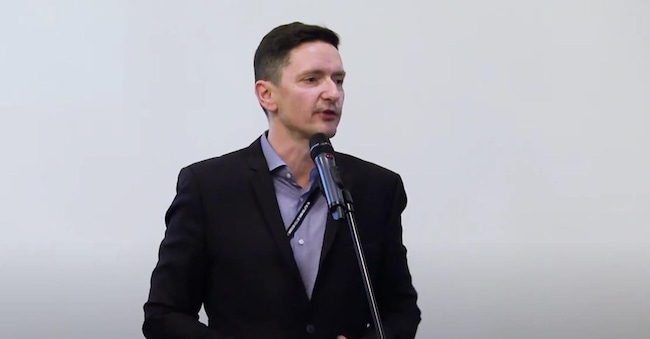
Zsolt Feher, Vicepresidente dello Sviluppo Business di Hogan Assessments

4' min read

4' min read

The development of corporate leadership and its "dark sides", the connection between personality and professional success, the impact of artificial intelligence on people and organisations. And again the still little-explored topic of Data Driven HR and the increasingly decisive role of information management in selection and talent management processes. These are the items that fill the agendas of all management and HR managers in particular and that a great expert on the subject such as Zsolt Feher, Vice-President of Business Development at Hogan Assessments, one of the world's leading companies in the field of personality assessments in the workplace, addressed during his recent visit to Italy to take part in the Digit'Ed Fast Forward 2024 event. We caught up with him to ask him to shed light on current trends in the world of work and how the scenario is (fast) changing.

Is being a manager in today's digital society more difficult than being a manager in an analogue society? And why?

Loading...

It should not be, because the fundamental principles of leadership remain unchanged. However, it is becoming increasingly important to be able to manage versatility, and versatile leaders are always more effective than less flexible ones. Today we see that few companies really operate as digital realities and, indeed, the current trend is a widespread return to the office. The real challenge for leaders is therefore to understand that they do not have to impose their own policies, but rather to respect the individual preferences of employees, whether they work remotely or in person.

You talk about 'data driven HR': but if the data that the company collects and processes are not of quality what happens?

Poor quality data leads to decisions based on 'unreal' facts. The key is always to identify good and reliable data. In HR, in particular, we believe that the best indicator regarding individuals is personality. It will never be definitive data, but it is an element that helps to make more informed decisions.

Can a young talent with no management experience in the company be a good leader?

It will probably be a smaller group of people, but technically it is possible. If a talented young person has the right skills, the right values and the necessary motivation, he or she has all the makings of a good leader. And it is likely that these qualities have already emerged in contexts other than the classic work environment, such as student organisations or similar.

What personality trait cannot be missing in a manager who wants to make a career?

It depends on the position one wishes to hold. The best answer, as is often the case, is 'it depends'. However, if I had to point out a fundamental quality for a leader, it would probably be ambition, a characteristic that includes how competitive and self-confident this figure is, how willing he or she is to express his or her successes, how much he or she identifies with the leadership role and how prone he or she is to social anxiety.

Is an empathetic leader who draws maximum commitment from his or her team more successful or a competent leader who prioritises the achievement of personal goals?

I see these two characteristics as complementary. An empathetic leader will probably also be able to prioritise the personal goals of his or her team. And it is certainly an advantage if those personal goals align with the intention to stay and excel in the same company.

Of the 'dark sides' of leadership, which one is likely to have the greatest impact on the organisation?

All the risk factors we focus on are potentially harmful. We may notice typical tendencies depending on the sector: leaders of financial institutions, for example, may be excessively risk-taking and are described as 'Mischievous'; a leader of a creative sector may be too imaginative, while a chief accountant may be more scrupulous than necessary. All these tendencies, however, are not always obvious and these unfiltered behaviours may emerge when we abuse our qualities. Let me take another example: taking risks in an investment context is crucial, but exceeding a certain limit can be detrimental. Similarly, being punctual and diligent as a CFO is important, but when we overdo it and do not delegate to team members, the task becomes so burdensome that it becomes a leadership problem.

Let's end on a high note: is there a risk that we will become 'slaves', in the workplace, to artificial intelligence?

I do not think this is possible. Artificial intelligence is still far from being able to take on a leadership role, because it can only perform tasks and is not able to make all the decisions and considerations that a leader has to face. AI represents an opportunity to increase our efficiency and problem-solving ability, and its use in employee selection, both from a legislative and a legal point of view, is currently banned or is at least in a grey area in some regions. Rather, we are trying to improve efficiency by helping our client companies interpret results or by supporting coaches in integrating artificial intelligence into their processes. We are not trying to replace in-house HR staff or a coach, but to help them grow and improve.

Copyright reserved ©
Loading...

Brand connect

Loading...

Newsletter

Notizie e approfondimenti sugli avvenimenti politici, economici e finanziari.

Iscriviti