
VAIMOO’s high-tech bikes are gaining ground abroad and have arrived in Lisbon
The company, based in Mola di Bari and led by CEO Matteo Pertosa, designs and operates advanced bike-sharing and micro-mobility systems

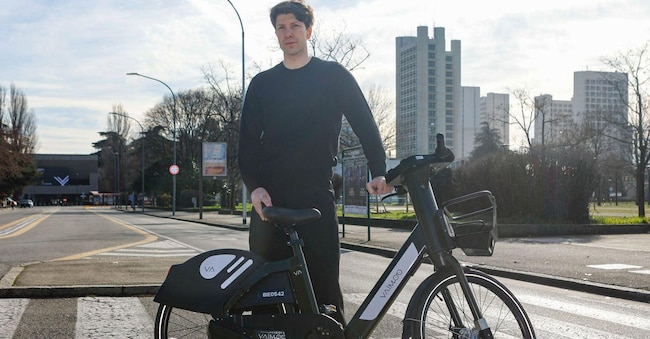
VAIMOO is launching in Lisbon, keeping a close eye on the Italian market and developing new bike-sharing schemes. Led by CEO Matteo Pertosa, the company, based in Mola di Bari, designs and manages advanced bike-sharing and micromobility systems. It also supplies fleets of smart electric bikes, virtual or physical docking stations, and an integrated digital platform for managing the service in cities.
To date, it has recorded 1.6 million journeys, 5.8 million kilometres cycled and one million hours spent cycling. The company has 120 employees, including contractors. “We’ve already invested around ten million,” explains Pertosa. “Looking ahead to the whole plan, including engineering, vehicle construction and other activities, we’ll be looking at around 30–50 million.”
“We are working very hard,” says Pertosa, “to try and create an alternative to private transport services. In Italia, according to ACI 2025 data, around 160 billion is spent each year on private cars – something like 11 euros a day per car. Furthermore, these vehicles are stationary 95 per cent of the time. This represents untapped resources. And if we compare this with what is spent by public bodies and the system as a whole on public transport, we see that the figure is only 8 billion. The disparity is therefore clear. Hence, then, our determination to seek an alternative, because the real problem is that Italians rely on private transport because they have no other options that provide an immediate solution to their travel needs. The authorities should create the conditions for the market to offer alternative services, but this is difficult. In Puglia, for example, the tender for local public road transport – worth 250 million a year – has not been held since 2004, and the system continues to operate under extensions.’
According to VAIMOO’s CEO, “what we are doing is building a part of this mobility chain – the first and last mile.” Light electric mobility sharing services – such as e-bikes, cargo bikes and minicars, a segment that is currently developing – serve to make a very low-cost mobility offering widespread and pervasive, available 24 hours a day and within a maximum of 100 metres from home. We are therefore developing a range of vehicles designed to meet a variety of mobility needs. Let me give an example: I arrive at the station and need to carry my suitcase, or I need to go and do the shopping. In production and in the field, we have electric bikes and shared electric bikes. They are very specialised and you need to know them inside out. We have an advantage because not only do we know them well, but we also design, manufacture and monitor them at every stage. We know exactly what maintenance is required.”
Figures and markets. “As for electric bikes,” explains Pertosa, “we’ve produced around 15,000 of them, and almost all have been sold in Europe. The region that has performed best has been Northern Europe, particularly Copenhagen, Stockholm and Rotterdam. We have just won a tender in Lisbon, where, for 2.5 million, we will be supplying VAIMOO technology – in other words, everything needed to run a bike-sharing scheme. But we also operate in Italia. There are cities where we are bidding to establish a presence. In Bologna, we are waiting to hear what the local council will do; we are also looking at major cities such as Milan, but we have to wait for the tenders to be announced.”

