Agribusiness

Aosta Valley launches biodiversity certification to enhance products and the environment

The project involves numerous regional stakeholders and aims at environmental sustainability as an added value and at enhancing local agricultural products through a recognised quality label
by Carlo Andrea Finotto

4' min read

4' min read

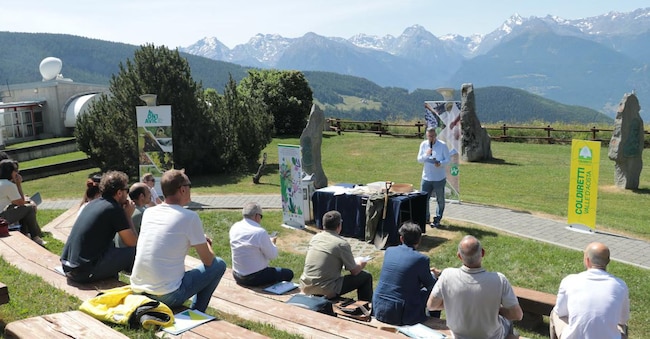
Entitled 'Certification of the biodiversity of ecosystems in the Aosta Valley: an innovative proposal for environmental sustainability', the project launched on Wednesday in Saint Barthélemy, in the setting of the natural amphitheatre at the Region's Astronomical Observatory.

This is an initiative dedicated to the protection and enhancement of biodiversity, promoted by the Institut Agricole Régional, Cave Mont Blanc de Morgex et la Salle, Coldiretti Valle d'Aosta, the Municipality of Nus, Csqa and the Mont Avic Natural Park. The objective is to valorise the environmental and productive peculiarities of the region through the application of a certification scheme for the environmental sustainability of agricultural activities in the Valle d'Aosta territory.

Loading...

The main actions

.

Among the project's main actions, five stand out. Adapting the Biodiversity Friend certification scheme based on the valorisation of biodiversity to the specificity of the Valle d'Aosta; training certifying technicians and agricultural operators to ensure the effective application of the certification system; promoting the involvement of local stakeholders, including farms, local authorities and consumers; reinforcing environmental sustainability in the Region's agri-food supply chains and tourist activities; and, finally, valorising local agricultural products through a recognised quality label, which highlights the link with the territory and the protection of biodiversity.

"I consider the synergy between the bodies involved in the project, which have chosen to work together to implement the European directives on organic farming, to be positive," says the Marco Carrel assessor for Agriculture and Natural Resources. "The 2023/2027 Rural Development programming has chosen to emphasise the authenticity and genuineness of the Valdostan agricultural territory through organic certification and, in this context, the Department is working and coordinating with the paying agencies to ensure that these measures are truly implemented and, above all, recognised by our farmers and breeders'.

The territorial identity

.

The project not only aims to improve the quality of local agri-food production, but also intends to strengthen the territorial identity of the area, promoting awareness among producers and consumers towards the environment that surrounds us. The certification will allow Valle d'Aosta agri-food production to have an added value that can be used locally, nationally and internationally, a virtuous example of how tradition combined with sustainability and innovation allow growth with an integrated and sustainable approach.

"Agriculture in Valle d'Aosta is harmoniously integrated into the territory and is essentially based on the valorisation of biodiversity," says Mauro Bassignana of the Institut Agricole Régional. "The high prevalence of permanent meadows and pastures is a distinctive characteristic of our region and is associated with the presence of species-rich flora and fauna. Moreover, studies conducted by the IAR have highlighted high levels of plant and animal biodiversity not only in the meadows and pastures, but also in the orchards and vineyards of Valle d'Aosta. This project, therefore, intends to implement an innovative certification process, both at the level of individual farms and at the level of the territory, in order to enhance the link between agricultural practices, territory and biodiversity and to valorise local agricultural products through a recognised quality mark'.

Sustainable Practices

.

'The idea of joining this project,' says Nicolas Bovard, president Cave Mont Blanc de Morgex et la Salle, 'is to start analysing our agricultural practices to understand at what level we are in terms of sustainability and how and if we can improve in the future, thus enhancing our vineyards and therefore the most representative cultivation, the Prié Blanc.

"Having conceived, stimulated and shared this project," emphasise Alessia Gontier and Elio Gasco, respectively president and director of Coldiretti Valle d'Aosta, "will allow the farms involved in the experimentation to obtain a tool for the certification of biodiversity resulting from the adoption of sustainable agricultural practices that will allow a wide-ranging result both for the conservation of biodiversity in the territory and for consumers, thanks to the certification that the products have been obtained thanks to farm practices that allow a sustainable anthropisation of our beautiful but rather difficult territory, the Aosta Valley'.

"We are proud to participate in this project,' says Camillo Rosset, mayor of the Municipality of Nus. 'The municipality has always believed in preserving the original habitat of Saint Barthélemy, through the preservation of agricultural and pastoral activities and the creation of eco-sustainable tourism, precisely because we firmly believe that respecting nature and the infinite differences that make it up is fundamental for our future. Biodiversity will be one of the resources for tackling the serious climate changes that await us, and I hope that this study will be an opportunity to create a virtuous collaboration between business, land users and science'.

Respect for the environment

.

"We are proud to participate in this important project that stems from the strong conviction that innovation, when it is firmly rooted in the specificity of the territories, represents one of the most effective tools for enhancing and protecting the biodiversity heritage of the agro-ecosystems of the Valle D'Aosta,' says Pietro Bonato, president Csqa. 'Our contribution is in the form of technical, methodological and training support, adapted to the particular agro-ecological conditions of the Region. This path represents a virtuous example of synergy between public institutions, the world of research and conformity assessment bodies, in the common objective of building a more resilient, ethical and natural capital-friendly agricultural future'.

"The aim is to allow all the breeders operating in the Park," explain Davide Bolognini and Daniele Stellin, president and director respectively of the Mont Avic Natural Park, "to obtain certification, demonstrating that their work and their products are obtained in strict compliance with the principles of conservation of the natural environment that the Park has been pursuing for over 35 years. The organisation's objective is to certify that the breeding activities carried out within the protected area are always conducted according to criteria of strict protection of biodiversity, while at the same time providing the breeders with identity tools of recognition, also for greater visibility on the market".

The project - fully financed by line SRG08 - Support for pilot actions and innovation testing of the Regional Complement for Rural Development 2023/27 Autonomous Region of Valle d'Aosta - will last 24 months and will be accompanied by constant communication and dissemination activities, with updates available on the official websites and through the social channels of the project partners.

Copyright reserved ©
Loading...

Brand connect

Loading...

Newsletter

Notizie e approfondimenti sugli avvenimenti politici, economici e finanziari.

Iscriviti