The trip to Spain

Vatican, Pope to Cortes: 'Weapons do not build lasting peace'

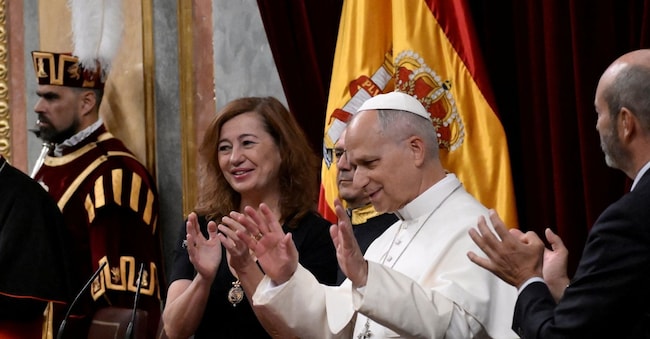
Leone in speech to Spanish Parliament, ten minutes of applause
by Carlo Marroni

 via REUTERS

5' min read

Translated by AI
Versione italiana

5' min read

Translated by AI
Versione italiana

From the protection of human life to the strong concern for the global arms race, passing through the centrality of the family and the dignity of migrants. These were the cornerstones of the speech delivered by Pope Leo XIV in front of the Spanish Parliament, where for the first time in history a Pontiff spoke. At the end of the speech the parliamentarians - Premier Sanchez was present - applauded for over ten minutes.

"Worrying that rearmament is presented as inevitable!"

"Every war constitutes a painful defeat of the ability to negotiate," Leone said, "weapons may impose a temporary silence, but they can never build a genuine and lasting peace. This is why it is worrying that, in various parts of the world and also in Europe, rearmament is once again being presented as an almost inevitable response to the fragility of the international scenario. True security, on the other hand, comes from justice, patient dialogue, and respect for international law'. Today, the international community is called upon 'to rediscover the indispensable value of dialogue as a patient path towards just and lasting agreements, based on respect for treaties, on the transparency of diplomatic action and on the sincere desire to put peace before recourse to force'. Only from this return to the field of diplomacy and law, the Pontiff added, "are trust and hope born", for the whole of humanity.

Loading...

"Promoting a culture of reciprocity"

Leone - who arrived in Spain in the midst of a political crisis - added to the parliamentarians: 'Within societies themselves, it is urgent to promote a culture of reciprocity. Political pluralism should not degenerate into permanent discrediting of the opponent. In a mature coexistence, even conflict can become a passage towards peace, when differences are mitigated by listening and are oriented towards the recognition of the needs, aspirations and capacities of all'. Prevost called on those with public responsibilities to 'protect also through language'. "Words," said the Holy Father, "can open roads or close them, they can illuminate reality or distort it to the point of making encounter impossible. Those who exercise public responsibility have, therefore, a special obligation to guard the word in order to 'disarm language'. Firmness does not demand contempt, dissent does not entail humiliation'.

"Never treat man as a commodity"

"Modern freedom," Leo went on to say, "has also been prepared by a long education of conscience, deeply marked by the Christian tradition. In this inner school, people have learnt that law must serve the good, that justice sets limits to force, that power needs legitimacy, that the poor belong fully to the community, that the stranger must be welcomed according to his dignity, and that human life can never be treated as a commodity,' he said, adding that in the face of challenges such as the development brought about by artificial intelligence, he called for human dignity to come before utility.

"On migrants no nation can be left alone"

"The tragic migratory drama" must be tackled by going "beyond the simple management of flows," said the Pope speaking to the Spanish Parliament: there is "a twofold need for social justice: to offer safe and legal routes, a respectful welcome and real possibilities for integration, and to promote, at the same time, the right to remain in one's own land." The Pope then mentions "increasingly dangerous routes" such as the Atlantic one: "It is necessary to strengthen rescue and assistance, especially with multilateral cooperation" because "no nation can face a challenge of this magnitude alone".

"Give reparations to victims of abuse and include lay people"

"Our journey is made up of encounters", "one of the most painful is with those who have been wounded by the very people who should have cared for them, including members of the clergy. Faced with this scourge, the Church community is called to respond with listening, truth, justice, reparation, and an ever stronger commitment to prevention and a culture of care. Every wounded person must be able to find sincere listening, welcome, protection and real paths to healing," said the Pope when meeting the bishops at the headquarters of the Spanish Episcopal Conference (Prevost is also scheduled to meet some victims of abuse). "Difficulties can be faced as opportunities. Sometimes we find it difficult to present the vocation of the laity and their integration in this journey of life that we as a Church are making. On the other hand, we see how in many works, traditionally run by religious, lay collaborators are used in order to continue doing the work. This is a difficulty that we can transform into an opportunity for encounter, dialogue and communication,' Pope Leo XIV adds. "It depends on us," he adds, "that these lay people come to perceive their participation in this ecclesial service as a call from God to take on responsibilities as Christians, internalising the spirit, feeling part of the mission".

"Defending life from conception to its natural end"

In Parliament he returned to the issues of Catholic morality: 'If life ceases to be recognised as a fundamental value, what future can our societies have? Can a community be fully just that leaves in the shadows the unborn child, the elderly, the sick, those who suffer in silence or those who depend entirely on the care of others? The defence of human life is not a matter of special interest or confessional: it is a goal of civilisation. Every human life must be recognised and cherished from conception until its natural end, in every circumstance of its existence'. When this certainty becomes blurred - the Pope emphasises - 'the most vulnerable are the first victims the law loses its deepest meaning: to serve and protect every person. For this reason, the moral greatness of a nation is manifested, above all, in its capacity to accompany, protect and love those lives marked by greater fragility'.

"Just society is founded on the recognition of inviolable dignity"

"Every truly just society is founded on the recognition of the inviolable dignity of the human person. This dignity precedes any concession by the State and cannot be subordinated to changing social consensus or to the fluctuations of the majorities of the moment," said Pope Leo and added: "The Church walks with humanity, she shares its hopes and wounds, she listens to the questions of every age and allows herself to be challenged by everything that concerns the existence of men and women today. For this reason, when he also addresses public life, "he does so with respect for the mission proper to institutions and the legitimate responsibility of those who have received the mandate to legislate", recognising "the autonomy of earthly realities". In the first address by a pontiff to the Spanish Parliament, Prevost therefore reiterated that the Church, in the clear distinction of roles, plans and functions, "offers a reflection that stems from the desire to serve the common good and to remember what makes coexistence truly human".

Copyright reserved ©
Loading...

Brand connect

Loading...

Newsletter

Notizie e approfondimenti sugli avvenimenti politici, economici e finanziari.

Iscriviti