Latin America

Venezuela: a double blow – the earthquake and the massive $240 billion debt

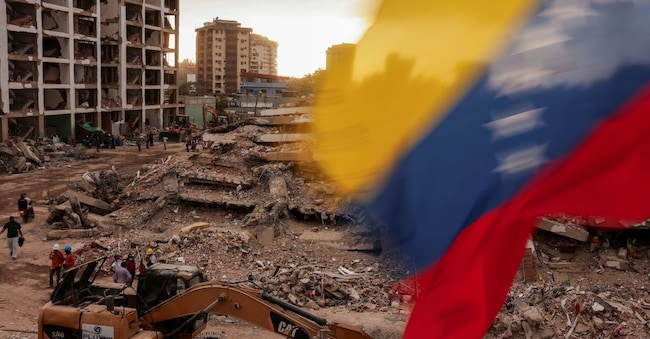
There are more than 5,000 victims of the earthquake, and at least 20,000 people have been injured. And the economic situation is dire

Reuters

3' min read

Translated by AI
Versione italiana

3' min read

Translated by AI
Versione italiana

The smell of salt mingles in the air with the more persistent odour of cement dust that has never quite settled. In La Guaira, not far from Caracas, where the earthquake destroyed hundreds of buildings, there are still an unknown number of people missing. It is that suspended moment in the wake of a disaster, when the figures – enormous, almost abstract – become the only way to express the grief that families are unable to accept or put into words.

The earthquake has exacerbated the economic collapse: inflation is the highest in the world, at over 500 per cent a year, and the bolívar, the country’s currency, continues to lose ground against the dollar. And, to top it all off, despite oil being at $100 a barrel, Venezuelans see none of it.

Loading...

The earthquake struck a country already grappling with a historic and fragile transition. On 3 January 2026, US special forces captured Nicolás Maduro in Caracas during Operation ‘Absolute Resolve’, transferring him to New York on charges of drug trafficking and terrorism. In his place, the former vice-president, Delcy Rodríguez, is governing as interim president, with no free elections yet announced; a form of governance with extremely limited sovereignty. Donald Trump’s threats were far from subtle: ‘If Delcy doesn’t do what we tell her to, she’ll end up like Maduro.’

“People thought that everything would change the very next day. That wasn’t the case,” says José Rodríguez of the AVSI Foundation, “doctors and teachers still earn less than 20 dollars a month, and over two million children are not in school.”

The $240 billion reckoning

In the coming weeks, Venezuela will publish, through the US investment bank Centerview Partners, the ‘viability plan’ that will lay the foundations for the largest sovereign debt restructuring in history. The total figure that Caracas is set to announce is 240 billion dollars: well above market estimates, which ranged between 150 and 200 billion, and even higher than the Greek default of 2012, which has so far been the benchmark case for sovereign debt analysts. This is where the first controversy arises: why Centerview Partners? An American investment bank with close ties to President Trump, according to US press sources.

The plan will not bear the International Monetary Fund’s signature. And without the IMF’s seal of approval, the restructuring will have to look elsewhere for guarantees, starting with oil.

Venezuela, messa e minuto di silenzio a La Guaira a un mese dal sisma

Oil: ‘Acquired’ Sovereignty

Control over those resources has already largely passed into American hands. Since 9 March 2026, Washington has exercised ‘operational control’ over the marketing of Venezuelan crude oil through the ‘Monitored Sovereignty’ framework, which entrusts the US Treasury’s Office of Foreign Assets Control (OFAC) with the management of oil sales revenues. A new hydrocarbons law, passed on 29 January, has dismantled PDVSA’s monopoly, opening up full operational management to private companies for the first time: Chevron, ExxonMobil and ConocoPhillips.

The aim is to increase production from the current 800,000 barrels a day to over 3 million within 24 months: the reserves, at over 300 billion barrels, remain the largest on the planet, but the ability to exploit them now depends, to a large extent, on Washington.

The Financial Times has calculated exactly how much this control is actually yielding: since the start of 2026, the United States is said to have received over 13 billion dollars from the sale of Venezuelan crude oil. The proceeds are first channelled through bank accounts in Qatar and, since February, into US Treasury accounts, with traders Vitol and Trafigura tasked with placing the crude oil on the market; from there, in theory, the funds should be channelled back via ‘controlled channels’ to the central bank and the Venezuelan state coffers, to pay public sector wages, fund equipment for the oil industry and, as Washington promises, support post-earthquake reconstruction. But there remains a huge gap between the amount collected and the amount actually returned: the transparency portal set up by the Caracas government records just one transfer, of $300 million, in March. “This is a serious problem of US financial governance,” says Enzo Farulla, a financial analyst specialising in Latin America, “and this is not the best way to initiate a sustainable debt restructuring.”

Against this backdrop lies an economy ravaged by inefficiencies and sanctions: although inflation has fallen from its previous peaks, it remains the highest in the world (612 per cent annually in April 2026); around 90 per cent of the population lives below the poverty line and, since 2014, nearly 7.9 million Venezuelans have left the country. Amidst the ruins of La Guaira and the boardrooms of Centerview Partners in New York, the same game is being played out: who will truly control Venezuela’s future. President Trump had already announced back in February: ‘I’m in charge in Venezuela now.’

Copyright reserved ©
Loading...
Loading...

Brand connect

Loading...

Newsletter

Notizie e approfondimenti sugli avvenimenti politici, economici e finanziari.

Iscriviti