
Venezuela, Maduro reconfirmed president. Opposition denounces fraud
He obtained 51% of the vote, beating opposition candidate Edmundo González with 44%. The opposition denounced irregularities

3' min read
3' min read
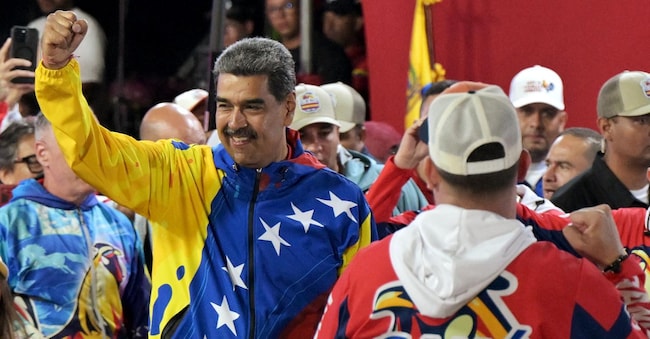
The opposition did not break through. The president, Nicolas Maduro, was the most voted (with 80% of the ballots counted he obtained 51.2% against Edmundo Gonzalez Urrutia's 44.02%), and he will be at the head of Venezuela until 2030, thus totalling 17 years at the head of the government. A longer period than his mentor Hugo Chavez, who in 2012, before his death, chose him from within his magic circle to carry on the Bolivarian socialist project, and whose 70th birthday it was on election day.
"They didn't succeed with sanctions, with aggression, with threats. They have not succeeded now and they will never succeed with the dignity of the people of Venezuela. Fascism in Venezuela, the land of Bolivar and Chavez, will not pass," were Maduro's first words as he celebrated with thousands of supporters concentrated in front of the Miraflores Palace. "Chavez lives. Chavez this triumph is yours. Hasta la victoria siempre. You are the people of peace, the people of God,' he added, warning of 'a massive hacker attack on the centre of the Electoral Council'. "We know who did it. They did it because they wanted to prevent the people of Venezuela from having their official result today. So they could act out the script they had prepared, so they could 'scream fraud'. Ugly, ugly, beautiful people are here with me,' he added, recalling: 'We have already seen this film, with Capriles, there were deaths because of them. We will not allow them to unleash violence again. Today the voice of peace has prevailed'.
In the same moments, as fireworks exploded in the Caracas sky accompanied by salsa notes and a drone show, the US Secretary of State, Antony Blinken, issued a statement expressing 'serious doubts' that the presidential election results represented the will of the people. A few hours earlier, Vice President Kamala Harris and seven other Latin American countries had called for 'respect for the will of the Venezuelan people'.
In 25 years of political life, the former bus driver, who likens himself to a 'gallo pinto', (a fighting rooster), has been deputy, president of parliament, foreign minister, and head of the United Socialist Party of Venezuela (Psuv). As of 8 December 2012, he is the heir to the eternal commander, who appointed him on TV when he was terminally ill. The caudillo then assumed the role of interim president until the National Electoral Council called elections in April 2013. 'I am not Chávez, but I am his son,' Maduro declared during the election campaign. On that occasion he obtained 50.61% against the candidate of the Democratic Unity Table (Mud) Henrique Capriles, with 49.12%. And in 2018, Maduro won again, against opposition candidate Henri Falcón. A result that was disavowed by much of the international community. In his trajectory to power, the former bus driver has lived mainly on the legacy of Chavez, the country has been on a perpetual rollercoaster ride, with waves of protests and repression costing him accusations of human rights violations at the United Nations, an investigation by the International Criminal Court and dozens of international sanctions.
The opposition in Venezuela claimed success in the elections. 'Venezuelans and the whole world know what happened,' opposition candidate Edmundo González said in his first speech. Opposition leader Maria Corina Machado said the margin of González's victory was 'overwhelming' based on the vote counts received by campaign representatives from around 40 per cent of ballot boxes across the country. The National Electoral Council, controlled by Maduro's loyalists, had announced earlier that Maduro secured 51% of the vote against González's 44%. But it did not make public the counts of each of the 30,000 polling stations across the country, promising to do so only in the 'next few hours' and thus hindering the possibility of verifying the results.

