The post

Venezuela, Trump 'closes' the country's airspace

The US president continues hostile operations towards Caracas. After the sea operations and the announcement of land initiatives, Washington tries to block Venezuelan airspace in the name of the fight against drug trafficking

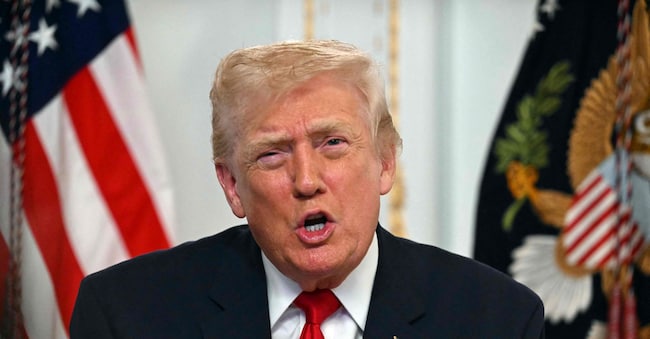
Il presidente Usa, Donald Trump

5' min read

Translated by AI
Versione italiana

5' min read

Translated by AI
Versione italiana

Donald Trump, on his Truth Social, proclaimed that"the airspace over and around Venezuela" should be considered "closed in its entirety", addressing not only airlines and pilots but also "drug dealers" and "human traffickers".

It has been months since the US administration turned the Caribbean into a military theatre with Operation Southern Spear: aircraft carrier Gerald R. Ford, at least seven other warships, a nuclear submarine, F-35s, and thousands of soldiers officially deployed to combat Venezuelan-linked drug trafficking.

Loading...

Since 2 September onwardsthe United States has conducted at least 21 attacks against boats suspected of transporting drugs in the Caribbean and Pacific, with at least 83 deaths; no public evidence has been released that those boats were actually carrying drugs, and Latin American jurists and governments speak of extrajudicial executions masquerading as a 'war on drugs'.

Yesterday, 28 November, Trump had already announced the quantum leap: after claiming that naval strikes would 'stop 85% of the drugs' bound for the US by sea, he declared that the US will start striking 'by land' at Venezuela-related trafficking very soon". The post on the "closed" skies is, therefore, the next step: if the sea is already the scene of bombings against alleged narcos, the airspace is politically transformed into a zone of operations, where those who fly know they are moving over a potential battlefield.

Even before the tycoon typed his post, the administrative machine had already prepared the ground. On 21 November the Federal Aviation Administration (FAA) issued a warning to airlines: 'Potentially dangerous situation' over Venezuela, 'worsening security situation' and 'increased military activity in or around the country', with risks to aircraft at all altitudes, including due to interference with the GNSS (GPS) system linked to military manoeuvres by both countries. In the space of a few daysat least eleven international airlines have suspended flights to and from Venezuela or overflying its airspace: among them Gol, Avianca, TAP, Iberia, Latam and Turkish Airlines, as documented by Reuters, AP and BBC.

The government of Nicolás Maduro reacted by revoking the traffic rights of six carriers, accusing them of participating in 'state terrorism actions promoted by the US government' and ordering other companies to resume flights within 48 hours. Many preferred to give up, confirming that the perception of risk has already changed the map of the skies above and around the country.

Within this framework, Trump's post has no direct legal value: the United States cannot 'close' the airspace of another state, which under international law remains under the exclusive sovereignty of Caracas. No convention allows Washington, in peacetime, to declare Venezuelan skies off-limits to the entire world with a communiqué on social media. But the president can do three very concrete things: order US airlines not to fly over the area, push the FAA to turn the current notice into a de facto ban, and use the political and financial clout of the US to force allied carriers to behave as if that space were really closed. The suspensions of recent weeks show that this mechanism is, in fact, already in motion.

In the absence of a no-fly zone voted at the UN Security Council or an ICAO resolution, a president uses his personal social media to send a message of deterrence to three different circles: to the airlines, to say 'the US will not cover those who insist on flying there'; to the cartels and criminal networks, to reiterate that sea and, shortly, land and air are under threat from American fire; to the domestic electorate, which sees the image of a commander-in-chief who 'closes the skies' with a phrase confirmed.

The Washington Post's investigation of the first naval operation on 2 September recounts a direct order from Defence Secretary Pete Hegseth: 'Kill them all', referring to the occupants of a boat suspected of drug trafficking off Trinidad. After an initial missile, a second attack would be launched against the two survivors clinging to the wreckage, to 'close down' the mission.

This is the beginning of a campaign that has already claimed more than 80 lives in some 20 attacks to date, according to Reuters and Al Jazeera; the White House presents them as 'narco-terrorists', but has provided no public evidence, while governments and organisations in the region report that many victims were fishermen.

In parallel, on a legal level, Trump pushed the logic of the 'state of war against the cartels': he signed an executive order allowing criminal groups on the continent to be designated as terrorist organisations; in 2025, he had Tren de Aragua, a Venezuelan gang, and the Cartel de los Soles included on these lists, claiming that their activity is a threat to national security comparable to that of Al-Qaeda.

The symbolic closure of Venezuelan skies fits into this framework: if the country is described as a giant narco-terrorist hub, then its entire airspace can be treated as hostile. But this narrative clashes with a fact that many analysts keep pointing out: the overdose epidemic that kills tens of thousands of Americans every year is mainly linked to fentanyl and synthetics largely produced in Mexico and Asia, which enter by land, not through alleged Venezuelan air routes.

Then there is the very real level of effects on those who actually fly. The FAA warning speaks of GPS interference, of Venezuelan military exercises, of massive mobilisation of the armed forces of Caracas, which has deployed air defence systems capable of reaching the altitudes of scheduled flights. In such an environment, all it takes is a misidentification error, a misunderstanding between control tower and crew, an aircraft deviating from course due to weather conditions, to turn a Boeing full of passengers into a target. To formally close the airspace, if only for all western airlines, is to reduce this risk but at the price of isolating an already strangled country even more.

The consequences, many observers argue, will not be paid by the 'drug dealers' evoked by Trump, but by ordinary Venezuelan and Latin American citizens. The cut-off routes raise ticket prices, lengthen time, make family reunions, business trips, even the transport of sensitive goods difficult. The Venezuelan diaspora - millions of people scattered between Colombia, Brazil, the US, Spain and Portugal - will see their ability to move worsen still further. The companies that remain operational, often regional, will find themselves working under risky conditions and in a hostile insurance ecosystem: the 'closure' proclaimed by the president weighs more heavily on their valuations than any communiqué from Caracas.

Meanwhile, diplomacy moves in a grey area. Reuters sources tell of direct contacts between Washington and Caracas, phone calls and discussions on possible negotiations, even the possibility of a future meeting between Trump and Maduro.

Copyright reserved ©
Loading...

Brand connect

Loading...

Newsletter

Notizie e approfondimenti sugli avvenimenti politici, economici e finanziari.

Iscriviti