Budget Act

Venice: the entry fee could double in 2027 – from 10 to 20 euros

The latest development comes in an amendment tabled by Caramanna (Fdi). Meanwhile, the council has increased the tourist tax from 5 to 9.50

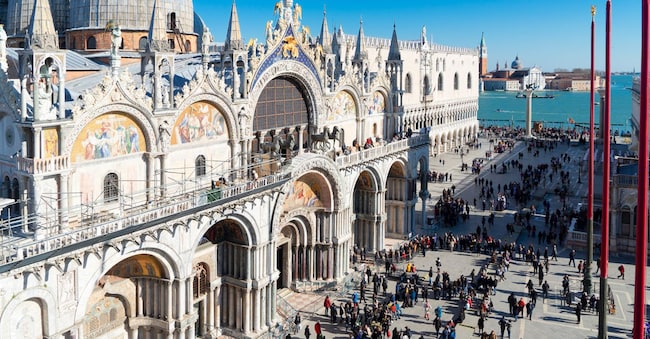
 (Adobe Stock)

4' min read

Translated by AI
Versione italiana

4' min read

Translated by AI
Versione italiana

Venice, oh dear. The cost of visiting the lagoon city is rising: the City Council has decided to raise the maximum tourist tax charged at the most upmarket accommodation from 5 to 9.50 euros. The City Council has also reintroduced a proposal for an air passenger tax to come into effect in 2027, a measure that had already been approved in 2022 but was subsequently overturned following an appeal to the Council of State by Save, the concessionaire of ‘Marco Polo’ Airport, and by airlines.

But that’s not all. There could be some news from Rome: amongst the amendments to the Budget Bill tabled in the Chamber of Deputies, there is a proposal signed by Gianluca Caramanna (Fdi) which, if approved, would double the maximum amount of the entry fee for the historic city centre and the smaller islands of the lagoon, to be applied on a trial basis from 2024. The fee would rise from 10 to 20 euros.

Loading...

Higher tourist tax: up to 9.50 euros

Drawing on the provisions of Law 197/2022, which allows provincial capitals with tourist numbers at least 20 times higher than the number of residents to levy a tax of up to 10 euros per night, Venice has decided to apply the new rate of €9.50.

“With this measure,” explained the Councillor for Taxation Michele Zuin, “we are bringing our approach into line with what the law permits and with what is already practised by other major tourist cities. This is a decision based on fairness and responsibility: the revenue generated by the tourist tax is essential for supporting services, the city’s appearance, maintenance and quality of life in a city that welcomes millions of visitors every year. This adjustment enables the council to have resources commensurate with the actual scale of tourism and the needs of the city and its residents.”

In 2025, Venice collected 38.976 million euros in tourist tax, the fourth-highest amount amongst Italian cities after Rome, Milan and Florence, according to Federalberghi’s “Tourist Tax Report” based on data from Siope. Last year, 5.858 million visitors arrived in Venice, 87 per cent of whom were from abroad.

Airline boarding tax makes a comeback

There’s more good news for tourists wishing to visit Venice. The Venetian city council, led by Simone Venturini (in office since 29 May) has included in the 2027–2029 draft budget, which has just been approved, a municipal surcharge for boarding aeroplanes of €1.60 per passenger. The administration states that this decision was taken following a process that began in 2024 and was finalised with the approval of the Ministries of the Economy and Finance and the Interior, and the signature of the Prime Minister’s Office.

“This is a short-sighted decision that adds yet another burden to the already serious problems linked to the geopolitical situation, high fuel prices, energy costs and inflation, and which exacerbates Venice Airport’s disadvantage compared, for example, to Trieste Airport, which does not even pay the national tax,” is the stance taken by the Save Group. The company has stated that, as has been the case in the recent past, it “will oppose this in all appropriate forums”.

Last year, Venice Airport recorded 11.8 million passengers, accounting for 5.2 per cent of total domestic traffic and representing an increase of 2.2 per cent compared with 2024.

The admission fee could rise to 20 euros

The entry charge for Venice’s historic centre and the smaller islands of the lagoon, which was first introduced in 2024, has also been confirmed for 2027. The number of days on which the charge will apply has increased from 60 to 72, during the period from 26 March to 15 August, between 8.30 am and 4.30 pm. The rates have been confirmed: €5 for those who book and pay for the ‘ticket’ within 10 days of arriving in the city, and €10 from midnight on the ninth day.

The 2019 Budget Act had authorised Venice to levy a disembarkation fee and set a maximum amount identical to that of the tourist tax: 10 euros. However, in recent months, Mayor Venturini had suggested raising the levy to 50 euros. For this to become a reality, however, legislative action is required. “We are in discussions,” the Minister for Tourism, Gianmarco Mazzi , had stated in September.

Loading...

The latest development may well come from the Budget Bill: among the 7,000 amendments that have poured in on the 2027 budget bill in the Chamber of Deputies, there is one bearing the signature of Gianluca Caramanna, a Fratelli d’Italia MP, head of the party’s tourism department and an adviser to Mazzi. The proposal is simple: to raise the limit to 20 euros. On Monday 23 November, we will find out whether the amendment passes the first screening stage – the admissibility check. Then, on Thursday 26, the package will be narrowed down to only those amendments flagged by the parliamentary groups as priorities for consideration by the Budget Committee.

The trial of the access charge in 2026 generated revenue of 5.215 million euros for Venice, averaging 87,000 euros a day. A fee raised to 20 euros and applied for 72 days would guarantee revenue for the city’s coffers of 12.5 million euros, representing a 140 per cent increase. For now, this remains purely theoretical.

The mayor: our appeal has been accepted; we are now awaiting the next steps

“This is a request that we, as the local administration, had been putting forward to the Government for some time – in particular to Minister Mazzi – and which has also been supported by UNESCO,” Mayor Venturini told *Il Sole 24 Ore*. “I would like to thank Mr Caramanna for the sensitivity he has shown in heeding our appeal and turning it into a concrete proposal.”

The mayor emphasises that ‘the entry fee is not intended to raise funds, but to manage visitor numbers and protect a unique and fragile city. Having greater scope to adjust the fee, particularly on days of peak demand, would give us an additional tool, following the first three years of the trial’. If the proposal were to go ahead, would the increases come into effect in 2027? “It’s too early to say,” says Venturini. “We’re waiting for the parliamentary process to be concluded. Only once the legislation has been approved will we assess the timing and methods of implementation.”

Copyright reserved ©
Loading...

Brand connect

Loading...

Newsletter

Notizie e approfondimenti sugli avvenimenti politici, economici e finanziari.

Iscriviti