
Venice Biennale: the EU takes a hard line on the Russian pavilion, cutting off 2 million in funding
The EU Commission has officially recommended that the EACEA (the European Agency for Culture and Education) suspend funding. Zaia: “An act of institutional arrogance”

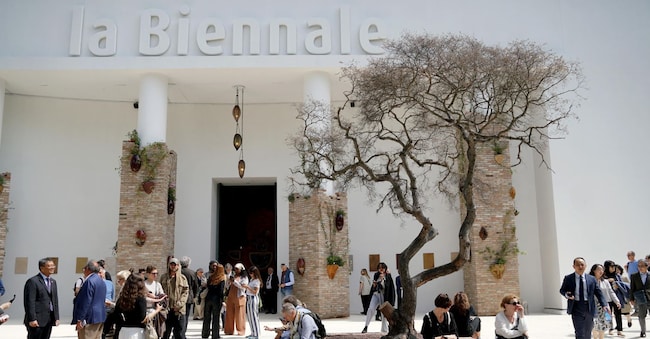
The lengthy correspondence in May and June was not enough. Nor was the government’s position – which was in line with that of Brussels – sufficient. The European Commission has decided not to let the Venice Biennale off the hook over the Russian pavilion affair and has officially recommended that the EACEA (the European Agency for Culture and Education) halt the €2 million in funding earmarked for the Foundation. The announcement was made on X by the Vice-President of the European Commission, Henna Virkkunen. “Culture in Europe – funded by taxpayers’ money – should promote and safeguard democratic values. These values are not respected in today’s Russia,” emphasised the Finnish Commissioner.
The controversy surrounding the Russian pavilion erupted in the spring. Despite the objections raised by the Minister for Culture, Alessandro Giuli, the Foundation pressed ahead, deciding to host the Russian pavilion. Formally, the structure was never opened to the public, and the Biennale has always maintained that its presence did not breach European sanctions. However, the controversy had already spread from Italia to Brussels as early as March. The European Commission and the EACEA sent several letters to the Biennale seeking clarification, both before and after the opening of the event, and had warned the Foundation that, should it go ahead, it risked losing its funding.
On 9 May, however, the Biennale opened. And the Russian pavilion was there. It was Europe Day, and the coincidence only served to further harden the stance of EU leaders. Similarly, at the Berlaymont Building, they made no secret of their irritation at the remarks made by Deputy Prime Minister Matteo Salvini, who was in Venice on 9 May.
“The decision announced by the European Commission to recommend halting the €2 million grant to the Venice Biennale is, quite frankly, unacceptable. I regard it as an act of institutional arrogance and unprecedented hostility towards one of the world’s most prestigious cultural institutions,” said Luca Zaia, President of the Veneto Regional Council, in a statement. “It is time for Italian institutions, at every level, to pull together and close ranks. Europe cannot come in with a heavy hand against an institution that has made freedom, a world-class cultural profile, autonomy and the capacity for dialogue its hallmark.”
In the meantime, however, European funds are set to run out. The Commission’s stance towards EACEA is merely a recommendation, but it is unlikely that it will not be formalised. The Biennale case, as well as that of Russia’s participation in the Milan-Cortina Paralympics, was, incidentally, implicitly included in the conclusions of the June European Council. ‘Until there is a just and lasting peace in Ukraine, there should be no normalisation of Russia’s participation in international sporting and cultural events,’ the text of the conclusions stated. And, in recent days, the EU has also made its voice heard vis-à-vis the IOC, following the latter’s decision to reopen the door to the participation of Russian athletes.

