Ideas

Venus: from Joana Vasconcelos, a plural body for the memory of fashion

The Roman exhibition at PM23 does not separate aesthetics from ethics: beauty is not only to be contemplated, but to be built together

by Maria Laudiero

3' min read

Translated by AI
Versione italiana

3' min read

Translated by AI
Versione italiana

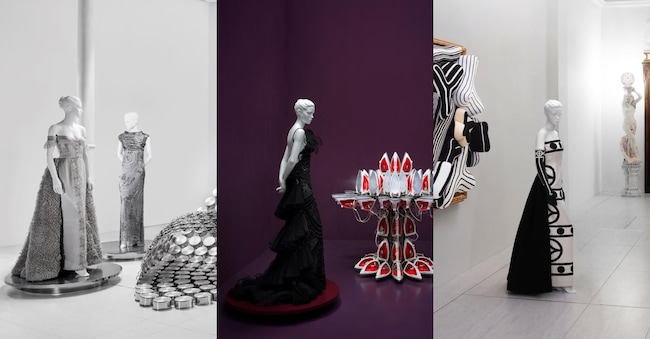
With Venus, the Fondazione Valentino Garavani e Giancarlo Giammetti entrusts Joana Vasconcelos with a project conceived in total creative freedom, designed specifically for the spaces in Piazza Mignanelli 23. The exhibition brings together twelve works by the Portuguese artist - including monumental installations and site-specific interventions - and thirty-three creations by Valentino Garavani, selected from the historical archive and curated by Pamela Golbin.

The result is a close dialogue between fashion and contemporary art, in which different visions, materials and languages intertwine to offer a lively and non-celebratory reading of the couturier's legacy, reinterpreted in the light of present-day sensibilities and urgencies.

Loading...

La bellezza composita di Venus in mostra a Roma

Photogallery4 foto

Interrogating the present

Entering the Venus exhibition means accepting a suspension: that between the memory of an absolute aesthetic and its transformation into a living, collective, open experience. It is neither a nostalgic celebration nor a simple re-reading of the archive, but a narrative device that uses fashion as a sensitive material to interrogate the present.

Stratifications

Joana Vasconcelos' gaze does not observe Valentino Garavani's work from afar; it neither frames it nor protects it. It passes through it. The clothes become fragments of a larger body, cells of an organism in continuous transformation. The Venus that dominates the space is neither a classical icon nor a symbol of motionless perfection, but a hybrid, expanded entity, built by stratification, in which the concept of beauty shifts from result to process.

Couture, traditionally associated with the idea of uniqueness and distance, is here rewritten as a shared gesture. Valentino's clothes, with their formal precision and rigorous balance, are not annulled by the dialogue with contemporary art, but made permeable. They lose their museum-like fixity to become narrative surfaces, capable of supporting new meanings without renouncing their own identity.

A central role in this process is played by the social dimension of the work. Venus was constructed through extensive crochet work, a technique deeply linked to Vasconcelos' artistic practice, here elevated to the status of a relational tool. People from the most diverse social backgrounds took part in the creation: fine arts and fashion students, hospitalised children, prisoners, women in protection, associations and individual citizens. The thread thus becomes a common language, capable of uniting distant experiences, transforming a traditionally intimate and domestic gesture into a public and collective act. The final work preserves the trace of these differences, making them an essential part of its own form.

The Venus that emerges from this process is therefore not an abstract symbol, but a real body, built by different hands, a bearer of stories, times and fragility. In this sense, the exhibition does not separate aesthetics from ethics: beauty is not only to be contemplated, but to be built together. Manual labour, often relegated to the margins of art history, becomes here a political and poetic device at the same time.

Venus refuses a chronological or celebratory reading of the archive. It does not recount a career, but an idea: that of an aesthetic that can still generate meaning, confrontation, participation. The greatness of Valentino Garavani is not staged as an untouchable myth, but as fertile matter, capable of welcoming new voices. In this tension between memory and transformation, between high fashion and collective practice, the exhibition finds its most authentic strength.

Also dedicated to the collective experience that shaped Venus is Trame #73, the documentary by Daniele Luchetti presented within the exhibition itinerary. Through a montage of voices and gestures, the film restores the human dimension of the project, highlighting the value of shared work and the transmission of knowledge. Manual making emerges as a common language and transformative act, capable of generating awareness, relationships and new forms of belonging.


Brand connect

Loading...

Newsletter

Notizie e approfondimenti sugli avvenimenti politici, economici e finanziari.

Iscriviti