
Vercelli, business pact and Turin Polytechnic for innovation
Synergies. Chancellor Corgnati: 'Contacts with local realities are our futureWe are at the service of the territory, seeking to enhance uniqueness'

3' min read
3' min read
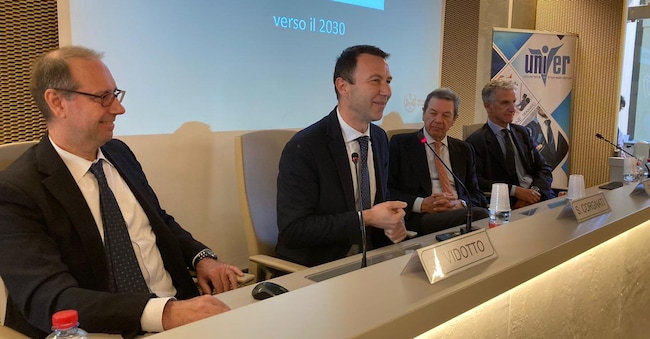
The Politecnico di Torino as a support and vehicle for the development and growth of the Vercelli area, thanks to the synergy between the business and academic worlds for the promotion of policies aimed at innovation. This was the central theme of the meeting held in Vercelli at the headquarters of Confindustria Novara Vercelli Valsesia (Cnvv), which organised it together with the Univer (university and enterprise) Vercelli Consortium, with the newly appointed rector of the Turin Polytechnic, Stefano Corgnati, who illustrated the objectives that the Polytechnic is setting itself in the coming years.
'Contacts with the local business fabric are the future of the Politecnico di Torino,' he said. 'In recent years it has focused a lot on internationalisation, but it is a public institution and therefore its mission is to serve the territory. First of all, we must identify and enhance its uniqueness'. Corgnati invites us to think in a glocal perspective, i.e. to invest, innovate, raise the level of competitiveness of the university-business system, to make it an excellence on an international scale. The Vercelli area excels in the energy sector and the rice-growing tradition: 'How can we increase the competitiveness of an area in terms of technological development and generate conditions for success over time? The challenge is to think ahead, so as to create fascinating job opportunities for young people, which will encourage them to stay in their place of origin, proud and fulfilled by the choice they have made'.
The rector emphasised how essential a strong vocation for innovation is: 'Digital transition and ecological transition are the big issues we have to deal with. And they must be guided by an evolved technological approach: the Politecnico must and wants to support decision-making with a scientific approach, strongly marked by innovation. In particular, green innovation. We are already doing this, for example, by supporting the City of Turin in the Carbon Neutrality project, which aims to reduce CO2 emissions by 80% by 2030. And in addition to the Politecnico, Piedmont boasts other excellences in the field of energy transition: for example, the Energy Center and the Environment Park, both closely linked to the Univer Consortium'.
The role of the Consortium was also emphasised by its president Carlo Piazza: "It is exactly 30 years that Univer has been working by bringing together the best energies of the territory, creating virtuous dynamics between entrepreneurship, public administration and university. And director Davide Vidotto dwelt on its future: 'The Consortium's activities are being concentrated above all through the Clever Cluster, of which we are the managing partner: it is one of Piedmont's seven innovation clusters and operates in the Energy and Clean Technologies field. In the coming months, we will give more and more impetus to animation, awareness-raising, and networking activities in favour of local entrepreneurial realities, which are strongly interested in the topic of energy transition'. Giovanni De Santi, Director of the Sustainable Transition Initiative of the Politecnico di Torino, took stock of the international scenarios: "The energy transition must take place as quickly as possible. Yet, the European regulatory framework is still inadequate and obsolete. Italy faces epochal challenges: how to become independent in the production of clean energy, considering that the nuclear option does not exist here? And how to tackle the mission impossible of the Green Buildings Plan, when in Italy more than 9 million buildings currently fall short of the required standards?". Gianni Filippa, president of Cnvv, expressed his conviction 'that the Politecnico di Torino is an important guide for innovation, especially by maintaining the dialogue already started with another reality that is fundamental for us: the Università del Piemonte Orientale'.

