
Verona and Fascism: This is how freedom was won
The exhibition set up in Castelvecchio, where the Congress that baptised the RSI was held, retraces the crucial two-year period that ended with the Resistance struggle and 25 April
4' min read
4' min read
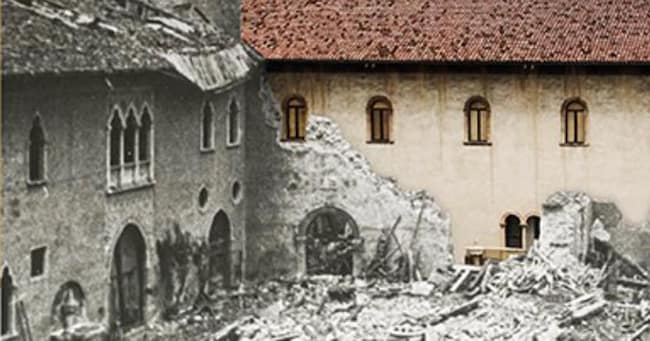
One feels tiny and almost (guiltily) lucky in front of the images documenting the gash in Verona's Castelvecchio caused by Allied bombs on 4 January 1945. Observing them in the space that was the Salone dei Concerti at the time, reduced to a heap of rubble, the emotion is great: one relives the mad violence of the two-year period 1943-1945 and the path from which everything stemmed: the rise of Mussolini, his fall, the constitution of the Republic of Salò with the Congress in the hall (later reconstructed in the post-war period: today it is the Boggian Hall), the heart of the exhibition Fascism, Resistance, Freedom. Verona 1943-1945. Up to 25 April and the hope of a new era.
The story has its strength not only in the substance of documents and images, but also in the clever multimedia proposal: the holograms of Galeazzo Ciano and the Jewish partisan Rita Rosani speak to us; some paintings - such as Mario Mafai's Natura morta con fiori (1942) polluted by a mournful ribbon or Albano Vitturi's Allarme in piazza delle Erbe (1943) - tell of the artistic temperament of the time; the restitution of weapons by the partisans marks a new beginning; the recovery of the saved paintings accompanies the rebirth. When one leaves, one looks at Castelvecchio with new eyes, today in the guise that Carlo Scarpa gave it in 1958.
In this exhibition there is a protagonist, here prima inter pares in the history of that season: it is Verona, whose parable is intertwined with the national one. It is indicative, moreover, that this is the first exhibition set up in view of the 80th anniversary of the Liberation (opened on 13 March, it will be open until 27 July), curated by Andrea Martini (director of the Veronese Institute for the History of the Resistance and Contemporary Age), Federico Melotto, (president of the same institute), Marta Nezzo (art historian at the University of Padua) and Francesca Rossi (director of the Civic Museums of Verona). Just as eloquent is the fact that at the moment, in the Municipality, there is a Councillorship for Historical Memory alongside that for Culture.
The desire to make people understand, to make sense of what we are today - avoiding improvident divisions but giving new generations in particular the chance to recognise the terms of what happened - is all in the result of the six rooms in which Fascism, Resistance, Freedom. Verona 1943-1945. It starts with a film from the Archivio Luce showing Mussolini's visit to Verona on 26 September '38. The Arena overflowing with women - girls, workers, housewives - dressed in black and white, with alternating 'segments' that make up the words 'Dux' twice, is a plastic demonstration of the pompous rhetoric of the regime. The Duce arrives there after passing through the city amidst howling black shirts, decorations on the balconies, hierarchs and celebrating people. The idea of a new Europe to bury the one attempted by the bankrupt Versailles Treaties, he argues, haranguing the crowd, is to be pursued even at the cost of conflict.
He could never have imagined, Mussolini, that less than five years later everything would change: the original minutes of the meeting of the Great Council of Fascism of 25 July 1943, which sanctioned his downfall, are displayed in a display case in the hall, where not only was the Congress held that baptised the disgraceful Italian Social Republic (14 November of that year), but also the traitors, the signatories of the Grandi agenda (Ciano, Marinelli, Gottardi, Pareschi, Cianetti, De Bono) were tried: they were all shot on 11 January '44 except Cianetti, who was spared for having withdrawn his no-confidence. While observing the images of those tragic moments, projected on the large wall opposite the shrine, a German voice resounds on the left: it is the one lent to the figure of Nazi Friedrich Boβhammer, Eichmann's close collaborator and involved in planning the final solution. From January 1944, he managed the deportation of Italian Jews from Verona to the Fossoli camp, and from there to the German extermination camps. The texts one hears, based on the testimonies of members of the SS at the (belated) Berlin trial in which Boβhammer was sentenced to life imprisonment (1972), are worthy of the infamy of his role, a repertoire of hatred and contempt for the Jews qualified as 'scum', 'parasites', a 'pestilence' of humanity to be extirpated.


