
Versatile, precious, unisex: chains, the world's most popular ornamental motif
They first appeared in 7000 B.C. in Anatolia and since then they have ceaselessly inspired micro and macro creations, following the progress of craftsmanship, technical innovation, the evolution of materials and the evolution of decorative taste.
4' min read
4' min read
The chain is the most widespread and versatile element in the history of jewellery. It tightens, binds, supports, decorates, encompasses universal symbolism, alludes to the fascinating idea of circularity, is an ornament without boundaries, neither chronological nor geographical, spanning the history of costume as well as anthropology, art, fashion and techniques. Chains traditionally have a dual interpretation: in the negative sense they are the signs of slavery, while in the positive sense they represent beauty and social prestige and as such have been depicted by the greatest painters in the history of art to symbolise universal values such as honour, loyalty and love.
The chain has accompanied mankind since the dawn of time. It is an artefact of variable length consisting of connected links, generally used to join parts of clothing such as the flaps of a cloak, sleeve or bodice, but over time, in addition to its functional role, it has also taken on the symbolic values of bonding, union, loyalty, power, wealth and social revenge. In his Mundus symbolicus, Filippo Picinelli states that whoever wears a gold chain around his neck, on the one hand recognises himself as bound, but on the other feels ennobled and embellished because it finely adorns him, whereas for Plato the chain represented the link between earthly life and spirituality. The chain also has an important meaning from a religious point of view: for Christian doctrine, the gold chain is a symbol of eternal faith, of the connection between man and God, while for Buddhists and Hindus it is the emblem of karma, which binds the actions of human beings to their consequences.
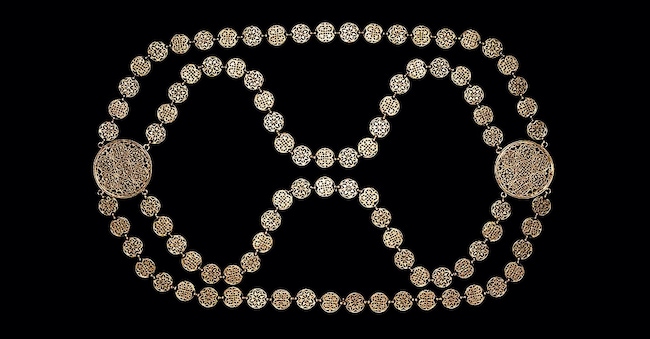
The history of the gold chain is inextricably linked to the history of metals. The earliest traces of metalworking, of gold and copper, date back to 7000 BC and were found at Çatal Hüyük in Anatolia, in the oldest urban settlement of mankind. There are no certain data, but archaeologists agree that the processing of the gold thread, the constituent element of the chain, is as old as rolling: thin strips of gold, cut from hammered sheets and then rolled up, gave rise to the golden thread. To this thread mankind gave the term chain, a jewel in daily use, then mainly worn by men and worn around the neck. From the slender gold, lapis lazuli and carnelian chains of the Babylonian queen Puabi found in Ur to the sumptuous gold chains with repoussé pendants of the Minoan civilisation, from the opulent chains of Roman matrons with coloured cabochons to those in polychrome Byzantine enamels (on the final page of the feature 7th century Byzantine gold pectoral made of opus interassile, preserved in the British Museum), the chain is the aesthetic and manufacturing mark of all the great civilisations of the past. With the Renaissance, it became the emblem of social prestige and the protagonist of fashion, both for women and men, as shown by the paintings of Botticelli, Bronzino, Raphael, Leonardo and Moroni, among others. Nonetheless, painters from beyond the Alps confirm the fascination and diffusion of chains, from the marvellous arabesque chain of Maria Portinari portrayed by Memling, to the 3-kilo chain worn by Henry VIII in Holbein's painting, to Cranach's flamboyant ladies wrapped in massive gold chains.

The chain also encapsulates advances in craftsmanship and innovations in technique and materials. Up until the 18th century, there were mainly four types of handmade chain: the rope (curved and then twisted wire), the forzatina (ring within ring), the foxtail (knot within knot) and the grumetta or rope in the well (round or oval links arranged obliquely), technically complex processes that required considerable skill. With the advent of industrialisation, the chain was enriched with radical technical and formal innovations to which Italy made an important contribution, representing, since the beginning of the 20th century, one of the centres of excellence for high quality production, both for jewellery and costume jewellery, as demonstrated, among others, by the vintage chains of Ornella Bijoux and Sharra Pagano or those made by Leo France for the great stylists. The chain has, in fact, traversed the 20th century as a protagonist, from the naturalistic chains of Art Nouveau to the elegant geometries of Art Deco chains, from the masterpieces of the great jewellers, Van Cleef & Arpels, Buccellati, Tiffany, Bulgari, Vhernier, to the symbols of youthful countercultures: hippies, punks, hip hop. To the chain, jewellers like Pomellato have entrusted their image and success, transforming it from a functional element into a jewel of mastery and creativity.
Nevertheless, fashion designers have made it the iconic element of their collections: after the futuristic chains of Paco Rabanne, the fashion metallurgist, in the 1960s, the oversized ones of Karl Lagerfeld, Franco Moschino and Gianni Versace in the 1980s, after the minimalist rigour of Giorgio Armani and Miuccia Prada in the 1990s, today the chain is the queen of the catwalks, from Chanel to Dolce & Gabbana, from Miu Miu to Louis Vuitton, from Pucci to Valentino, from McQueen to Dior, every collection sees chains enhance and merge with beautiful clothes and accessories. Even art and design have found a powerful means of expression in the chain: such as the body sculptures of Giò Pomodoro, Gijs Bakker or Giampaolo Babetto, up to the super-light experiments of Giancarlo Montebello, Carla Riccoboni and Emma Francesconi. Today, the chains of the future are designed with 3D printing by Giulio Iacchetti, Odo Fioravanti for Maison 203 and Selvaggia Armani or Monica Castiglioni for .bijouets. Because of their joyful versatility, they are the most beloved jewellery in history and that is why, to a friend who asked her advice on what to give to the woman she loved, Mademoiselle Coco replied without hesitation: 'I know women, women adore chains, give her a chain and she will adore you'.

