Formula 1

Verstappen claims his first win in Singapore. Antonelli on the podium, Ferrari shoots itself in the foot

Hamilton was forced to retire after his tyres wore out: he dropped from third to sixth place. Russell finished ninth, bringing the Italian closer to the world title

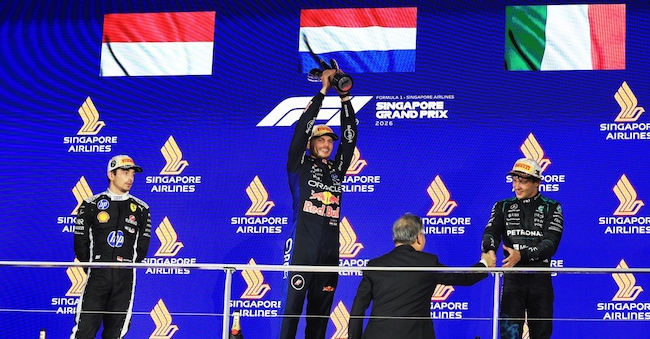
Max Verstappen Charles Leclerc e Andrea Kimi Antonelli  EPA/FAZRY ISMAIL EPA

6' min read

Translated by AI
Versione italiana

6' min read

Translated by AI
Versione italiana

Pole, Sprint, Fastest Lap and Grand Prix: a Grand Chelem or Grand Slam ‘enhanced’ by the Sprint: there’s still no official name for the ‘full package’, but perhaps someone from the English-speaking world will come up with one between now and 2027. Verstappen, then, literally on his own as in the old days, wins for the first time in Singapore – a circuit where, until Saturday, he had never even secured pole position – and he does so without putting a foot wrong. Yet on that dry Singapore evening, he got off to a worse start than Leclerc, shut him out at the first corner and from there led unchallenged all the way to the chequered flag, with a lead of around ten seconds. Behind him came Leclerc and Kimi Antonelli. For the Italian, this third place carries significant weight: Russell, who started from the back of the grid due to a power unit change, finished ninth, and Antonelli’s lead in the standings continues to grow. Barring any penalties, in short, he will have his first mathematical chance to clinch the championship at Austin.

Ferrari’s result is a bitter one. Starting from second and third on the grid, the Scuderia returned home with just one driver on the podium – and bad luck had little to do with it. Hamilton started on medium tyres and, on lap 19, was the first in a ‘train’ – the same order as at the start, from first to seventh – to pit: he switched to Softs with the intention of taking them all the way to the end, i.e. for another forty-three laps. Pirelli had predicted that this year the C5 compound could last almost an entire race distance, and for a while the gamble seemed to be paying off. The reality is that he struggled with the medium tyres, whilst for Verstappen they were the secret to his success. Low temperatures and a rubberised track seemed to favour the soft compound as well. But after his pit stop on lap 25, Leclerc returned to the track a hair’s breadth ahead of his team-mate, and Lewis was stuck in his slipstream without finding a clear opening.

Loading...

The decisive moment came on lap 39, with the second Virtual Safety Car. The pit wall called Leclerc in for a set of new Softs and ‘deliberately’ left Hamilton out, on tyres that already had around twenty laps under their belt. According to the post-race transcripts, it appears to have been the driver’s decision: for once, it wasn’t entirely the pit wall’s fault. However, it was the same pit crew who, shortly afterwards, made it clear to him that they risked not making it to the finish. On lap 47, Leclerc overtook him without Lewis being able to defend his position; he was then overtaken by Antonelli and finally, on the very last lap, by Norris. The stewards even launched an investigation into him for gaining an advantage by going off the track, but they let it go: he had already lost those positions of his own accord.

Hamilton finished sixth, and his performance can be viewed in two ways. With his tyres well and truly worn out, he managed to hold off Piastri right to the finish line – which was by no means a foregone conclusion. However, by not bringing him in under the VSC – when a pit stop would have cost less – Ferrari turned what was likely to be a one-two finish into a third-place finish handed to Mercedes on a plate.

Russell, meanwhile, tries to limit the damage. By the tenth lap he is already thirteenth; on the twenty-third lap he overtakes Ocon and moves within striking distance of the points. Then came the cruel twist: he pitted just as the second VSC ended and, instead of rejoining in seventh, found himself in tenth. He made up one place on Gasly, but the two points for ninth place were of little use against Antonelli’s fifteen.

Russell wins the Sprint ‘mini-world championship’. Leclerc is level on points

The Singapore Grand Prix also marked the end of a minor championship that does not officially exist, but which, from next year onwards, will be increasingly difficult to dismiss as merely a Saturday diversion. In the six Sprint races of 2026, George Russell and Charles Leclerc scored exactly the same number of points: thirty-four each. However, if the criterion used by the FIA to break ties – the number of wins, second places and third places – is applied to this virtual standings, the title goes undisputedly to the Englishman: three wins, in China, Canada and the Netherlands, compared to none for the Ferrari driver. And Russell could have sealed the deal as early as Saturday, had he not crashed into the barriers whilst leading the wet-weather Sprint. Leclerc reached this point via the opposite route: two second places, two thirds and two fifths – always in the points but never on the top step of the podium. Behind them, Norris on thirty-three and Antonelli on thirty-one.

So far, this would be little more than a statistical curiosity. From 2027, however, the number of Sprints will increase from six to ten: for each driver, the points up for grabs on Saturdays will rise from forty-eight to eighty, and around four hundred kilometres of actual racing will be added to the calendar, with all that this entails in terms of accidents, reliability and parts that will need to be sacrificed. Until now, the balance between the eight points on offer and the risk of jeopardising Sunday’s twenty-five points might, on some occasions, have called for a degree of caution. Next year, the calculation will be different. This is not the first time Formula 1 has adjusted the significance of the Sprints: back in 2022, it had already extended the points zone to the top eight, precisely to encourage drivers to attack from the first to the last lap. The teams, however, have continued to weigh up the pros and cons. This new move raises the bar – in terms of difficulty, costs and competitiveness – right from Saturday, with predictable repercussions for viewing figures and ticket sales too.

There is also a slight paradox. Following its debut this year, Singapore will be dropped from the 2027 Sprint calendar and replaced by Monaco, just as Verstappen, Hamilton and Leclerc are questioning the value of a short race on street circuits, where overtaking is a real challenge. In short, the number of Sprint races is increasing, but it remains to be seen where it really makes sense to hold them: even today’s Grand Prix showed just how difficult it is, with the walls so close, to ensure enough overtaking to keep the crowd engaged beyond the first ten minutes.

Verstappen, the youngest ever to reach 50 pole positions

In Singapore, Verstappen secured the 50th pole position of his career. Only four drivers had achieved this before him: Hamilton, who now stands at 104, Schumacher on 68, Senna on 65 and Vettel on 57. None, however, were as young: Max crossed the line aged 29 years and ten days. It all began in Hungary in 2019, with a pole position that made him the 100th different pole-setter in the history of the World Championship. The real breakthrough came with Red Bull’s title-winning era: 47 of his 50 pole positions have come since 2021. In 2023, he secured twelve in a single season; between Abu Dhabi 2023 and Imola 2024, he racked up eight in a row, equalling Ayrton Senna’s record. Singapore was missing from the list – one of the two circuits on the calendar (the other being Madrid’s Madring), the new and controversial Spanish track, where he has yet to win a Grand Prix.

Loading...

More software problems for the FIA

Following the chaos at Sepang, where a glitch left several cars without power during the formation lap, the FIA had to admit to another electronic error in Singapore. During the first phase of Sprint qualifying, Overtake Mode was not reactivated after the red flag. Nikolas Tombazis, the Federation’s Single-Seater Director, reconstructed the incident: not the race director, but the official who oversees the entire technical and regulatory side of the FIA’s single-seaters. He explained that reactivation is deliberately a manual process, as race control must first verify that safety conditions are in place. This time, however, a pop-up window that appeared on one of the computers was not dealt with in time and, in the flurry of activity surrounding the restart, the command was overlooked. Upon realising the error, race control activated the system for just 27 seconds, before deactivating it again: a decision that Tombazis himself described as ‘wrong’. Consequently, depending on where they were on the track at the time, some drivers had less electrical power available than others. For the Federation, Tombazis admitted, this is ‘the worst possible outcome’: a result that does not reflect the drivers’ performance on the track.

Copyright reserved ©
Loading...

Brand connect

Loading...

Newsletter

Notizie e approfondimenti sugli avvenimenti politici, economici e finanziari.

Iscriviti

Tutto mercato WEB