
Vertical farming after supermarkets conquers top chefs
Over 238 million euro invested in 74 deals in 2023. Stable presence in supermarkets and now growing number of starred restaurants favouring salads and indoor-grown products
by Maria Teresa Manuelli
 Aggiungi Il Sole 24 Ore
ai preferiti su Google
3' min read
3' min read
The crisis in start-up investments does not touch the Italian agrifoodtech sector, which continues its growth. According to data released at the NovelFarm fair in Pordenone (an exhibition and conference on agritech, indoor, vertical farming), 2023 saw over 238 million euros invested in 74 deals. A year earlier, in 2022, the millions allocated were only 153. 'A 53% increase is certainly not for everyone,' comments Antonio Iannone, professor at the Escp Business School in Paris, co-founder of Agrifood-Tech Italia and a reference point in our country for the sector, 'especially in a global and Italian context ravaged by the economic crisis and declining investments.
Attracting the most capital are mainly companies dedicated to vertical agriculture, which now absorb half of the operations. An anomalous situation compared to the rest of the world, where instead we have seen bankruptcies and vanishing investments over the years.
"Prominent contributors," emphasises Iannone, "include The Circle, the European leader in the aquaponics sector and one of the main players, as well as Planet Farms, which alone raised EUR 53.7 million. Other key players are Agricola Moderna, Kilometro Verde and Zero. Some argue that this success is due to Italy's relative immaturity in the sector. But this is not accurate. In the rest of the world it was the Silicon Valley ethos of 'growth at all costs, profits later' that failed. Italian start-ups, on the other hand, by adopting more sustainable growth models, are proving that the sector is far from obsolete'.The advancement of vertical farming was also taken into account in the recent fiscal legislative decree approved on 30 April by the Council of Ministers, which provided for taxation on a cadastral basis precisely for this innovative cultivation technique, since it takes place inside buildings or artificial structures, such as buildings, skyscrapers or greenhouses.
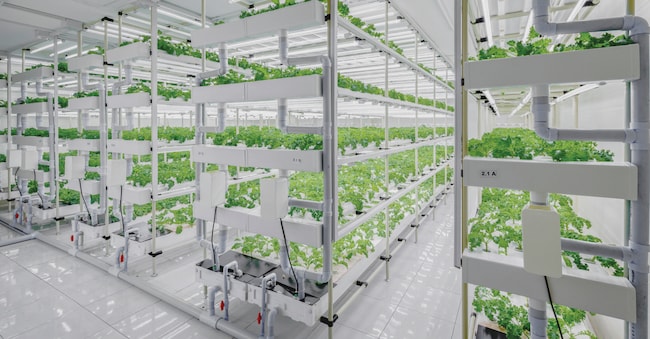
But what is meant by vertical farms? In general, it refers to the practice of growing plants on several vertically stacked levels, based on soiless, i.e. zero soil consumption, techniques such as hydroponics, aquaponics, aeroponics or controlled environment farming. They use advanced technologies to control growing conditions (temperature, humidity, CO2, light, etc.) to optimise the use of resources and elements, increasing plant productivity. Excess water and nutrients are recovered and fed back into the circuit and resource consumption is radically reduced.
"On one square metre of soil," says Benjamin Franchetti, co-founder and director of technology at Agricola Moderna , "we manage to be about 200 times more productive than traditional cultivation and with less environmental impact. The Milanese vertical farm, founded in 2018, will soon present four new salads in large-scale distribution that are longer lasting (12 days), more convenient and with new 100% recyclable packaging. From cutting to packaging, in fact, the process takes only two minutes, unlike traditional farming where it can take up to 24 hours. Furthermore, thanks to indoor production, the product does not need washing or treatment and is naturally ready for consumption.

