Anniversaries

Vespa, eighty years and counting

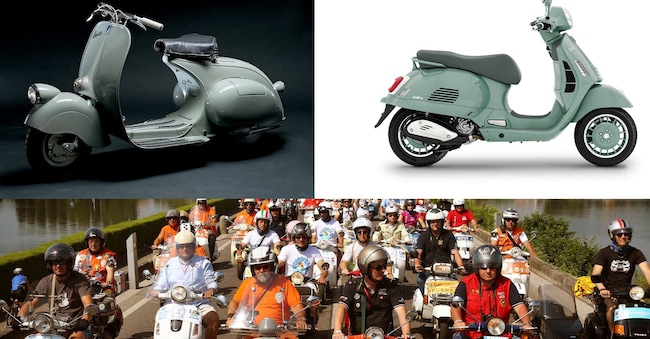
Since Piaggio filed its patent on 23 April 1946, the Vespa has known no crisis: witness the almost 20 million examples sold worldwide, two of which were produced in the last decade. We retrace its history up to the model created to celebrate the anniversary, the Vespa 80th

by Gianluigi Guiotto

4' min read

Translated by AI
Versione italiana

4' min read

Translated by AI
Versione italiana

The Vespa is 80 years old on its (small) wheels, but it doesn't show it at all: the Vespa continues its successful career all over the world. Very few objects have been able to conquer the collective imagination the way she has: ever since Piaggio & C. Spa of Pontedera, in the province of Pisa, filed a patent on 23 April 1946, signed by aeronautical engineer Corradino D'Ascanio for a 'motorbike with a rational complex of organs and elements with a combined frame with mudguards and bonnet covering the entire mechanical part', Vespa has literally conquered the world.

And to think that when Enrico Piaggio asked D'Ascanio, an engineer hired in 1932 to design planes and helicopters, to design a motorbike, the answer was no: 'No, I don't want to. I don't even know how to ride it, a motorbike". Enrico Piaggio's request was for a practical vehicle that could be easily ridden by a "man, a woman and a priest in a skirt".

Loading...

Today, Vespa is a global brand, produced in three production sites: Pontedera, a factory where it has been in continuous operation since 1946 and whose production is destined for Europe and the western markets, including the Americas; Vinh Phuc, in Vietnam, which serves the local market and the countries of the Far East; and Baramati, which has been serving the Indian market since 2012.

Vespa, i modelli più significativi della sua storia

Photogallery15 foto

The beginning in the reconstruction years

Vespa was born out of the need for individual mobility on the part of a population coming out of a five-year war and the need of Rinaldo Piaggio's sons, Enrico and Armando, to restart industrial production and rebuild the large plant in Pontedera, reconverting production. Having discarded the first prototype of a "motorscooter" modelled on the small motorbikes for paratroopers (initials MP5, code name "Donald Duck"), Enrico commissioned Corradino D'Ascanio who, however, did not like motorbikes, which he felt were too uncomfortable and cumbersome. D'Ascanio drew on his aeronautical experience to solve a motorbike's 'defects': to eliminate the chain, he imagined a vehicle with a load-bearing, direct-drive body; to make riding easier, he placed the gearstick on the handlebars; to facilitate changing the wheels, he devised not a fork but a support arm similar to aircraft bogies. And, lastly, he devised a bodywork capable of protecting the driver, preventing him from getting dirty or dishevelled in his clothing. The Vespa was born: the name was given to it by Enrico Piaggio himself who, in front of the MP6 prototype, with its very wide central part to accommodate the driver and narrow 'waist', exclaimed: "It looks like a wasp!".

The debut in society

Once the patent was filed, Enrico Piaggio started mass production of 2,000 examples of the first Vespa 98. The company debut of the new vehicle took place at the Circolo del Golf in Rome, in the presence of US General Stone representing the Allied military government, and was filmed by the US newsreel Movieton: Italians would see the Vespa for the first time in the inside pages of "Motor" (24 March 1946) and on the black and white cover of "La Moto" on 15 April 1946, touching it at the Milan Trade Fair that same year; there even Cardinal Schuster stopped in curiosity to look at the futuristic vehicle.

The 98 cc Vespa was offered in two versions: the "normal" type at 55,000 lire and the "luxury" type at 61,000 lire with optional extras such as an odometer, side crutch and tyres with white sidewall. In the final months of 1947, production began to take off, and the following year the Vespa 125 rolled out of Piaggio's factories, a superior model that immediately established itself as the successor to the first Vespa 98. Since then, the sales curve has always been upwards: in 1946 Piaggio put 2,484 scooters on the market, which became 10,535 the following year, 19,822 in 1948, 60,000 in 1950 and in November 1953 total production reached the 500,000 mark; in June 1956 the one millionth Vespa was produced and, four years later, Vespa crossed the 2 million mark, rising to 4 million in 1970, and over 10 million in 1988. Today Vespa is travelling towards the 20 million units produced since 1946; 2 million of these have been produced in the last decade, a sign of the vitality of a project destined to become 100 years old.

The 80th model

The celebratory series is called Vespa 80th and involves the Primavera and Gts models. It starts with the colour scheme, a special pastel green that echoes the colour code, retrieved from historical archives, of the very first single-colour Vespa models. The rims are also based on the early models, also painted in Pastel Green and characterised by a design that reinterprets the closed pressed sheet metal structure of the wheel rims of the period. The wheels are embellished with the inscription 'Est. 1946" and the channel with diamond finish. On the Vespa Primavera 80th the cooling grille on the left side stands out, a further detail that brings it closer to the technical and stylistic solutions of its origins. On the shield, together with the legendary Vespa logo, the "80th" commemorative plaque stands out, while on the back shield there is a badge with the logo "80 years of Vespa Est. 1946".

And to celebrate the important anniversary of the world's most famous and best-loved scooter, a big gathering is planned: Vespa World Days 2026 will be held in Rome, 25-28 June 2026, and will be the biggest Vespa party ever.

La Vespa compie 80 anni: i modelli che hanno fatto la storia

Photogallery32 foto

Copyright reserved ©
Loading...

Brand connect

Loading...

Newsletter

Notizie e approfondimenti sugli avvenimenti politici, economici e finanziari.

Iscriviti