
Italian marine drones to monitor seas and seabeds
Mirai robotics is building self-driving, Ai-powered surface marine vehicles capable of performing patrol missions

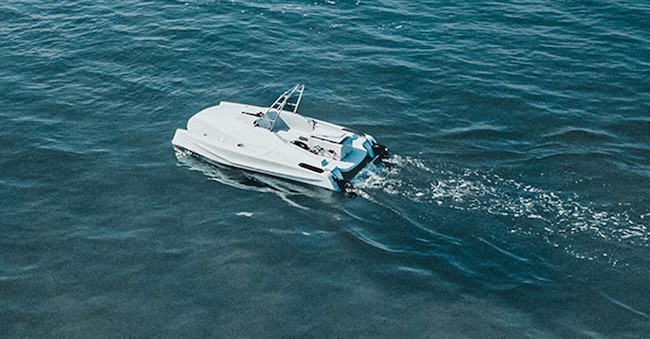
A 5-metre-long, unmanned surface marine drone, the prototype of which is already in operation, and a second vehicle, with similar characteristics and also unmanned, this time 10 metres long, which will be presented in the autumn. This is the debut of Mirai robotics, a start-up with headquarters in Puglia, Italy, whose ambitious project is to create systems equipped with an integrated robotics and artificial intelligence (Ai) technological architecture for managing any type of activity in the seas: civil, industrial, institutional and military; in a perimeter that ranges from autonomous guided vehicles for monitoring, to intelligent systems that can be integrated into existing fleets, to software and data analysis, to govern complex maritime missions.
The company was born from the collaboration of three entrepreneurs with solid international experience: Luciano Belviso, former founder and head of several companies, including Blackshape, specialised in aeronautical design and production; Luca Mascaro, at the forefront of technology and Ai, founder of Sketchin (advanced design company) and former chief innovation officer of Bip (IT consultancy); and Davide Dattoli, founder of Talent garden and angel investor in the tech world.
3.5 million investment round
Mirai was started with a base of the founders' own resources, to which was added what was raised through an initial investment round of EUR 3.5 million, which was led by some Italian venture capitalists, such as Primo Capital, Techshop and 40 Jemz Ventures, with the participation of both Italian and international angel investors. Today, the company has a team, joining the founders, of 15 people, divided between robotic and system engineers, from Italia, Switzerland and Germany.
"The sea,' says Belviso, Mirai's CEO, 'is traditionally a very vulnerable domain, and there is also a systematic shortage of personnel at the moment. Moreover, all EU countries are reconsidering their defence budgets, both to reach the threshold required by NATO and because it has been realised that it is increasingly easy to violate the territoriality of states, even across the sea. With Mirai, we would like to build a new European leadership in the ocean economy, starting from Italia, where the strength of the naval supply chain, ranging from defence to shipbuilding, from offshore to marine infrastructures, represents the ideal industrial base to be integrated with the robotics skills that our team can bring to bear'.
5 and 10 metre hulls
The company is working, Belviso continues, 'on a high-level objective: to develop an autonomous object to which targets can be assigned, such as patrolling a marine area, which the vehicle then does by itself: deciding where to move, avoiding any obstacles and concealing itself when necessary. We have already realised, by entrusting its construction to shipyards working with us, a 5-metre long vehicle, designed for near-shore applications, to be used for surveillance activities. We are also developing a larger one, 10 metres, for persistent irs (intelligence, surveillance and reconnisance, ndr) missions. The objective of these objects is to send reliable images of what is moving both on the surface and underwater, because the vessel, although not submarine, has a series of active sonars, capable of monitoring the bottom'.


