
Vietnam, a platform for production and exports to the world
Italian technologies for manufacturing. In Hanoi, second leg of the roadshow ahead of the 21st Trento Festival of Economics
from our correspondent Marco Masciaga
 Aggiungi Il Sole 24 Ore
ai preferiti su Google
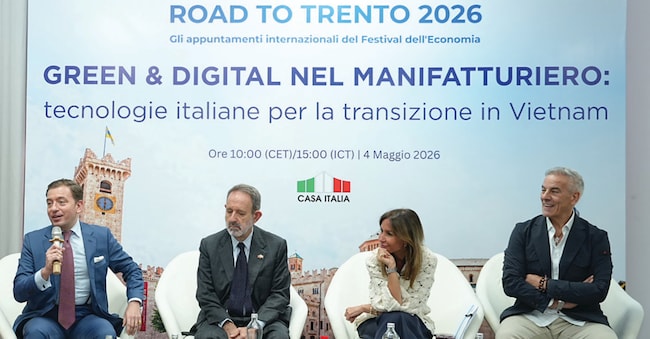
HANOI - Not so much a market to conquer in search of a middle class growing in numbers and ambitions, but above all a country in which to invest with a long-term view, possibly by creating partnerships with local players, with the aim of making it a production platform from which to export to the rest of the world. This is the portrait of Vietnam that emerged yesterday during the second stage of Road to Trento, the roadshow organised by the Il Sole 24 ORE Group in collaboration with main partners Sace and Simest, which anticipates the Festival of Economics scheduled in Trento from 20 to 24 May. The meeting entitled 'Green & Digital in manufacturing: Italian technologies for the transition in Vietnam' was attended by companies, institutions and academics, each with their own point of view on the opportunities and criticalities of a country of 100 million inhabitants that grew by 8 per cent last year.
In a context in which 'volatility is no longer a conjunctural element, but increasingly appears as a structural feature of the global economic system', Italy's ambassador to Hanoi Marco della Seta emphasised the importance of Vietnam, a country that has developed a 'development model based on integration into global value chains and the ability to attract productive investment'. A position shared by the president of the Italian Chamber of Commerce in Vietnam Federico Vasoli, who, despite having witnessed 'the extraordinary transformations that have taken place over the past 20 years', did not refrain from drawing attention to the potential criticalities of the Vietnamese growth model, such as the risks associated with property speculation and over-indebtedness. Nodes that, according to Vasoli, must be a cause for attention by foreign investors, regardless of the economy management skills demonstrated by a leadership that is aware that a model based on cheap labour cannot be sustainable in the long term.
A theme, that of sustainability, was also touched upon by the chief operating officer of the Il Sole 24 Ore Group, Paola Boromei, who identified Vietnam as "one of the contexts in which the transformation into an integrated production hub is most rapid and evident," thanks also to the direction taken "towards digitalisation and energy sustainability. Speaking remotely, Simest's Head of Business Strategies and Sustainable Innovation Marco Cantalamessa emphasised the transition process underway in the company controlled by Cdp "from being a purely financial partner to a strategic partner" of Italian companies, so as to "reduce the level of complexity" with which they have to contend, through "an integrated approach made up of financial instruments, local presence, and support for building long-term industrial partnerships".
The topic of finance for companies was the focus of the speech by Salvatore Banco, of D'Andrea & Partners, a specialist in foreign direct investment in Asia. 'When we talk about industrial transformation in Vietnam,' he explained in connection from Ho Chi Minh City, 'the real limitation is not growth, but the structuring of projects. We observe a paradox of opportunities that do not turn into financed projects because there is a lack of clear governance or reliable data, or there are no sound economic-financial models. In this sense, finance becomes a design tool that must make risks identifiable, measurable and monitorable, distributing them among the various actors'.
One risk facing companies operating in Vietnam is the difficulty in retaining talent in a highly dynamic environment. Madex's country manager in Vietnam Dario Vendrasco explained how the Padua-based garment company has set up a transport system for its employees to enable them to achieve a work-life balance that guarantees more stable and long-lasting relationships and avoids dispersing the wealth of skills transferred over the years. The theme of Vietnam as a production hub was also addressed by Claudio Dordi of Bocconi University, who explained how today the Asian country is 'a decidedly attractive market for production investments, also and above all because of its strong commercial openness. Vietnam has a network of free trade agreements that allow access to international markets with preferential tariff treatment, often close to zero tariffs. In this context, setting up a production base in Vietnam is not only a cost containment choice, but also a strategic decision that affects the company's positioning in global value chains'. A centrality also reiterated by the editor-in-chief of Sole 24 Ore, Fabio Tamburini, in explaining the choice of Hanoi as a stopover for the Festival of Economics: 'We began to love Vietnam when it was a dwarf fighting against the American giant. Today it is a major manufacturing hub, a success story that is destined to last. It reminds us that when the West continues to consider itself the navel of the world, it makes a mistake'.


