
Viktor and Ursula, two approaches to Europe

4' min read
4' min read
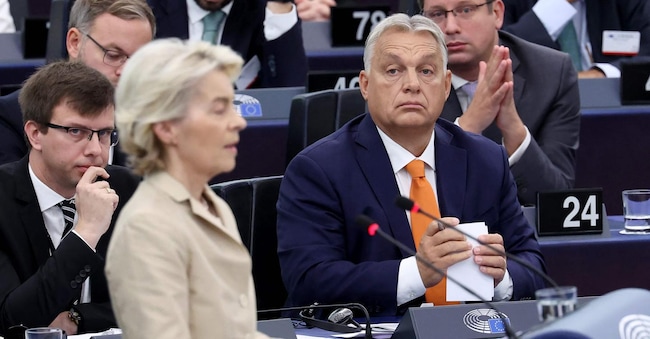
Personality is involved, but above all politics. Last Wednesday, in the European Parliament, Viktor Orbán, President-in-Office of the Council of Ministers of the European Union (EU), and Ursula von der Leyen, President of the European Commission, openly clashed on European politics, making paper of the latter's consensual tradition. Orbán spoke as the leader of the Patriots for Europe (the parliamentary grouping of the nationalist right, which includes Matteo Salvini's Lega and Marine Le Pen's Rassemblement National ) and von der Leyen as the leader of the parliamentary majority. The EU is becoming politicised. What are the implications?
Instead of presenting the programme of the six-month Hungarian presidency, Viktor Orbán spoke like the leader of the opposition, questioning the main choices made by the previous (2019-2024) European Commission led by Ursula von der Leyen.
In the field of foreign policy, he criticised the unequivocal support given to the Ukrainian government committed to defending itself against Russian aggression. For Orbán, that support turned out to be a failure because it was 'poorly planned and even worse implemented'. By refusing to negotiate with Putin, Zelensky has led his country into a blind alley, having to accept Russian territorial claims despite the immense human losses his country has suffered. For Orban, the EU should promote relations of cooperation, not confrontation, with Russia, given the latter's military and economic strength (and geographical location). This is why Hungary opposed the energy embargo against Russia, preserving its 15-year contract with Gazprom. This also applies to the relationship with China, a great power to be kept friendly. Thus, the Hungarian government recently opened its borders to Russian and Belorussian workers, as well as to Chinese security officials. For Orbán, the EU's internal policies have also failed. In particular, the Green Deal policies that 'are stifling' businesses, imposing constraints that will lead to the de-industrialisation of Europe. For Orbán, European competitiveness, as proposed by the Draghi Report, will have to be achieved through both the de-bureaucratisation of regulatory policies and the national decentralisation of industrial policy decisions. Moreover, for him, the EU's migration policy is a prisoner of ideological prejudices, as that policy considers immigrants a resource and not a problem. Hence, his support for offshoring policies, with immigrants placed in hot spots outside the EU where their demands can be examined.
von der Leyen's response did not lack for clarity. On foreign policy, the split with Orbán and the Patriots is clear. 'How is it possible,' von der Leyen said, 'to condemn those who invaded and not those who invaded? It would be like condemning the Hungarians for the Soviet invasion of their country in 1956 or the Czechoslovaks for the Soviet repression in 1968'. For von der Leyen, Putin's Russia is an enemy of peace and stability, a country with imperial ambitions that are incompatible with the principles of international and European law. Thus, the relationship with China, for von der Leyen, must be placed in a context of geostrategic rivalry, not just cooperation. Not least because China does not respect the rules of international trade, subsidising its high-tech companies that are conquering European markets. As far as competitiveness is concerned, von der Leyen argued that it requires greater coordination between member states, not decentralisation of economic choices. And if the Green Deal has to be implemented pragmatically, helping businesses and households in the transition process, nevertheless one cannot think of defending the statu quo in a context of radical change. At the risk of technological dependence on China and America in the coming years. Finally, von der Leyen did not declare herself against offshoring in migration policy, but she was aware of the risks, legal and humanitarian, that they entail.
Viktor Orbán's merit was to openly challenge the majority that supports von der Leyen. His demerit is to offer no alternatives to the policies pursued by the European Commission. Orbán is against supporting Ukraine, but does not say how to achieve an acceptable peace with Russia. He is against the Green Deal, but does not say what to replace it with. He wants a competitive European economy, but then favours a small group of companies connected to him in his country. He criticises the institutions that make the single market work, but then defends the structural funds policy that would be unthinkable without the role of those institutions. Be that as it may, Orbán is verticalising the relationship between parliamentary majority and opposition, reducing the political space for the parliamentary grouping of Giorgia Meloni's European Conservatives. Indeed, the latter are part of the nationalist right but do not share the pro-Russia and anti-European Commission radicalism of Orbán and the Patriots. What will Giorgia Meloni do, will she converge towards the majority or remain in opposition? In a politicised Europe, a choice has to be made.


