
'Viva!', Air and Underworld light up electronics (and the economy) in Valle d'Itria
The festival scheduled from 1 to 4 August has been attracting tourists to Apulia for eight editions. Setting in motion a virtuous mechanism
3' min read
3' min read
The trend is well known: cultural tourism is a winning formula, especially in Italy, where attractions stand out in terms of both quality and quantity. Large metropolises, cities of art and locations with a purely natural profile contribute decisively to the success of an area. But how to root the flow of tourists when the offer becomes incredibly heterogeneous and (in some cases) even artificial? The key word is 'authenticity', a quality that tourists are ready to chase from the four corners of the globe, aware that the discovery of a place passes through the work that the community of reference does to preserve local specificities.
The bet of "Viva!"
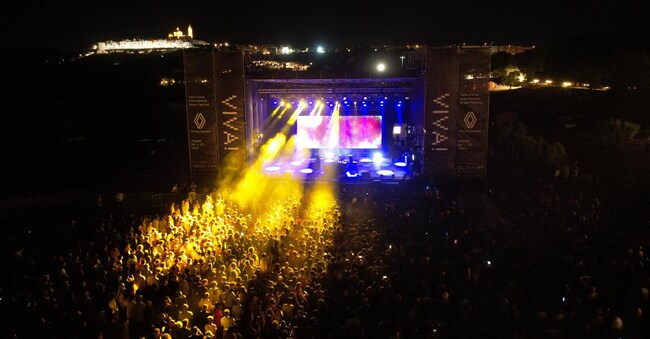
.The organisers of the "Viva! Festival', the event held for eight editions in Locorotondo, the pearl of the Valle d'Itria, and which has now become a cult event for lovers of contemporary electronic music, knows this well. The challenge of "Viva!", in fact, revolves around two apparently divergent guidelines: on the one hand, to create an event with an international slant, able to compete with the most interesting European festivals. On the other, to integrate this particular event into the landscape and socio-cultural fabric of the Itria Valley, a place where tradition and nature coexist in an evidently synergic manner.
Between Air and Underworld
.For this year's edition, to be held from Thursday 1 to Sunday 4 August, the line-up aims to tell the story of our time through the sounds and productions that are changing the profile of contemporary music. Having always been an outpost devoted to innovation and avant-garde music, with two resounding headliners such as Air and Underworld, the "Viva!" has chosen a sound capable of crossing time and space, with two formations that have renewed electronics and paved the way for new sound suggestions. Alongside these names come leading artists of the twenties, including Dardust, Shygirl, The Blaze and Venerus, who will take the stage set up in the splendid Valle d'Itria Arena. This space, totally immersed in nature, is located close to the ancient village of Locorotondo, in the centre of a memorable natural oasis. The proximity between the village and the concert venue will also be reinforced by meetings, debates and side events spread throughout the town.
The vision of the organisers
."As entrepreneurs in the music world, it is essential for us to have an eye on what is happening internationally," explains Giuseppe Conte of the Viva! festival management. "However, we are equally aware of the uniqueness of the territory in which we live and we consider these places to be fundamental elements of the festival's identity. When we plan a new edition, we do so by imagining possible interactions with the natural and urban spaces in which we live, which become a reason for discovery and participation not only for the spectators, but also for the artists'.
The Valle d'Itria (and Locorotondo in particular) has in fact become one of the world's most attractive tourist locations, not only because it is less than 20 kilometres from the venue where the last G7 summit was held, but above all because it preserves a fundamental imprinting with local customs and 'Meridian thought', which laid the foundations of a new, proudly southern culture. Also supporting this line of thought is Antonio Convertini, president of the Banca di Credito Cooperativo di Locorotondo, which has decided to believe in and invest in the event. "We have decided to stand by the Viva! Festival because it is part of the great history of the Itria Valley, with implications that are not only 'emotional' but also economic, social, ritual, anthropological, representing a true community in relation and always on the move. It is therefore not only an economic return for all the structures in the area, but above all the benefits that this cultural project determines in measurable terms, with even ethical paradigms'.

