Cycling

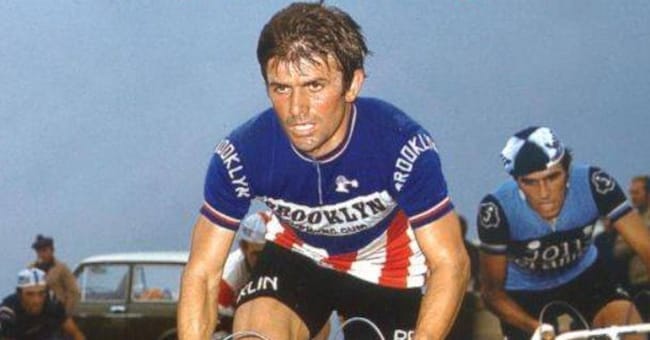
Vladimiro Panizza, the little great champion who challenged Bernard Hinault

Paolo Costa's book recounts both the competitive exploits of the Lombard rider and a historical period already launched towards modernity but with that post-war peasant naivety still alive
by Dario Ceccarelli

5' min read

5' min read

In these days of prolonged celebrations for the 80th birthday of Eddy Merckx, the strongest ever while waiting for Tadej Pogacar to dethrone him sooner or later (but it will be hard...), we like to remember a little great protagonist of cycling in the 1970s-1980s, a very effervescent period for this sport which, as a popular following, still held its own against football, the big brother that in a few years would devour the general attention.

Those were the years of Merckx and Gimondi, of Hinault and Battaglin, of Basso and Bitossi, of Baronchelli and Contini, of Moser and Saronni. A dense list that should be stretched to infinity. Because in that cycling, not only the most popular champions stood out, but also less successful but equally important figures who made that season unforgettable and unrepeatable.

Loading...

Some were gregarians, and they proudly reiterated this, not ashamed of that definition, which now sounds almost offensive. Others, on the other hand, were riders with respectable palmarès who, from time to time, took the pleasure of leaving the colonels of the peloton behind when they got distracted.

These brave NCOs may not have won the Giro or the Tour, but they did manage to win a few stages and a few good placings in the rankings, and they thrilled their fans, especially if, like our Vladimiro Panizza, they came from small villages that, although part of the cycling topography, had never managed to cross the border of great fame.

Well, Vladimiro Panizza, who was born on 5 June 1945 in Fagnano Olona in the province of Varese and died on 21 June 2002 in Cassano Magnano, embodies that prototype of a runner at his best. A generous runner, all heart and courage, well described by Paolo Costa ('Miro Panizza Campione tra i campioni', Macchione Editore, 20 euro).

A child of the post-war period

A beautiful book, with many splendid photographs, where, in addition to his competitive exploits, the frame of time also emerges and how Panizza's career matured in a historical period already launched towards modernity but with that post-war peasant naivety still alive. Of that Italy that when it says 'Good morning, it really means 'good morning', as one of the protagonists of 'Miracle in Milan', the famous film by Vittorio de Sica, released a few years after the end of the conflict, points out.

And Vladimir Panizza, known as Miro to avoid references to that other Vladimir (Lenin) who changed Russian history, was indeed a child of the post-war period, having been born in June '45 when, clearing away the rubble, a humiliated and devastated country was struggling to restart.

The last of four children, with his father Angelo, a communist partisan, who died in 1948, little Panizza was a muddy child who ran between the chicken coop and the vegetable garden to escape his mother Maria's reproaches. Miro was fast but light-footed, especially when, playing football at the oratory, he always ended up on the ground. He distinguished himself, however, when he was hired as an errand boy by a goldsmith in Oggiona, another village in the Varese area, a fertile land of champions such as Luigi Ganna, Alfredo Binda, Claudio Chiappucci, Ivan Basso and Stefano Garzelli.

From delivery boy, Miro became a 'driver ante litteram' when it was still the Italians who pedalled and distributed parcels. Panizza, juggling farmyards and farmsteads on a bicycle heavier than himself, realised that pedalling was his destiny, a destiny that materialised at the age of 21 when he was signed by a professional team, Vittadello, a company active in the textile industry. It was an ambitious team, with captains such as Michele Dancelli and Aldo Moser, leading figures in that 1967 era in which even more acclaimed champions such as Gimondi, Adorni, Motta and Zilioli excelled.

The long competitive career

.

As small in stature as Panizza was (1 metre 60 cm and 50 kilos), so long was his competitive career, which ended at the age of 40 in 1985 at Ariostea with Silvano Contini as captain.

An agile and tenacious climber, nicknamed 'Rock' because of his endurance, Panizza often managed to go faster than his captains, making them nervous because, when his legs spun, he could no longer hear reason. But then, because he was a pure soul, they ended up forgiving him his exuberances, which nevertheless led him to win a Milan-Turin, two stages in the Giro d'Italia and one in the Tour de France.

Panizza has toured so many teams. His magic moment was in 1980 at Beppe Saronni's Gis, pink jersey in 1979. Miro, who was already 35 years old, was ordered by his captain to mark that Bernard Hinault, who was an unbridled fury in the mountains. Panizza stuck to him and never let go, responding sprint after sprint. An extraordinary tenacity that impressed Hinault, who admired the courage of the young Panizza who, in Roccaraso, also managed to conquer the pink jersey by holding on to it until the Dolomites, after dedicating it to his wife Mariarosa and son Massimiliano.

Buoyed by the cheers of the whole of Italy, Panizza for a week is the protagonist of a beautiful fairy tale, the outcome of which, however, everyone knows. Too strong, too powerful Hinault, to be beaten by the Lombard who, in the end, after the Stelvio, had to give in, coming in second over five minutes behind the Frenchman. Having evaporated the dream, Miro's feat will, however, remain in the collective memory.

A gruff that likes it

I like that straightforward little guy with the sunburnt face, who even on television, in front of the microphone of the unforgettable Adriano De Zan, doesn't mince his words. Especially when there is an injustice or something that goes against the riders' interests. A gruff do-gooder, protective of the younger riders, who in 1984 organised the protest at the Marconia di Pisticci stage, when they all fell like skittles because of a poorly lit tunnel.

Torriani, the great patron of the Giro, did not listen to the reasons of the riders and the good Miro went on a rampage, siding against 'the masters of steam', a colourful expression used by Gino Sala, the unforgettable correspondent of 'l'Unità' in those years.

But apart from the vanished dreams, and some inevitable regrets, such as that of not having beaten Merckx in the Tre Cime di Lavaredo stage (1967), Panizza will be remembered for his 18 participations in the Giro d'Italia, finishing in the top ten nine times.

A record that Miro would still be proud of today. In 25 years in the saddle he travelled over 700,000 kilometres. Almost as far as from the Earth to the Moon. He died early, too early, Panizza: at just 52 years of age, betrayed by the very heart that, in the mountains, had dared to challenge even the legendary Bernard Hinault.

Paolo Costa

"MIRO PANIZZA. Champion among champions".

Macchione Publisher, euro 20

Copyright reserved ©

Brand connect

Loading...

Newsletter

Notizie e approfondimenti sugli avvenimenti politici, economici e finanziari.

Iscriviti

Tutto mercato WEB