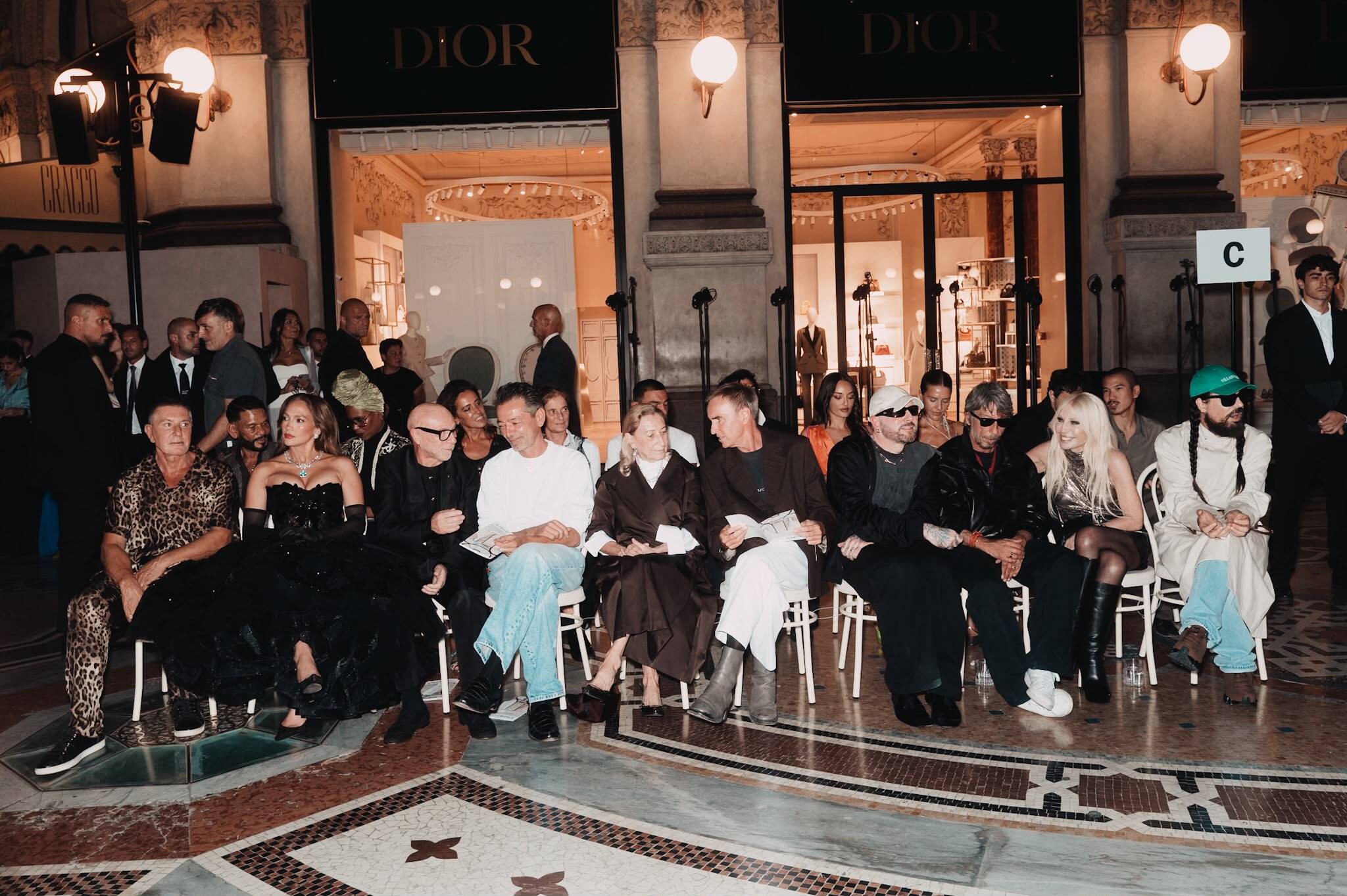
Vogue World in Milan: reflections and concerns
A 45-minute show in the Galleria Vittorio Emanuele, featuring a mix of fashion, dance, music and (supposedly) cultural storytelling

Key points
‘The human body cannot contain both alcohol and anti-Semitism at the same time. All it takes is a little alcohol to start driving the anti-Semite out.” Let us begin with these words by Stanisław Jerzy Lec, a Polish writer and poet who lived from 1909 to 1966, as we write about Vogue World: Milan, an event organised by the global Vogue network and its publisher Condé Nast, which took place in the Galleria Vittorio Emanuele from 8.02 pm to 8.47 pm on Tuesday 22 September: A 45-minute show, streamed live around the world, amidst hours of disruption for those who needed to pass through Corso Vittorio Emanuele and Piazza del Duomo, with the Red Line metro station closed from the afternoon until the end of the event.
Signs of a decline in mental faculties
But let us return to Lec: he was interned in a concentration camp in Germany, where he remained until July 1943, when mass executions took place in the camp. Having escaped by disguising himself in a German uniform, he managed to reach Warsaw, where he joined the local partisan movement. At the end of the war, he resumed his career as a writer, interrupted only by a brief spell as a cultural attaché at the Polish embassy in Vienna. Lec’s words help to explain why, in this writer’s view, Anna Wintour – the driving force behind last night’s event and previous editions of Vogue World (in New York, London, Paris and Los Angeles) – has lost her clarity of thought. To this clarity of thought one might add considerations regarding the capacity for self-criticism, but when it comes to Anna Wintour, it is pointless. On 3 November she will turn 77; she was editor-in-chief of American Vogue from 1988 to 2025, when she handed over the role to Chloé Malle, who until then had been responsible solely for the magazine’s digital operations. A decision that was contested both for what many saw as blatant nepotism (Chloé Malle is the daughter of Candice Bergen and Louis Malle) and, perhaps more seriously, for the young journalist’s lack of ‘clout’. It was a decision that seemed designed specifically to ensure that Anna Wintour’s figure was not overshadowed even for a moment; following the ‘handover’, she became global chief content officer of Condé Nast and of all editions of Vogue, including the American and Italian editions. Vogue World: Milan was presented by Wintour and Francesca Ragazzi, formally editor-in-chief of *Vogue Italia*, as an exceptional event that would embrace many aspects of creativity – Italian and beyond – and promote the craftsmanship inherent in our country’s fashion industry. To this end, Wintour and Condé Nast chose the opening day of Milan Women’s Fashion Week, during which Prada and Diesel, amongst others, held their shows. We shall return to this choice of date, as we consider it the first sign of a lack of clear thinking.
The precedent set by the Galliano exhibition at the Met
And let us return once more to Lec’s words, for they seem to have been written to describe what happened to John Galliano, at the time creative director of Dior, which, alongside Chanel, is a symbol of the history of French and global women’s fashion. LVMH had chosen Galliano in 1996, thereby entrusting him with the task of marking the 50th anniversary of the House of Dior with his first fashion show in January 1997. On 25 February 2011, the idyll between Galliano, Dior and LVMH came to an abrupt end: the designer, born in the United Kingdom in 1960, was arrested whilst intoxicated in Paris for violent behaviour towards a Jewish couple and for making anti-Semitic insults. On 2 March 2011, Dior initiated dismissal proceedings, citing, amongst other things, a video circulating online in which the designer, visibly drunk, praised Adolf Hitler. Galliano, who at the time admitted to being addicted to alcohol, barbiturates and other opioid drugs; he was tried and ordered to pay compensation, and was required to undertake a ‘re-education’ programme on the Holocaust and the history of the persecution of the Jews. In recent years, however, testimonies have emerged from people who have heard Galliano return to the same themes, using a tone and words not dissimilar to those uttered in Paris 15 years ago. What is Anna Wintour doing? On 3 August, she announced that the next exhibition at the Costume Institute of the Metropolitan Museum of Art, accompanied by the Met Gala – a major fundraising event for the museum – would be dedicated to John Galliano. The exhibition, entitled ‘John Galliano: Horizons’, was due to open in May 2027, preceded by the Met Gala, to celebrate the designer’s forty-year career (from Central Saint Martins in London to Givenchy, Dior and Maison Margiela, where he served as creative director from 2014 to 2024), who is universally recognised as a genius in his role as a designer. Announcing the exhibition, Wintour wrote on vogue.com: “There is no one more deserving of an exhibition of this scale than John Galliano. He’s a great designer and his career isn’t defined by a single moment – something he will have to live with for the rest of his life. The exhibition will not shy away from any of the darkness in John’s past. It is part of what has shaped him. The show will encompass the full arc of his career and grapple with it all.” According to some accounts, in a moment – this time, admittedly – of clarity, Wintour and Andrew Bolton, curator of the Costume Institute, are said to have met last May with a group of New York rabbis and leading figures from New York’s Jewish community. Either they failed to understand one another, or Wintour and Bolton did not want to understand. How could Anna Wintour have thought that in the country – the United States – with the largest Jewish population outside Israel, and then in the city – New York – with one of the largest Jewish communities, and finally in a private museum – the Met – which counts some of New York’s wealthiest Jewish philanthropists amongst its donors – that an anti-Semite could be enshrined in the history of fashion remains, to this writer, a mystery. Hence the simplest explanation, in the spirit of Occam’s razor: Anna Wintour has lost her judgement or, perhaps worse, does not understand much about anti-Semitism, Judaism or Jewish communities. Let us remember: we are talking about 2011. The Middle East was certainly not at peace, but it is unthinkable to use the arguments of many of today’s anti-Semites, namely the war crimes committed by the Netanyahu government in the Gaza Strip and the West Bank.
Deafening silence
Just over a month has passed since the announcement in early August, and the exhibition – following an official statement from the Met and a post by Galliano on social media – has been cancelled. The designer has issued yet another painful admission of fault. Anna Wintour and Condé Nast remain silent. Too busy planning Vogue World: Milan? Perhaps. But many are also waiting to find out which exhibition will fill the void left by Galliano. On this point too, Anna Wintour and Andrew Bolton are maintaining a deafening silence. And so we finally come to Milan: as we have said, the date was chosen and then imposed, apparently after consulting only the mayor and the Milan city council, which granted the necessary – and entirely unprecedented – permits to use the historic Galleria space and to close the surrounding area to the public, offering its assistance in managing the event’s logistics (I’ve never seen so many traffic wardens as there were yesterday in the Galleria and the surrounding area).
Context and its representation
The global fashion industry is going through a very difficult period (see *Il Sole 24 Ore* of 18, 22 and 23 September), linked to economic, financial and geopolitical factors, as well as cultural and social ones. Italia is the only country in the world to have an intact supply chain for mid-to-high-end and high-end textiles, fashion and accessories, to the extent that French luxury goods are essentially produced here, from Chanel to the fashion houses of the aforementioned LVMH. For Italia, the textile, fashion and accessories sector is a driving force for the economy (the sector is worth around 100 billion euros) and for the country’s image. There have been countless appeals and initiatives to support the most vulnerable parts of the sector (essentially all of them apart from the major brands) and to ensure that manufacturing, artisanal and creative know-how is not lost. The latter, however, is perhaps inexhaustible; it is what the world has always envied about Italia. As for manufacturing and artisan workshops, however, the debate remains open, and the figures tell a story of closures among micro-enterprises, SMEs and even medium-sized firms, as well as a crisis of purpose. That said, an event that promotes all this is most welcome; one that presents the world with such a fascinating and positive picture of Italia, blending fashion with culture, music and history. This is how ‘Vogue World: Milan’ was presented. But let us be realistic: did Anna Wintour and everyone involved in the event really think they could achieve this in just 45 minutes? The first absurdity, from which the rest perhaps inevitably follows: with a highly questionable soundtrack (the most famous tracks were by Adriano Celentano and Umberto Tozzi), equally meaningless theatrical interludes and the inevitable touch of Bolle’s ‘parsley’, those in the gallery saw a few – we repeat, a few – Italian fashion brands take to the catwalk, but the choice of outfits, those wearing them and the little poses which the director – we assume – forced the models (some extremely famous, others with entirely different backgrounds, particularly sports personalities), made the whole thing seem caricatured, if not farcical.