
Volkswagen Golf GTI Edition 50: how does it drive and how much does this commemorative model cost?
Created to mark the 50th anniversary of the GTI badge, it is the most powerful Golf ever

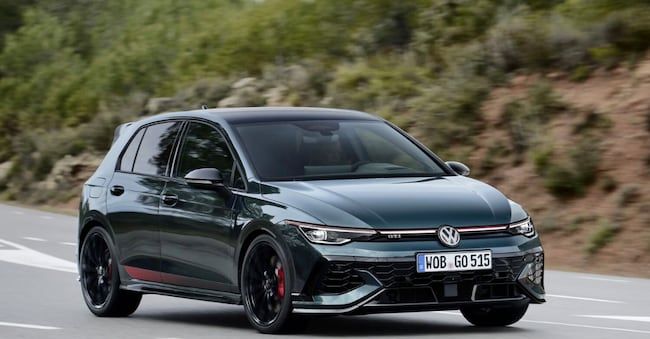
Fifty years on from the first Golf GTI in 1976, Volkswagen is launching the Edition 50. It is not just a commemorative model, but the most powerful version ever derived from the Wolfsburg-built sports hatchback. The 2.0-litre four-cylinder turbo engine delivers 325 cavalli, the suspension has been modified, and the standard specification includes DCC electronic suspension, Matrix LED headlights and 19-inch alloy wheels.
Golf GTI Edition 50: engine and performance
Under the bonnet lies the 2.0 TSI from the EA888 family, an evolution of the engine used in the GTI Clubsport. Modifications to the engine have increased power from 300 to 325 cavalli and torque from 400 to 420 Nm. Compared with the standard Golf GTI, this represents an increase of 60 cavalli and 50 Nm. Maximum torque is available between 2,000 and 5,400 rpm and is transmitted solely to the front wheels via the seven-speed DSG dual-clutch gearbox. Neither a manual gearbox nor all-wheel drive is available. Traction control is managed by the electronically controlled front differential, coordinated with the stability control system and the Vehicle Dynamics Manager. It accelerates from 0 to 100 km/h in 5.3 seconds, compared with 5.6 seconds for the Clubsport and 5.9 seconds for the 265-cavalli GTI. The top speed is electronically limited to 270 km/h. Combined fuel consumption is between 7.6 and 7.9 litres per 100 kilometres, with CO₂ emissions of between 173 and 179 grams per kilometre.
How does it handle on the road
The test took place exclusively on public roads, with no track sessions. The test car was fitted with the GTI Performance Pack, the most performance-oriented specification available for the Edition 50. The first thing that stands out is the front-wheel drive system’s ability to handle the 325 cavalli without making the car feel twitchy. The steering is quick and precise during the initial phase of corner entry, and provides sufficient feedback as the load on the front wheels increases. The electronic differential intervenes mainly when exiting the tightest corners, transferring torque to the wheel with the most grip and limiting understeer. When accelerating decisively from low gears, there is some feedback through the steering wheel – inevitable on a front-wheel-drive car with 420 Nm – but this remains mild. The Golf does not require constant corrections and maintains a clean line even when you lift off the throttle early. The engine’s power delivery is not abrupt. Power builds rapidly from around 2,000 rpm and remains constant across the mid-range. Rather than a power peak, you feel the continuous availability of torque.
DCC settings and Special mode
The Edition 50 is the only GTI in the range to offer adaptive DCC dampers as standard. The system adjusts each wheel individually and allows you to modify the suspension response via the Eco, Comfort, Sport, Individual and Special programmes. On the road, Comfort mode makes the car comfortable to drive even on uneven surfaces. The 19-inch wheels and low-profile tyres remain, but the suspension filters out bumps without transmitting jarring impacts into the cabin. Switching to Sport mode, the body is controlled more firmly and body roll is reduced during direction changes. Special mode has been developed based on the characteristics of the Nürburgring Nordschleife. However, it does not correspond to the stiffest possible setting. The German circuit alternates between fast corners, compressions and uneven surfaces, so the set-up retains some of its shock-absorbing capacity whilst simultaneously stiffening the steering, throttle response and gearbox control.
What’s included in the GTI Performance Pack

