PREVIEWS

Volkswagen ID.Tiguan: we’ve seen it in the flesh. What’s the ID.4’s successor electric SUV like?

The Volkswagen ID.4 is getting a new name, design and concept. From 2027, the ID.Tiguan will be launched, intended to complement rather than replace the petrol-powered Tiguan.

4' min read

Translated by AI
Versione italiana

4' min read

Translated by AI
Versione italiana

The Volkswagen Tiguan is also going electric, adopting the ‘ID.’ suffix. Built on the MEB+ platform and manufactured at the Emden plant in Germany, it differs from the ID.4 in terms of its proportions, front end and interior, whilst the range features 58 and 77 kWh batteries, power outputs ranging from 190 to 299 cavalli and a claimed range of up to 600 kilometres. Its public debut is scheduled for the upcoming Paris Motor Show, whilst orders will open from mid-October with list prices starting at around 45,000 euros.

Volkswagen ID.Tiguan, tutte le foto del suv elettrico erede di ID.4

Photogallery13 foto

Volkswagen ID.Tiguan: dimensions and styling

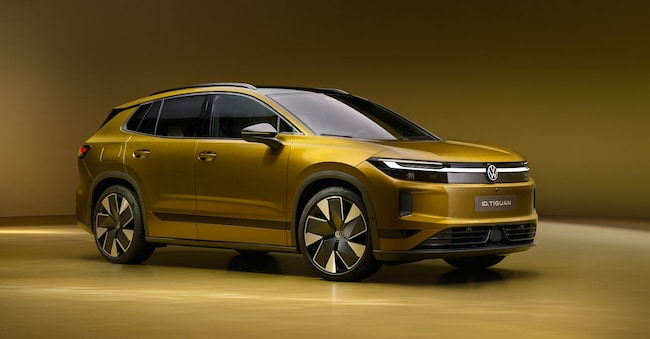
The new ID.Tiguan is 4.62 metres long, 1.86 metres wide and 1.62 metres high, with a wheelbase of 2.77 metres. Its proportions are closer to those of a traditional SUV than those of the ID.4. Seen in person, what stands out most is how the bodywork moves away from the more rounded lines of the previous model and adopts more taut surfaces, whilst retaining a design distinct from the Tiguan with internal combustion and hybrid engines built on the MQB Evo platform.

Loading...

The front end is one of the areas that has changed the most. The upper section is almost completely enclosed, a design made possible by the reduced cooling requirements of the electric powertrain. The headlamps are set within a transparent horizontal strip that runs across the front end and, on the Style and R-Line trim levels, incorporates the illuminated Volkswagen logo. Further down, there is an air intake designed to cool the battery and the air-conditioning system. The drag coefficient has been reduced from 0.27 on the ID.4 to 0.26.

On the side, the roofline and rear pillars are painted in the same colour as the bodywork, whilst a horizontal crease runs along the body from front to rear. The traditional stirrup-style door handles make a return. The wheel arches can accommodate 19-, 20- or 21-inch wheels. The R-Line comes with 20-inch wheels as standard and features gloss black finishes on certain bodywork elements.

At the rear, the light clusters are linked by an LED strip. On versions fitted with IQ.Light, they feature a three-dimensional design and include an illuminated Volkswagen logo. The ‘ID.Tiguan’ lettering appears in the centre of the rear, whilst the R-Line features a dedicated bumper.

Volkswagen ID.Tiguan: what’s the interior like?

Volkswagen has thoroughly revamped the interior and, in particular, the controls, adopting the style already seen on the ID.Polo. Physical buttons have finally returned to the steering wheel, the door panels and the climate control system, replacing the touch controls used on the previous ID. range. The climate control system features a row of buttons on the centre console, the volume is adjusted via a dial, and the steering wheel once again features traditional buttons.

The dashboard features three displays. There is a 10-inch display in front of the driver, a 15-inch infotainment screen in the centre, and – for the first time in a European Volkswagen – a 12-inch display can be added in front of the front passenger. The latter uses a filter that prevents the driver from seeing the content displayed and can be used for infotainment and games. An augmented reality head-up display is also available.

A function allows you to display the Golf IV graphics on the instrument cluster. On the central display, you can choose from themes inspired by the Golf I, Golf II Country, Golf IV, Tiguan I, Race Touareg and Beetle. Only the appearance of the home screen changes; the infotainment functions remain the same.

The centre console features two inductive charging pads for smartphones and several storage compartments. The 2.77-metre wheelbase – 84 millimetres longer than that of the Tiguan with petrol and hybrid engines – provides more legroom for rear passengers. The boot offers 534 litres of space, which increases to 1,577 litres when loaded to the roof. A second compartment has also been created under the bonnet, which is useful for storing the charging cable.

Volkswagen ID.Tiguan: engines and batteries

The range starts with the ID.Tiguan, featuring a 58 kWh net Lfp battery and a 140 kW rear motor, equivalent to 190 cavalli. This configuration will be available on the Trend, Life and Style trim levels and will have a provisional WLTP range of up to 450 kilometres. It accelerates from 0 to 100 km/h in 8.5 seconds and has a top speed limited to 160 km/h.

Loading...

With the 77 kWh net NMC battery, power output rises to 210 kW, equivalent to 286 cavalli, still with rear-wheel drive. The claimed range is 600 kilometres; 0–100 km/h takes 6.6 seconds and the top speed is 180 km/h. This powertrain will be available on the Life and Style trim levels and will come as standard on the R-Line.

The most powerful version is the ID.Tiguan 4Motion with all-wheel drive and a 77 kWh battery. It has an output of 220 kW, equivalent to 299 cavalli. It accelerates from 0 to 100 km/h in 6.3 seconds, reaches a top speed of 180 km/h and has an estimated WLTP range of 560 kilometres. Its towing capacity is 2,000 kg, compared with 1,800 kg for the 190 cavalli version.

Volkswagen ID.Tiguan: range and charging

All versions support up to 11 kW of AC charging. For DC charging, the ID.Tiguan with a 58 kWh battery supports up to 105 kW and charges from 10 per cent to 80 per cent in around 26 minutes. The 77 kWh versions, on the other hand, reach 165 kW and take around 29 minutes for the same charge. Range figures are still provisional and range from 450 kilometres for the 190 cavalli version to 600 kilometres for the 286 cavalli version, whilst the 4Motion version has a range of 560 kilometres.

The new ID.Tiguan will be unveiled to the general public at the upcoming Paris Motor Show and will be available to order from mid-October, with list prices starting at around 45,000 euros. It will go on sale in 2027 in the Trend, Life, Style and R-Line trim levels, joining the range alongside the Tiguan with internal combustion and hybrid engines and replacing the ID.4 and ID.5.

Copyright reserved ©
Loading...

Brand connect

Loading...

Newsletter

Notizie e approfondimenti sugli avvenimenti politici, economici e finanziari.

Iscriviti