Volkswagen ID.3 Neo, restyling changes interior and increases range
Up to 630 kilometres on one charge, revised styling and new dashboard

Key points
Volkswagen ID.3 gets an update with its mid-career restyling and does so in a profound way, starting with the exterior and ending with a completely new dashboard that forgets the criticism of the past. New engines also arrive, now more efficient, mounted on the rear-wheel-drive Meb+ platform.
Volkswagen ID.Neo, size and style
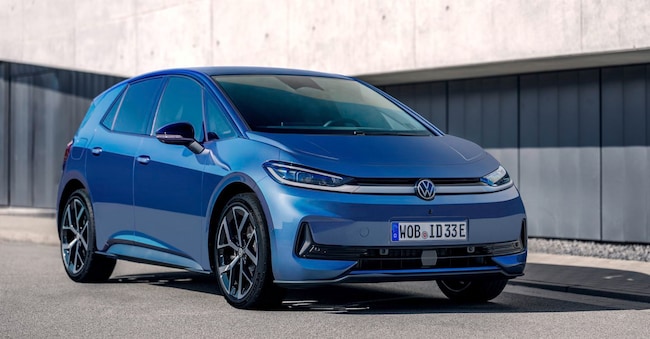
The ID.3 Neo changes from the past with a new front-end design divided into three horizontal levels. In the upper third level, the newly designed LED headlights stand out. They are narrower and connected by a wide crossbar with a glass surface, which, depending on the equipment, is fully illuminated in the lower half. In this case, the logo integrated in the centre is also illuminated from now on. The headlights themselves are bordered towards the top by thin LED strips. Unlike the previous model, the air intakes of Volkswagen's drive and cooling system are extended to the sides of the bumper. The Acc radar sensor is integrated in this part. Farewell also to the black roof, creating a more dynamic line than before. In terms of dimensions, they remain similar to the past with a length of 4,287 mm, a width of 1,809 mm, a height of 1,554 mm and a wheelbase of 2,764 mm. Turning to load capacity, a boot volume of 385 litres opens behind the rear sofa, which can be divided and folded asymmetrically. By folding down the rear seatbacks, the maximum volume of the luggage compartment, in this case 1,601 mm long, increases to 1,267 litres.
Volkswagen ID.3 Neo interior
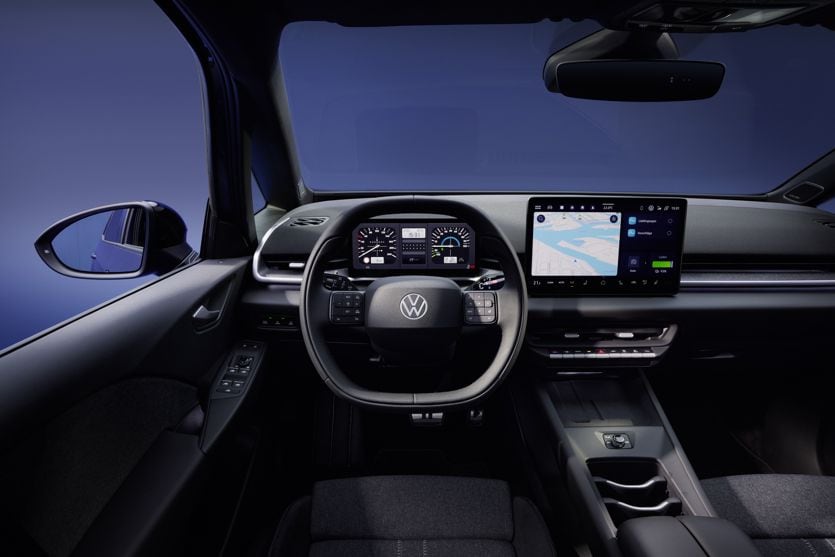
Goodbye to the touch interior of the past, criticised for the lack of physical buttons but above all for a perceived quality level not up to the standard of the Volkswagen brand. Now the ID.3 Neo brings to the road what was anticipated by the ID.Polo, starting with the multifunction steering wheel with physical buttons. The new rectangular and larger Digital Cockpit and the new infotainment display are arranged on a single axis. The 10.25-inch Digital Cockpit features high-resolution graphics. Unlike the smaller digital instruments of the previous model, it also offers several graphic 'views', including an integration of the navigation system's map display. The Innovision infotainment system was also developed and redesigned from scratch. It replaces the previous Discover system and, as with the previous version, will be launched in three levels of functions. In the new-generation software of the ID.3 Neo, the Vw Connect package is provided free of charge for ten years from first delivery. In future, it will include numerous functions that were previously part of the paid-for Vw Connect Plus option, including the Ida online voice assistant, navigation services, a digital key, various charging services and various remote functions. Integrated in the centre console, in a separate position in a bar with practical physical buttons, are the key climate control functions (temperature control, fan, climate control on/off, automatic climate control mode, air recirculation, windscreen defrosting, rear window defrosting) and, in the centre, the emergency flashing switch. A new audio knob is integrated between the smartphone compartment and the cupholders, allowing the track and broadcaster to be changed via the Track function.
New ID.3 New motorisation
The ID.3 Neo is one of the first Volkswagens based on the latest evolutionary stage of the Meb+ modular electric platform. Unlike the front-wheel drive models ID. Polo and ID. Cross models, the rear-wheel-drive variant of the MEB+ platform is used in the ID.3 Neo, which is better suited to the ID.3 Neo's tendentially higher power and larger battery pack. The propulsion system was developed from scratch and is called App350, which replaces the previous App310 powertrain and provides power up to 170 kW. The only exception is the future top-of-the-range sports model, which will be equipped with its own propulsion system, the App550. In general, APP stands for Axial Parallel Position, an axial parallel arrangement of the permanently excited synchronous motor, while the number 350 (310 and 550) indicates the maximum drive torque in newton metres.
Volkswagen ID.3 Neo autonomy
Initially, the ID.3 Neo will be available in three equipment lines (Trend, Life and Style) and three power levels, as well as with three different battery sizes. The three electric motors develop 170 horsepower, 190 horsepower and 231 horsepower respectively. The 125 kW version is combined with a battery with a capacity of 50 kWh (net) and is the standard configuration of the ID.3 Neo Trend. The ID.3 Neo Life and ID.3 Neo Style can also be optionally equipped with a 58 kWh (net) and 140 kW battery, as well as a 79 kWh (net) and 170 kW battery. The 50 and 58 kWh batteries can be recharged at a high and constant rate at DC fast-charging stations with a maximum output of 105 kW, while the 79 kWh version reaches 183 kW. In terms of range, the ID.3 Neo will cover around 417 km with a 50 kWh battery, around 494 km with a 58 kWh battery and around 630 km with 79 kWh. Depending on the battery version, with DC charging it is possible to go from 10 to 80 per cent in 26 or 29 minutes. Consumption not yet declared pending final type approval.