
Volkswagen ID.Cross: the launch – everything you need to know about the compact electric SUV
A range of over 430 km, up to 211 cavalli of power and a price of under 30,000 euros

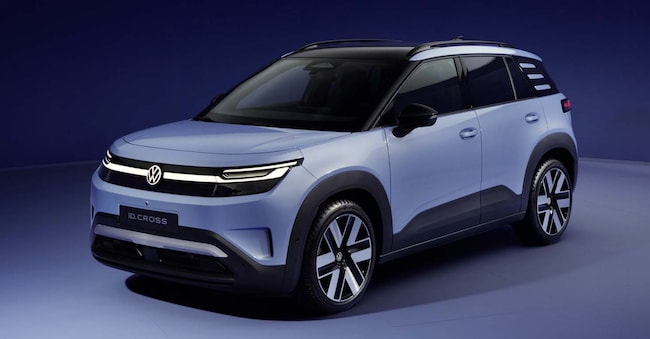
Volkswagen’s first compact electric SUV is now a reality. It’s called the ID.Cross, will hit the roads between the end of this year and early 2027, and is built on the MEB+ platform shared with the Škoda Epiq, Cupra Raval and Volkswagen ID. Polo. Featuring a design that marks a departure from the styling of the ID. range seen to date, it will be available with three power output options, two different battery packs and a range of up to 436 kilometres. Expected to be available in the Trend, Life and Style trim levels, the ID.Cross will have a starting price of less than 30,000 euros.
VW Id.Cross: dimensions and style
The Id.Cross measures 4,153 mm in length, 1,794 mm in width and 1,581 mm in height. The wheelbase is 2,601 mm. The ground clearance is 140 mm and the wheel rims will range from 17 to 20 inches. The bodywork follows Volkswagen’s newly conceived ‘Pure Positive’ design, which combines a style that is less radical than previous ID models but, above all, reassuring and with greater similarities to petrol and diesel cars. In other words? Goodbye to electric cars that bear no resemblance to internal combustion engine vehicles. The ID.Polo sets the example. The front end is characterised by an extended light strip; the pronounced wheel arches stand out on the flanks; and the rear features striking illuminated graphics. The lighting details are even more striking if the specification includes IQ.Light Matrix LED headlights and 3D LED rear light clusters with LED crossbars and illuminated VW logos.
Volkswagen ID.Cross interior
On getting in, the first impression was that of stepping into a “Volkswagen”, both in terms of the materials used and design choices such as the return to physical buttons. Gone are the ‘Tesla-style’ solutions, as evidenced by the many buttons on the door panel, steering wheel and centre console. The dashboard layout is horizontal. The digital instrument cluster and the central display are positioned on the same visual plane. The Digital Cockpit measures 10.25 inches, whilst the infotainment touchscreen measures 12.9 inches. Among the features on offer is a ‘retro’ instrument cluster display, with the speedometer on the left and the power gauge on the right. Behind the steering wheel are the gear lever and the handbrake lever, whilst the centre console retains physical controls for the climate control system, including temperature, fan speed, air conditioning activation, recirculation, windscreen defrost and heated rear window. In the lower section, there is a smartphone compartment with wireless charging (depending on the trim level), two cup holders and an armrest with a storage compartment. There is also a dedicated audio control knob. Standard equipment includes dual-zone automatic climate control, a rear-view camera, adaptive cruise control, IQ.Light matrix LED headlights, Keyless Access and Id.Light extended to the front doors, fitted as standard from the Style trim level upwards. Optional extras include 12-way electrically adjustable front seats with a massage function and memory setting for the driver’s side, as well as a 740 x 905 mm panoramic sunroof. The audio system comprises a 425-watt Harman Kardon system with ten speakers, including a centre speaker and a subwoofer in the boot. Interior space has been improved, with the boot offering 475 litres – 20 litres more than the T-Cross. Under the bonnet, there is a 22-litre ‘frunk’ – a first for an ID. model – designed to hold the charging cable and small items.
Meb+ front-wheel-drive platform
The technical basis is the MEB+, an evolution of the group’s modular platform for electric vehicles. The platform is now front-wheel drive, a solution the brand had not adopted on its dedicated electric models since the days of the e-up! and e-Golf. The motor is called the APP290. The designation indicates its parallel arrangement to the axle and its maximum torque of 290 Nm. The system uses a single-speed gearbox and a newly designed, in-house developed pulse inverter, which manages power delivery, torque and energy recovery, and converts the battery’s direct current into alternating current for the electric motor. The AC and DC charging sockets are located on the front right-hand side. Components integrated into the front of the vehicle also include the battery charger and the air conditioning’s electric compressor. The ID.Cross features a MacPherson strut suspension at the front and an interlinked rear axle. The braking system is known as ‘One Box’ and uses disc brakes on both axles. ADAS features include Connected Travel Assist utilising swarm data, responses to traffic lights and stop signs within the system’s limits, and the One-Pedal-Driving function.
Powertrains and batteries
The range comprises three power levels. With the 37 kWh net battery, two versions are available: 116 and 135 cavalli. With the 52 kWh net battery, the power output rises to 211 cavalli. The top speed is 150 km/h for the 116 and 135 cavalli versions and 160 km/h for the 211 cavalli version. The Trend trim combines 116 cavalli with the 37 kWh battery. The Life and Style trims start at 135 cavalli with the same battery, whilst the 211 cavalli motor with a 52 kWh battery is available as an option on these same trims. The batteries utilise the so-called ‘unit cell’ technology developed by the Volkswagen Group in collaboration with PowerCo, featuring a cell-to-pack design. The 37 kWh battery is of the LFP (lithium iron phosphate) type. The 52 kWh battery is of the NMC (nickel manganese cobalt) type. AC charging reaches 11 kW. For DC charging, the 37 kWh battery supports up to 90 kW, whilst the 52 kWh battery supports up to 105 kW. The WLTP range will be approximately 316 km with the 37 kWh battery and approximately 436 km with the 52 kWh battery. Charging from 10% to 80% takes approximately 27 minutes for the smaller battery and approximately 24 minutes for the larger one. A Vehicle-to-Load function is also included, providing up to 3.6 kW to external devices. Energy consumption figures have not yet been announced. Kerb weight is 1,539 kg for the 37 kWh version and 1,548 kg for the 52 kWh version.

