
Volkswagen ID.Cross: how it drives and what the German electric crossover is like
Test drive of the version with a 52 kWh battery and a 211 cavalli motor

Key points
Compact dimensions, spacious interior and a range of over 420 kilometres. The ID.Cross is Volkswagen’s first compact crossover and is launching on the market with a range of features set to significantly boost the German manufacturer’s electric car sales. With this new addition, Volkswagen is complementing the T-Cross – which features combustion engines – with a fully electric model, built on a dedicated platform and available with two battery options and four power levels.
Volkswagen ID.Cross: dimensions and styling
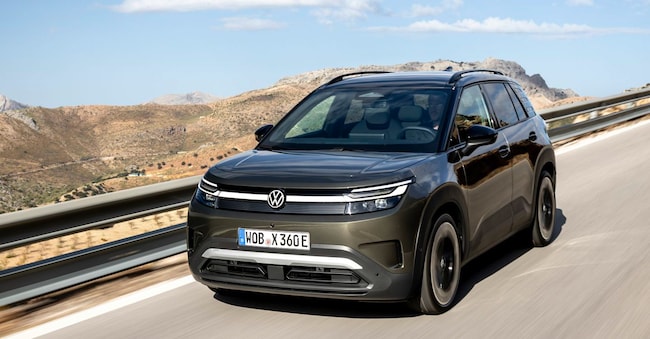
Built on the MEB+ platform – the same one used by the ID.Polo, Cupra Raval and Škoda Epiq – the Volkswagen ID.Cross is 4.15 metres long, 1.79 metres wide and 1.60 metres high, with a wheelbase of 2.60 metres. The styling echoes that previewed by the concept car and, above all, focuses on reassuring lines, marking a clear break from the design of the rather unsuccessful first ID. family. The front end is characterised by a high bonnet, slim headlamps and horizontal elements running across the bodywork, with pronounced wheel arches emphasising its crossover styling. On versions with LED matrix headlights, the front end is enhanced by a light strip and an illuminated Volkswagen logo. The side profile is recognisable by the smooth line of the windows, the dark front pillars and the roof that extends all the way to the rear spoiler. The rear pillar echoes certain styling cues from the first Golf, with rear doors that open wider to facilitate access to the seats. The rear end also follows a horizontal design, with light clusters linked by a horizontal strip and a tailgate with clean, regular lines.
Volkswagen ID.Cross: interior and boot
Stepping inside, we find a dashboard featuring a 12.9-inch central screen, a 10.25-inch instrument cluster in front of the driver and a long list of physical buttons on the steering wheel, centre console and door panels. Volkswagen has therefore reverted to separate controls for the main climate control functions, with a dedicated knob for adjusting the audio volume and changing tracks. The gear selector is positioned behind the steering wheel, leaving space in the centre for cup holders, storage compartments and wireless smartphone charging, which is available on certain trim levels. The instrument cluster can display graphics inspired by the first Golf, whilst the multimedia system allows smartphone apps to be used via Apple CarPlay and Android Auto. The dashboard features fabric upholstery and, in the higher-spec models, interior lighting extended to the front door panels. Optional extras include electrically adjustable seats with memory settings and a massage function, as well as a panoramic sunroof with an electric sunblind. There is plenty of space available, both for passengers and in the boot, where load capacity starts at 475 litres and increases to 1,345 litres when the rear seatbacks are folded down. Under the bonnet there is a 25-litre compartment, which can also be used to store charging cables, alongside an additional storage compartment beneath the boot floor.
Volkswagen ID.Cross: engines and range
The range comprises four power levels, all featuring a front-mounted electric motor and front-wheel drive. The entry-level Trend version delivers 85 kW, equivalent to 116 cavalli, paired with a 37 kWh net battery. With the same battery, the Life, Style and R-Line models deliver 99 kW, equivalent to 135 cavalli. For the Life and Style models, a 155 kW motor – equivalent to 211 cavalli – paired with a 52 kWh battery is also available, whilst the R-Line, with 166 kW and 226 cavalli, uses only the larger battery. Maximum torque is 267 Nm for the two less powerful motors and 290 Nm for the 155 and 166 kW versions. The new electric motor, known as the App290, weighs 75 kg and uses a single-speed gearbox. The two batteries also differ in the chemical composition of their cells: lithium iron phosphate for the 37 kWh version and nickel-manganese-cobalt for the 52 kWh variant. Both feature a design in which the cells are inserted directly into the pack, eliminating the need for intermediate modules. The certified range reaches 324 kilometres for the 116 cavalli Trend and stands at between 312 and 314 kilometres for the other configurations with the 37 kWh battery. Moving on to the 52 kWh version, the range is up to 427 kilometres for the Life, 429 for the Style and 428 for the 226 cavalli R-Line. The stated energy consumption of the 155 kW powertrain varies, depending on the trim level, from 14.2 to 16.9 kWh per 100 kilometres. For AC charging, the maximum power is 11 kW, whilst for DC charging, it reaches 88 kW with the smaller battery and 105 kW with the 52 kWh battery. Under optimal conditions, charging from 10 per cent to 80 per cent takes approximately 23 and 24 minutes respectively. The heat pump, available as an option, reduces the energy required to heat the passenger compartment when outside temperatures are low. The powertrain variants with the greatest range can be fitted with a tow bar, with a maximum towing capacity of 1,200 kg and a vertical load of 75 kg, sufficient to carry two electric bicycles.
Volkswagen ID.Cross: how does it handle on the road?
During our first test drive, we took the 155 kW ID.Cross Style for a spin, fitted with a 52 kWh battery and delivering 211 cavalli. This powertrain delivers 290 Nm of torque from a standstill, accelerates from 0 to 100 km/h in 7.1 seconds and has a top speed limited to 160 km/h. On the road, the German crossover offers a pleasant driving experience, thanks in part to the MEB+ platform and the new suspension set-up, developed specifically for electric front-wheel drive. The suspension layout features a MacPherson strut front suspension and a multi-link rear suspension, a solution that reduces the overall dimensions at the rear of the car. The braking system uses discs on both axles and incorporates energy recovery during deceleration. On the 155 kW Style model, electronic damper control is available as an option, capable of adjusting the suspension response according to driving conditions; however, this feature was not fitted to the test car we used, which was therefore equipped with conventional suspension. The fuel consumption figures recorded were also only slightly higher than the type-approval figures.

