
Volkswagen launches ‘For Europe’: a call to support the car industry and beat the Chinese
On the sidelines of the Paris Motor Show, the German group is launching an initiative that brings together business and politics to support the Old Continent’s technological sovereignty
from our correspondent in Paris Mario Cianflone
 Aggiungi Il Sole 24 Ore
ai preferiti su Google
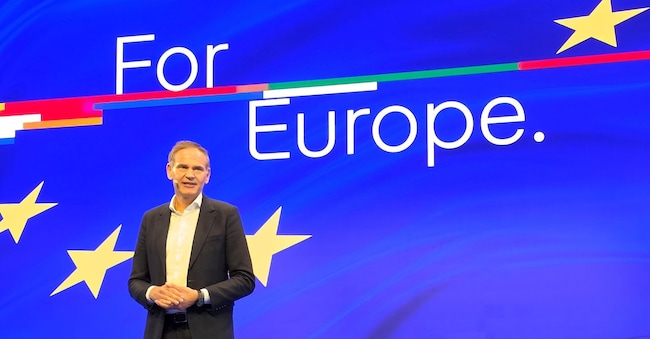
The Volkswagen Group is refocusing on Europe, on cars built in Europe and for Europeans. The Wolfsburg-based giant, which is currently navigating one of its most difficult crises, is launching a technological and industrial strategy during an event on the sidelines of the Paris Motor Show, to which it is returning after several years: The slogan leaves no room for doubt: For Europe. A key message that is simple in its complexity: to revitalise European technological sovereignty in order to achieve an industrial transformation based on products made in Europe for Europe. CEO Oliver Blume’s words are telling in this regard: ‘For us, Europe is not just a market; it is our home, our cradle.’
What does this mean? It is simple in its complexity: through the ‘For Europe’ initiative, the Volkswagen Group is demonstrating how Europe’s strengths can be channelled into an agenda for the future, in close collaboration with policy-makers. The Group is therefore banking on Europe as an industrial hub and a base for the future, and states its intention to combine this commitment to the Old Continent with a global transformation programme. The complexity of products, processes and structures is being reduced, decision-making is being accelerated, and investment is being focused on technologies and business segments that offer high value for both customers and the company.
At the same time, the Group advocates a regulatory framework that rewards genuine European value creation, supports the growth of electric mobility and enables fair international competition. And this is a key point: the ‘Made in Europe’ label aims to curb Chinese competition and, as Blume emphasises, it is not merely a label; rather, ‘Made in Europe’ must extend across the entire automotive value chain: research, development, and the creation of software and mechanical and electrical solutions that are reliable and competitive.
Through the ‘For Europe’ initiative, the Volkswagen Group is calling on its European competitors to work together in a collaborative and synergistic manner. In practice, Blume – without saying so openly – wants to find common ground with Stellantis and Renault, and is effectively reviving the ‘Airbus of the car’ concept that Luca de Meo had envisaged when he was CEO of Renault, but which came to nothing, partly due to the brakes applied by Volkswagen; but now the German group, which is facing a crisis – including one affecting employment – has decided on a different strategy and is staking everything on the revival of the European automotive industry.Finally, in Paris, Andreas Mindt made his official debut as Head of Design for Group I, whilst the Volkswagen Group unveiled the strategic and stylistic details of its new Electric Urban Car Family. The project, presented in Paris, represents a clear synthesis of the German giant’s approach to urban electric mobility: maximising industrial synergies without sacrificing the identity and personality of the individual brands.
A single platform, with over 80 per cent of components shared. The new family of zero-emission city cars comprises four models developed by three of the Group’s brands: the Volkswagen ID. Polo and ID. Cross, the CUPRA Raval and the Škoda Epiq. All are built on a common technological architecture and share more than 80 per cent of their components. This high level of standardisation across non-visible or non-distinctive parts has enabled estimated savings of around 600 million euros throughout the entire development process.


