
Volkswagen Polo GTI, the small electric sports car debuts. Everything you need to know
It is the first electric Volkswagen Gti, front-wheel drive, 226 horsepower and 424 km range

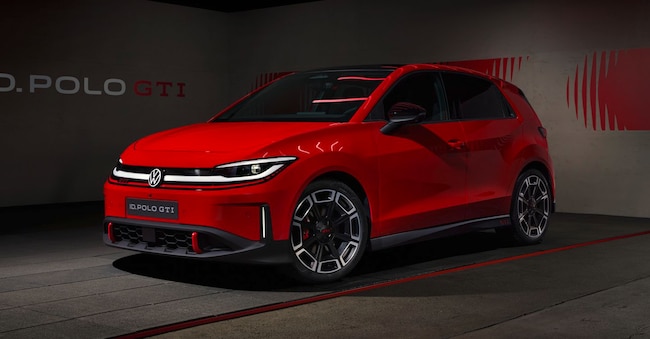
Key points
Volkswagen ID.Polo also becomes Gti. Built on the Meb+ platform, shared with the Cupra Raval, Skoda Epiq and Volkswagen ID.Cross, it combines the historic Gti badge with all-electric drive for the first time. Available for order from September, it will hit the road in early 2027 with a target price of around 20,000 euros.
Volkswagen ID.Polo style and dimensions
Built from the ID.Polo, the Gti claims 4,097 mm in length, 1,816 mm in width, 1,515 mm in height and 2,599 mm in wheelbase. The overhangs are 781 mm at the front and 717 mm at the rear. Unladen mass starts at 1,540 kg. The styling incorporates traits typical of the Gti models, combined with Vw's new stylistic direction; the full-width red stripe appears on the front, the Gti logo worked in 3D on the left side, the LED light strip, the illuminated Volkswagen logo and the Matrix Iq.Light LED headlights as standard. The lower honeycomb air intake includes two red vertical elements, while the bumper incorporates vertical LED strips on the side. The side displays a straight window line and a C-pillar reminiscent of the first generation Golf. The alloy wheels are 19-inch, with the Cape Town rim as standard while the Wörthersee is an option. The tail adopts roof-edge spoilers with a central split, Iq.Light rear light clusters with three-dimensional LED elements and a two-part black rear diffuser. The reported colour range includes Tornado Red, Candy White, Oyster Silver metallic, Celestial Blue metallic, Magnetic Grey metallic and Grenadill Black metallic.
Volkswagen ID.Polo interior
On board there are many references to the past, such as the red stitching that appears on the steering wheel, doors, front seats and rear seats. The sports steering wheel has red marking at 12 o'clock, a flattened crown above and below, perforated surfaces and buttons organised in two side groups. Behind the steering wheel are levers for the gearstick and parking brake, indicators, lights, wipers and the two paddles for adjusting the recovery levels. The front sports seats are standard with a checked pattern. The dashboard features the christened 10.25-inch Digital Cockpit instrumentation, flanked by a 12.9-inch central display. The Retro display reproduces the graphic layout of a restyled Golf I in the instrument cluster, adapting the speedometer, power meter, signal recognition and battery indicator to a 1980s style. The infotainment system also displays graphic elements from the past, including the representation of audio tracks as an audio cassette. The Gti driving profile is activated by the button on the steering wheel. It acts on the electric motor output, progressive steering, adaptive trim and graphic interface. The system also modifies ambient lighting, ID. Light and Digital Cockpit view. The equipment includes a physical bar for the main climate control functions, smartphone compartment with inductive charging, two beverage holders, centre armrest and volume, track and broadcaster knob. The electric platform increases interior space compared to the combustion Polo Gti destined to go out of production. The luggage compartment increases from 351 to 441 litres. With the rear seat backs folded down, the volume reaches 1,243 litres, compared to 1,125 litres in the thermal Polo.
Volkswagen ID.Polo engine and range
The traction system is called App290. The abbreviation App indicates the parallel axial arrangement, while 290 corresponds to the maximum torque in newton metres. The electric motor delivers 166 kW, equivalent to 226 hp, and reaches 15,000 rpm. Maximum torque is 290 Nm. Transmission is through a one-speed gearbox. Declared performance is 6.8 seconds in 0-100 km/h and 175 km/h limited top speed. The set-up uses a MacPherson layout at the front and a wishbone at the rear. Electronically controlled chassis dynamics control is standard, as is front differential lock. Progressive steering is standard. The braking system is of the One-Box type, with discs on both axles and regenerative function. The lithium-ion battery uses unified cells with cell-to-pack technology, with no intermediate modules. The chemistry is nickel-manganese-cobalt and the net capacity is 52 kWh. The expected wltp range is up to 424 km. Charging in alternating current is up to 11 kW. In direct current the maximum output is 105 kW and switching from 10 to 80 per cent takes 24 minutes. The ID. Polo Gti also introduces an external sound specifically for low speeds. It is active up to 25 km/h in all profiles and drive levels. In the Sport profile it remains active up to 50 km/h with dedicated calibration. The sound varies in real time depending on speed, accelerator pedal position and engine torque.

