
Von der Leyen: The EU must be united in space to ensure leadership and security
The President of the European Commission calls for a single market in a sector where strategic autonomy is needed

From our correspondent in PARIS
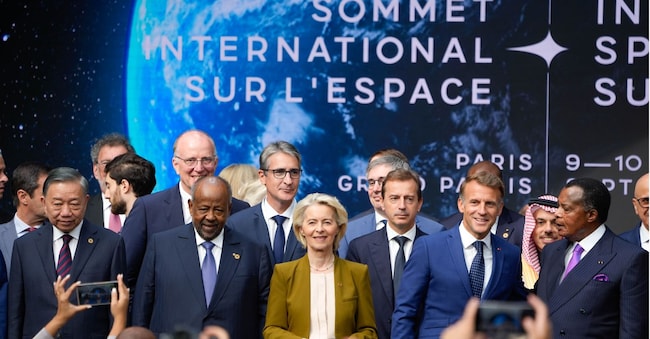
‘The space sector is everywhere,’ according to Emmanuel Macron. ‘We must act as a united Europe,’ according to Ursula von der Leyen. The French President and the President of the European Commission, at the International Space Summit in Paris, have drawn up a unified strategy aimed at the Union’s strategic independence, whilst not forgetting to involve external partners. Even at the risk of falling into some potential contradictions, such as when the French Head of State explained that ‘this summit aims to send a message of strength and dialogue’.
Europe and France thus present themselves as partners who, by virtue of their political and economic strength, can be leaders in an increasingly important sector: “The space economy is set to almost triple by 2035, rising from 630 billion to around 1,800 billion,” said von der Leyen, who pointed out that programmes such as Galileo and Copernicus (which played a key role in supporting civil protection efforts during the recent wildfires and the floods in Nepal) “have become global public goods”.
However, she warned that, in order to ‘remain at the forefront’, ‘Europe must act together’. The call for EU unity was a recurring theme in the President’s speech: ‘We need investment on an appropriate scale,’ she said, noting that the EU’s long-term budget provides for 131 billion in funding for defence, security and space. This call for unity involves the creation of ‘a single market for satellite communications’, with the allocation of frequencies managed at European level through the EU Space Act; and the emergence of ‘industrial champions’, for which von der Leyen cited the example of Bromo, a joint venture between Airbus, Thales and Leonardo due to become operational next year.
The invasion of Ukraine also serves as a reminder of the need for unity. ‘We are seeing disrupted and falsified navigation signals, with consequences for civil aviation; cyber-attacks on satellite networks that take critical infrastructure out of action; and drones flying through our airspace using technologies that rely on satellite navigation systems. The message is clear,’ he said. The European space shield initiative “strengthens,” he added, “our capabilities, with improved situational awareness and greater defences against jamming and spoofing, through joint action to address critical gaps, from early warning from space to the protection of our satellites”. “Europe,” echoed German Defence Minister Boris Pistorius virtually, “supports the peaceful and responsible use of space, international law, transparency and clear rules. “We Germans love rules, but they can be broken; on their own, they will not safeguard freedom and peace. It is capabilities that will do so.”


