
Von der Leyen to Chinese Premier: let's avoid distortions in global trade
The president of the EU Commission asks Beijing to do everything possible to avoid a "possible diversion" of trade from America to Europe. Meanwhile, the EU is preparing to vote on countermeasures to the US duties on steel and aluminium, while the anti-coercion tool, "the bazooka" that would also allow large digital companies to be hit "is still on the table".
from our correspondent Beda Romano
 Aggiungi Il Sole 24 Ore
ai preferiti su Google
3' min read
3' min read
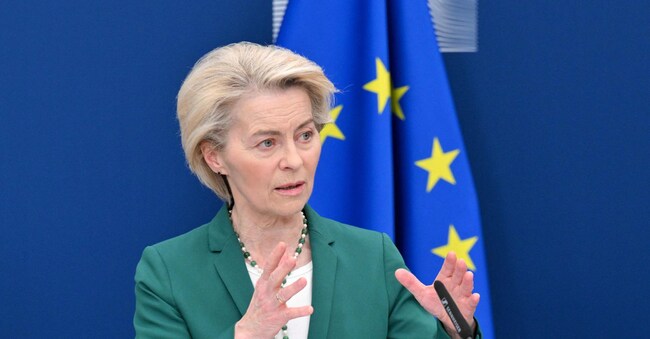
BRUSSELS - The trade war launched by the Trump administration on the rest of the world worries far beyond the risks of inflation and recession, linked to the adoption of customs duties. There is concern in Europe that we are witnessing a redirection of trade flows towards the European Union. This issue was at the centre of the telephone conversation between European Commission President Ursula von der Leyen and Chinese Premier Li Qiang.
In a summary of the conversation, Ms. von der Leyen emphasised China's 'essential role' in avoiding a 'possible diversion' of international trade from America to Europe, particularly 'in sectors where there are already levels of global overcapacity'. More generally, 'China and the EU must strengthen communication and coordination, (...) support free and open trade and investment'.
The telephone conversation is particularly interesting. While the European Union is keeping the door open for negotiations with Washington, wielding the weapon of counter-duties with wisdom and balance (if only to maintain cohesion between the Twenty-Seven), China has decided to confront the United States head-on, announcing eye-to-eye an increase in its own duties in response to the White House's choices and provoking an escalation in fact. Yesterday, Premier Li stated that 'China is perfectly capable of offsetting negative external effects'.
More generally, the telephone conversation reflects an attempt at rapprochement between Beijing and Brussels at a time when both capitals have poor relations with Washington. China and the EU both have an interest in strengthening their bilateral relations, if only with a view to trade diversification. Not least because the parties have announced a bilateral summit to be held in July to celebrate the 50th anniversary of diplomatic relations.
At the same time, there is a European fear of an invasion of Chinese goods, originally destined for the US. Steel is not the only sector facing overcapacity in China, leading to increased supply, falling prices and repeated company crises. According to the European Chamber of Commerce in Beijing, 51% of the companies polled in a survey believe there is also overcapacity in chemicals, 55% in manufacturing, 56% in pharmaceuticals, and 62% in automobiles.


