
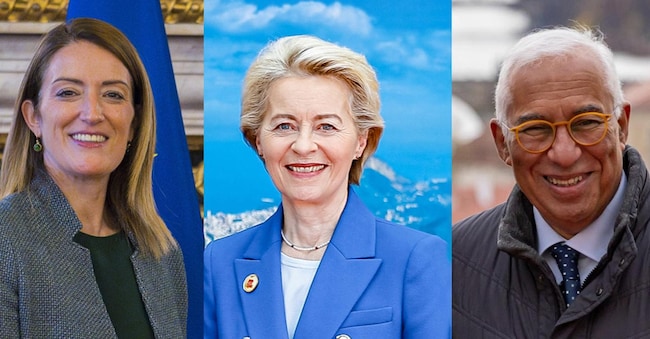
Von der Leyen, Metsola and Costa
Open letter to Ursula von der Leyen, President of the European Commission, Roberta Metsola, President of the European Parliament, and António Costa, President of the European Council

4' min read
4' min read
In light of the 'existential' consequences that Donald Trump's victory will have on the European Union (EU), it is striking the speed characterising the setting up of the new US Administration, compared to the conflicts that have delayed the decision on the formation of the new European Commission and that have made the commitments of the Budapest European Council vague and piecemeal relative to the recommendations of the Draghi and Letta reports. This is a clear demonstration that the institutional structures and governance of the EU are not up to the challenges we face.
Most of these weaknesses are due to historical factors that prevent the EU to become a fully-fledged federation and that can only be overcome in the long term, if ever. Yet, other weaknesses are the result of a lack of leadership at the central level and myopic choices at the national level. If the Commission's programme is changed before the hearings of the candidate commissioners or if tribal national dynamics are transferred to the European Parliament, cross-vetoes and 'hostage takings' will inevitably ensue; and if the European Council's indications are entrusted to leaders entirely absorbed by national problems, it is obvious that the decisions taken will be so generic as to be scarcely credible.
To prepare for the impact of the Trump era on the EU's economic and social model, those responsible for European institutions must commit to clear choices that avoid gradualist options justified by apparent prudence. If Trump has his way, multilateral international institutions able to mediate conflicts between economic areas in the recent past, will be replaced by a tangle of bilateral agreements leading to segmented markets burdened by increasing tariffs. In this context, it would be unwise to only aim at marginally reforming the growth model of a European economy dependent on mature technologies and high-cost energy sources and driven by net exports; instead, we should aim at introducing radical changes in the European business model.
It would be equally unwise to address the problems of security and immigration by settling just for gradual increases in Member States' defence spending (2% of GDP) and national barriers to migration flows. In the face of geopolitical instability and conflicts on Europe's borders, it is necessary to pursue economic and military security through a centralised approach, by giving substance to the principles of the 'open strategic autonomy'. In the current circumstances, gradualism cannot become either a method or, even less, an objective. Even when an 'imprudent' excess of caution has not prevailed, European and national leaders have shown little courage in exploiting the potential of the initiatives they have undertaken. The most recent case is offered by Next Generation-Eu (NGEU): instead of acting as a first substantial step in building a permanent fiscal capacity, this programme has been downgraded to just an extraordinary one-off measure. In addition to having reduced the market appeal of debt issued by the EU (and hence increased its cost), this has led to the failure of European social actors to appropriate the initiative. Citizens have not grasped the potential benefits of NGEU on their lives, present and future, and have treated it as a programme promoted by the elite.
Instead, it is the task of those responsible for European institutions and national governments to underline that the most courageous European choices, such as those indicated by the Letta and Draghi reports, respond to both European and national interests because they are essential to avoid the decline of the EU and its member states. Hence, it would be a losing proposition to limit ourselves to reactions to Trump's moves. In addition to preparing countermeasures in the event of the imposition of tariffs on goods and services produced in the EU, it is necessary to define clear priorities to be discussed at the European Council before the end of 2024 and to be placed at the centre of the activities of the Commission and the Parliament. These are: (a) using the recommendations of Draghi and Letta not à la carte, but as building blocks of a strategy to be adopted in its entirety; (b) launching a central industrial policy based on investments in innovative European public goods; (c) preparing human resources, both national and immigrant, for the 'green' and digital transition through the production of solidarity-based European public goods; (d) creating a common fund for European defence of 500 billion euros, based on Article 122 of the Treaty, financed by common debt; (e) re-proposing the 'green' agenda also as a basis for relaunching European global leadership and opening negotiations with China and the Global South; (f) promoting innovative solutions that allow overcoming the criterion of unanimity and the related veto powers.In the past, major changes in the EU have been triggered by initiatives of French and German national leaders, in close coordination with European authorities. Today, the task falls to you.

