Wallace Chan, the artist-alchemist, is exhibiting in Venice and Shanghai
From Venice to Shanghai, ‘Vessels of Other Worlds’ blends fine jewellery with monumental sculpture: the artist explores the intersection between titanium, iron and precious stones

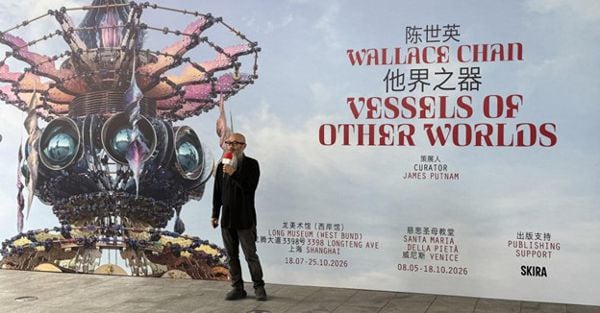
On 18 July, at the Long Museum, in Shanghai’s West Bund, the exhibition ‘Vessels of Other Worlds’ was inaugurated – running until 25 October 2026 – by the Chinese artist and goldsmith Wallace Chan. This exhibition in China forms a dialogue with the exhibition of the same name in Venice, held at the Chapel of Santa Maria della Pietà, open to the public until 18 October 2026. The solo exhibition in Shanghai was entirely funded by the Long Museum, a private museum founded in 2012 by the billionaire collector couple Liu Yiqian and Wang Wei, overlooking the Huangpu River promenade. The Chinese institution has also provided full financial and organisational support for the exhibition in Venice.
The ‘inventor’ artist
Wallace Chan, born in 1956, has been working with gemstones, metals and alloys in a revolutionary way for over forty-five years, patenting new methods of cutting gemstones (the so-called ‘Wallace cut’), setting them without visible metal supports and working with jade. The artist’s latest discovery, dating back more than ten years, has been named ‘Wallace Chan Porcelain’. It is a ceramic reinforced with iron, silicon, zirconium and a fourth element kept secret, which is five times stronger than steel. One of the first pieces of jewellery created using this alloy was added to the British Museum’s permanent collection in 2019.
Venice–Shanghai Corridor
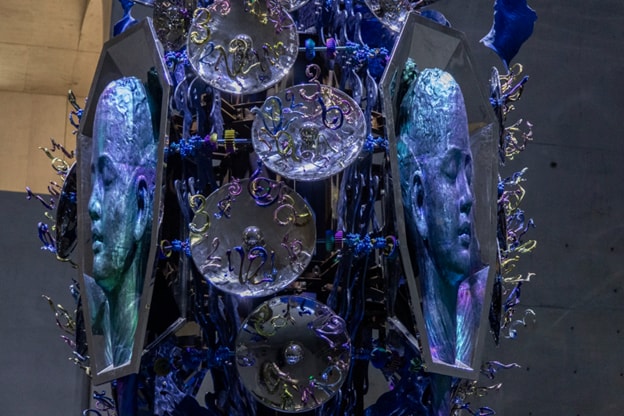
In Shanghai, the retrospective exhibition traces Chan’s body of work, with a focus on his recent artistic output. The exhibition opens with the ‘Titans’ – works previously exhibited at the Fondaco Marcello in Venice during the 2021 Architecture Biennale and subsequently taken to London, to Canary Wharf, in 2022. The Titans, immortal Greek deities, are, for Chan, anatomical parts, elongated faces and extremely tapered titanium sculptures, sometimes intersected by iron elements, which seem to drip onto the floor. According to the exhibition’s curator, James Putnam, ‘titanium, due to its infinite durability, has been chosen by the artist as a symbol of eternity’. Unlike iron, titanium is difficult to source and very expensive. ‘Chan sources the material,’ explains Putnam, ‘from scrap from the Chinese aerospace industry’, with a view to sustainable and circular production.
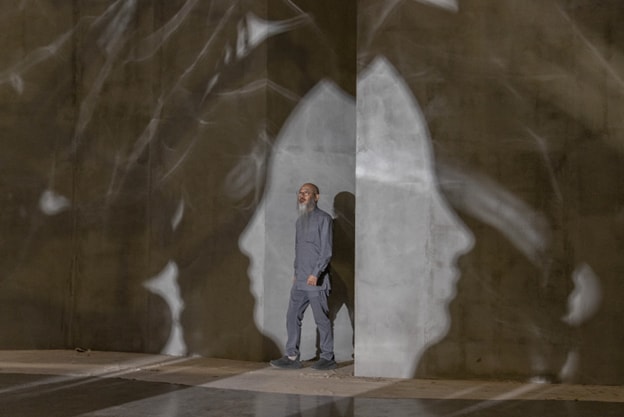
The following rooms feature ‘Totem’, ‘Mythos’ and ‘Transcendence’, previously presented at the Fondaco Marcello in April 2022, during the Cecilia Alemani Art Biennale, at Palazzo Contarini del Bovolo – currently open to visitors until 18 October 2026 – and at the Chapel of Santa Maria della Pietà, to coincide with the 2024 Art Biennale. In particular, the totemic sculpture, when assembled, measures ten metres, but Chan and Putnam have chosen to leave it disassembled, scattering the pieces across the floor. In the current installation, these pieces are visible through a glass balustrade, ‘in the same way that, in Italia, one views the ruins of Roman and Greek temples in archaeological parks’, explains the curator. Here in Shanghai, as in Venice, the work is accompanied by a ten-minute experimental short film by the director Javier Ideami.
Containers from other worlds
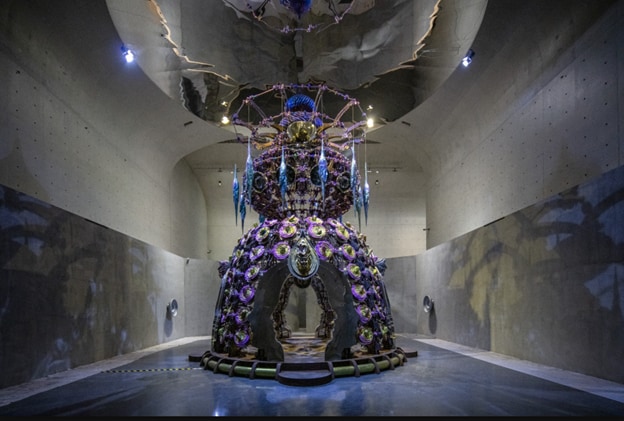
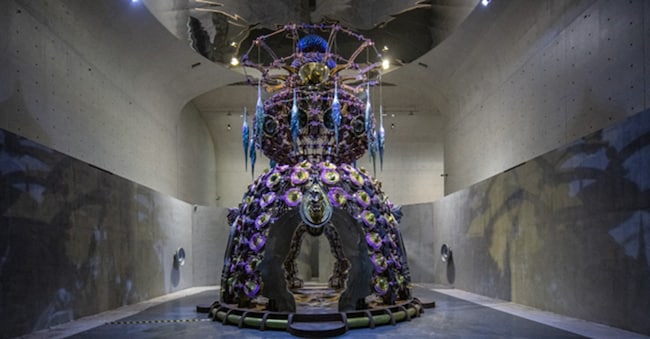
The heart of the exhibition is reached by passing through a labyrinth of narrow, winding corridors, which echo the traditional zigzag layout of Chinese passageways, such as those in the nearby 16th-century Garden of Mandarin Yu – a layout which, according to tradition, was intended to leave evil spirits behind. Where the corridors open up, the galleries display imposing vases, such as ‘Birth’, composed of more than a thousand polished titanium components, assembled into a complex organic structure representing the intertwining of relationships, movements and interconnected vital forces. In the next room, ‘Growth’ builds on the previous work, expanding and complicating it. From inside the work, one can observe a kaleidoscope of reflections: “It is,” as Putnam explains, “an attempt to translate the optical effect of the Wallace cut on gemstones into an architectural experience.” In this monumental vessel, the titanium components fuse into what appears to be a single living system, suggesting that growth is a complex and continuous process of transformation. Finally, the last vessel, ‘Rebirth’, brings the vital and alchemical cycle to a close, only to reopen it once more.