
Latest war news. Ukraine: concerns over possible Russian actions in the Baltic states
The head of the presidential office, Kyrylo Budanov, is calling on allies to speed up the supply of air defence missiles, whilst Zelensky has claimed responsibility for attacks on Russian refineries and ships in the ‘ghost fleet’

Lithuanian Defence Minister Robertas Kaunas has warned that Russia may be considering possible ‘false flag’ operations against NATO countries in the Baltic region. The term ‘false flag’ refers to an action or attack carried out by one party which then attempts to pin the blame on another. Kaunas, according to The Guardian, clarified that there are no indications of a specific date for any Russian actions, but emphasised that the Lithuanian authorities are closely monitoring Moscow’s moves and sharing information with Poland and other NATO allies. “We are constantly assessing and monitoring the threat level,” the minister said, as quoted by the public broadcaster LRT. According to the BNS news agency, one of the scenarios being considered by the Lithuanian authorities involves a possible false-flag attack on critical infrastructure in the region, carried out using Ukrainian-made drones intercepted by Russia and subsequently deployed to pin the blame on Kyiv. The same hypothesis was also reported by the Lithuanian news portal 15min.
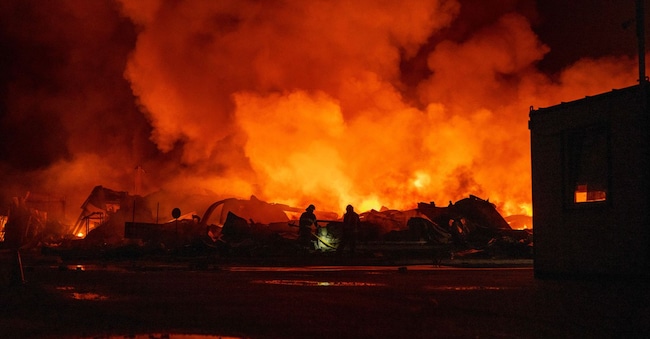
Meanwhile, a German cargo ship flying the Liberian flag has come under attack from Russian drones in the Black Sea, near Odessa. This is according to *Bild*. According to the tabloid, several rockets also destroyed a warehouse belonging to the German company Liqui Moly, based in Ulm, in Kyiv. The ship targeted by the drones is called the ‘Emil’ and was 21 miles from the port city. A fire broke out on board, and several technical systems failed. The crew were evacuated and no one was injured. Confirmed by the Russians, the attacks came the day after a bomb-laden drone was found at Leipzig Airport.
The head of the Ukrainian Presidential Office, Kyrylo Budanov, has issued a fresh appeal to allies to speed up the delivery of air defence missiles, arguing that strengthening Kyiv’s air defence shield means ‘preserving peaceful life in the West as well’. In a message posted on X, Budanov assured that Ukraine is also working on domestic solutions to bolster its defence capabilities.
According to the head of intelligence, Moscow continues to target civilian sites in an attempt to break the Ukrainian people. “By striking homes, logistics infrastructure and warehouses, the enemy hopes in vain to break us,” he wrote, adding that the country’s response remains “stability and unity”.
Another night of raids
The appeal comes after another night of Russian bombardments. In Balakliya, in the Kharkiv region, three people were killed in two separate attacks on private homes, according to the head of the local military administration, Vitalii Karabanov, as reported by Ukrainska Pravda. A woman was killed in the first raid, whilst a man and another woman lost their lives in the second. Rescue workers are at work amid the rubble.

