The war in Europe

Latest war news. Ukrainian drones spotted on a Russian beach; Moscow: ‘NATO and the EU are siding with the terrorists’

The death toll from a Ukrainian drone strike this morning has risen to six, including three children, with 40 people injured; during the attack, debris from one of the drones fell onto a crowded beach in Gelendzhik, in southern Russia

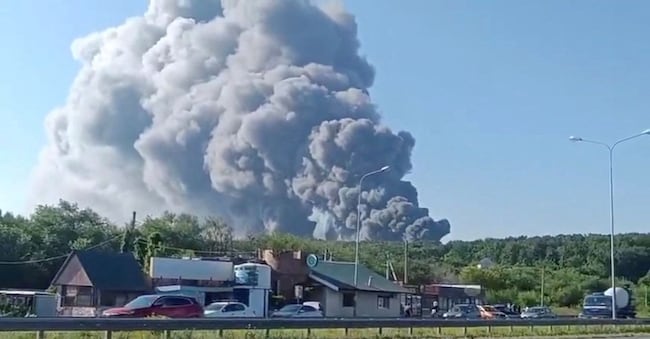
Il fumo si alza dopo un attacco con droni ucraini contro un magazzino di Wildberries a Novosemeykino, nella regione di Samara, in Russia, il 2 agosto 2026, in questa immagine tratta da un video. di Wildberries. via REUTERS

4' min read

Translated by AI
Versione italiana

4' min read

Translated by AI
Versione italiana

Attacks by the Ukrainian army on Russian territory are continuing. The death toll from a Ukrainian drone strike this morning has risen to six, including three children, with 40 injured, after debris from the drone fell on a crowded beach in Gelendzhik, southern Russia. This was reported by Venyamin Kondryatev, the governor of the Krasnodar region, where the seaside resort is located.

NATO and the European Union have become “part of international terrorist activities” by supporting the Ukrainian government. This was how the Russian Foreign Ministry spokesperson, Maria Zakharova, commented on the attack. “A terrorist gang has taken over the Ukrainian state apparatus and is operating in the heart of Europe,” she told the TASS news agency. “NATO countries,” she added, “are sponsoring terrorism. Not long ago, NATO and the EU declared a zero-tolerance policy towards terrorism. Now they have themselves become part of international terrorist activities.”

Loading...

Galuzin: ready to negotiate with Ukraine

Meanwhile, on the negotiating front, Russia is reportedly prepared to consider constructive proposals, including those relating to possible formats for talks. This was stated to the newspaper Izvestia by the Russian Deputy Foreign Minister Mikhail Galuzin.

“Russian representatives have repeatedly stated that we have always been open to negotiations. It was the Ukrainian side that broke them off and even banned them,” said Galuzin. “We have never refused to consider constructive proposals, including those regarding the formats of contact. Whether such ideas will be put forward is not up to us,” he added.

More than five months have passed since the last round of talks, which took place in Geneva in February 2026 with the United States taking part. According to Galuzin, Ukrainian diplomats have repeatedly disrupted the negotiation process in the meantime, whilst other countries have offered to host the talks.

Turkey has on several occasions acted as a mediator between Moscow and Kyiv, offering a platform for negotiations. The United Arab Emirates, Qatar and Switzerland have also been considered as possible diplomatic venues, although the Russian authorities have expressed doubts about Bern’s neutrality.

The Swiss Foreign Ministry told the newspaper that it was prepared to support any diplomatic initiative “to achieve a lasting peace” and to maintain contact with all parties. Bern also remains willing to host meetings on the conflict in Ukraine.

At the end of June, Russian President Vladimir Putin had stated that Moscow expected the dialogue with the United States on Ukraine to continue once the most intense phase of the Iranian crisis had come to an end. Russia, he added, is ready to resume negotiations and discuss all the details and issues raised in Anchorage in August 2025.

Meanwhile, Kremlin spokesperson Dmitry Peskov has reiterated that Moscow is open to a peaceful resolution of the conflict, but has the necessary capabilities to continue what Russia describes as a ‘special military operation’.

WSJ: Deception and violence used to recruit new troops in Russia

Russia is reportedly resorting increasingly to coercion to conscript men of fighting age into military service, in an attempt to bolster the ever-dwindling ranks of its army, as voluntary recruitment slows.

Loading...

According to sources cited by the American newspaper Wall Street Journal, in towns and smaller towns across Russia , some military recruiters have gone so far as to stop men in the street, outside their places of work or under the pretext of routine identity checks; and, once taken to a military recruitment office, the men may be threatened or beaten until they agree to enlist for the war.

Lawyers, human rights activists and witnesses have told the WSJ that, despite the large sums of money promised to new recruits, recruitment has become more difficult due to reports of abuse within the Russian armed forces and Ukraine’s increasingly effective military capabilities, which have reduced the average life expectancy of soldiers on the front line to a matter of minutes, days or weeks.

“The authorities have resorted to a violent approach: they round up men and send them to the front,” Artyom Klyga, a lawyer who is trying to assist those who have been forced into military service, told WSJ.

In the south-western region of Penza, where recruiters have stepped up their activities, a local resident, Vladislav Leonidov, told the American newspaper that he had found an acquaintance of his at a military recruitment office after the man had gone missing for a few hours in May.

The man had been asked to go to the local police station on the pretext of verifying his personal details. On arrival, two military recruiters were waiting for him and forcibly took him to the recruitment office, where, according to Leonidov, he was beaten, with blows to his liver and kidneys. Leonidov only managed to intervene and secure his release just as the man was about to be taken for a medical examination.

“If we’d arrived two hours later, they would have already taken him away,” the source told WSJ, adding that “they move very quickly”.

Copyright reserved ©
Loading...

Brand connect

Loading...

Newsletter

Notizie e approfondimenti sugli avvenimenti politici, economici e finanziari.

Iscriviti