
Waste: small towns lead the way in separate collection

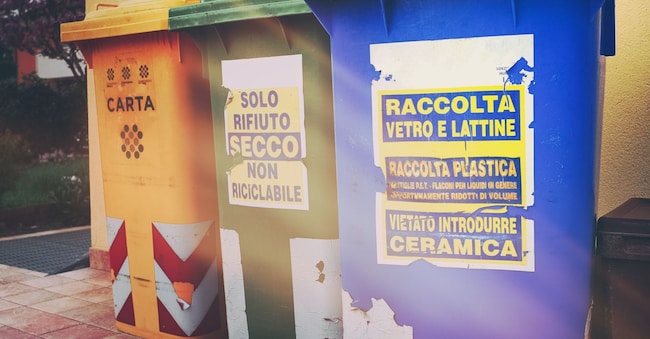
Year after year, Italian cities – taken as a whole – are performing increasingly well in terms of separate waste collection, the most significant indicator among the 20 on which the ‘Ecosistema urbano’ index is based.
Once again, the national average has risen, from 65.1 to 66.2 per cent. Admittedly, the target of 65 per cent by 2012 set out in Legislative Decree 152/2006 (the Environmental Code) was very ambitious. ‘However,’ notes Mirko Laurenti, a member of Legambiente’s scientific office and head of the annual report, ‘that legislation provided a significant incentive; it served (as the 1997 Ronchi Decree had done previously) to raise awareness amongst local authorities and citizens. And when it comes to separate waste collection and recycling, Italia is now among the leading European nations.”
The top five provincial capitals, led by Ferrara and with Nuoro in fourth place, manage to sort over 85 per cent of their waste. In general, the Legambiente representative highlights “a significant acceleration in recent years, with progress evident even in the largest cities”. These cities, however, are not performing at their best: only Bologna, at 72.4 per cent, is above the overall average, whilst five municipalities in Central and Southern Italy remain below 50 per cent. Whilst Bari, Rome and Naples still manage to come close to this threshold, the situation remains very critical in Sicily (with Catania at 34 per cent and Palermo bringing up the rear at 24.1 per cent).
‘In fact,’ says Laurenti, ‘the larger centres are making an effort, but they have more complex areas and high population densities; their efforts take longer to yield results. In the South, moreover, there are additional difficulties linked to environmental issues in general. The approach is more dynamic than in the past, but it is hard to keep pace with developments in the Centre and North.”
When compared with 2014, it is clear that the overall result for the 10 most populous cities has continued to improve. Bologna has climbed to its current top position, having started in fourth place amongst the ‘major’ cities and increasing its recycling rate by 33.4 percentage points. This represents the best performance, whilst at the other end of the scale is Palermo, which was also bottom of the table in 2014 and has since made modest progress (up 16.1 percentage points).

