Environment

Waste, Sicily's turning point to the test of construction sites

European green light for the regional plan and investments indicated at 1.5 billion. But between platforms, waste-to-energy plants, landfills still needed and large cities lagging behind on differentiated waste, the challenge is to transform planning into functioning plants

by Nino Amadore
4' min read

Translated by AI
Versione italiana

4' min read

Translated by AI
Versione italiana

The Sicily of waste today has two pictures. The first is the one presented last week at Ecomed - Green Expo of the Mediterranean, in Misterbianco: the European Commission's go-ahead for the updating of the Waste Plan and an investment package totalling 1.5 billion euros.

The presentation of the commissioner's structure made in Misterbianco details 357.4 million for the platforms for the selection, recovery and refining of undifferentiated waste, 145 million for the sorting plants for differentiated waste collection, 63.3 million for the expansion of public landfills, and 800 million for the two waste-to-energy plants in Palermo and Catania. The explicit items add up to approximately 1.366 billion: the 1.5 billion total therefore appears to refer to a broader perimeter, to be recomposed between funds already allocated, planned interventions, and further lines of the Plan.

Loading...

The objective is to reduce landfilling to within the European limit of 10% of municipal waste by 2035. Not an immediate zeroing, therefore, but the transition to a residual function of landfills within a system based on separate collection, material recovery, Css production and energy valorisation.

"I am not aware of any other Italian region that has obtained formal approval from the European Commission to update its waste plan," says Corrado Clini, former environment minister and honorary chairman of Ecomed's scientific committee. "This plan is based on real funds. These are not requests for funding, but firm commitments of expenditure'.

The emergency that is not over

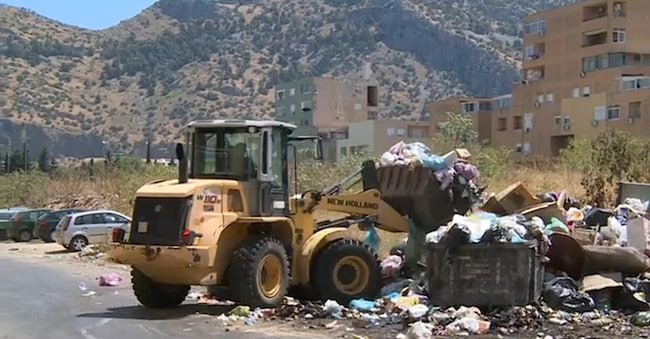
The second picture is less tidy. A few days before the presentation of Ecomed, Sicily had to reckon with yet another crisis in the supply chain: blocked waste, rising costs, about 200 municipalities in eastern Sicily exposed to the difficulties of the Lentini plant and dependence on outlets outside the region or abroad. According to Repubblica Palermo, costs have risen from 250 to 400 euros per tonne.

It is within this double image that the game is played: on the one hand the Turning Point Plan, on the other a system that continues to rest on fragile balances.

The entire operation is led by the President of the Region, Renato Schifani, who in March was extended for another three years as extraordinary commissioner for the completion of the integrated plant network.

From Tmb to Css

The new architecture aims at gradually overcoming the old Tmbs, plants linked to the landfill season, and replacing them with sorting, recovery and refining platforms. The model envisages the recovery of secondary raw materials, the production of Css-C and the treatment of the organic fraction.

Salvo Cocina, coordinator of the Special Office for Energy Recovery, explains: 'The numbers show that we are moving from theory to the operational phase. The island will be equipped with a network of integrated platforms, which is essential for treating waste in a modern way and drastically reducing the volumes to be sent for disposal'. Cocina indicates an estimated production of 350,000 tonnes of Css-C per year. This is the fuel that should also feed Sicily's future waste-to-energy plants, reducing dependence on external outlets.

The planned installations

The public network financed by the commissioner is divided into four blocks. The first concerns the sorting, recovery and refining platforms: eight interventions in Sciacca, Catania, Enna, Messina, Palermo, Ragusa, Melilli and Trapani, for an investment of EUR 357.4 million. The second block concerns sorting platforms from differentiated waste collection: seven interventions in Sciacca, Catania, Grammichele, Milazzo, Palermo, Vittoria and Trapani, for an investment of Euro 145 million. The third block concerns the expansion of public landfills: Sciacca, Gela, Enna, Palermo, Castellana Sicula and Trapani, for a total capacity of 4.4 million cubic metres and an investment of 63.3 million. This is a snapshot of the intermediate phase: the Region plans the post-dumps, but in the meantime it must guarantee new volumes to avoid the collapse of the system.

Waste-to-energy plants, first test case

The regional councillor for energy, Francesco Colianni, links the new plan to the two waste-to-energy plants in Palermo and Catania. "We are trying to turn a historical criticality into an opportunity," he says. "The waste-to-energy plants produce energy and we are a candidate to become the country's energy hub. The commissioner's presentation indicates an allocation of 800 million under the Cohesion Agreement 2021-2027. The two plants - Palermo-Bellolampo and Catania-Pantano d'Arci - will have a total capacity of 600 thousand tonnes per year, 300 thousand for each plant, and a total electrical power of 50 MWe.

The first test is the delivery of the Pfte, the technical-economic feasibility projects: it is scheduled for 30 April and the Region says it will meet the deadline. After that comes verification, opinions, environmental impact assessment, tender for the integrated contract, adjudication, executive project, works and testing. The timetable aims at commissioning in 2028, while the full effect on the closure of the cycle is placed in 2029.

The data node

The most up-to-date picture of the system is that of the ISPRA 2025 Municipal Waste Report, with data for 2024. The planning illustrated at Ecomed, however, is built on the ISPRA 2023 flows: 2.153 million tonnes of urban waste, 957,709 tonnes of undifferentiated waste and 1,188,879 tonnes of separate waste collection. In 2024 the national separate waste collection reaches 67.7 per cent, while Sicily remains at 55.5 per cent, still below the 65 per cent target. Within the regional data, the delay of the large cities weighs above all. Legambiente indicates Palermo at 17.31% and Catania at 33.55%: two decisive ballasts for landfill saturation and waste export.

The test will be at construction sites

The Plan marks a change of phase, but the transition from planning to implementation remains the real test. Sicily announces platforms, material recovery, Css, waste-to-energy plants and residual landfills. The reality, however, still delivers a fragile system, exposed to the bottlenecks of Lentini, the need to expand Bellolampo, and the weakness of collection in metropolitan areas.

Copyright reserved ©
Loading...

Brand connect

Loading...

Newsletter

Notizie e approfondimenti sugli avvenimenti politici, economici e finanziari.

Iscriviti