
Watches: a string of auction records in the first half of the year
New collectors willing to spend any amount are driving up sales: whilst 13 timepieces were sold for over $1 million in 2012, there have already been 70 in the first six months of 2026 alone

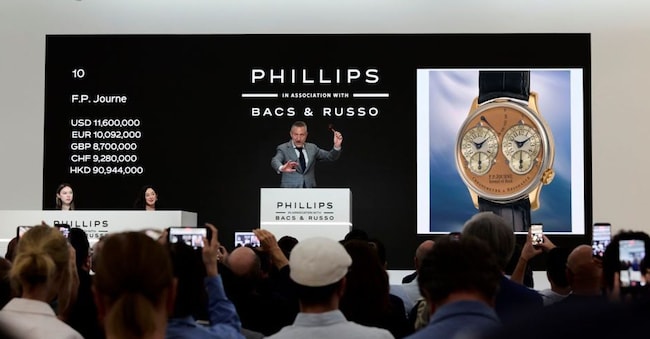
One auction house, three cities, three records, in the space of just over a month: between 9 May and 13 June, Phillips in Association with Bacs & Russo succeeded in writing three chapters in the history of watch auctions, first organising the auction in Geneva that achieved the highest result in history ($96.3 million), then selling, in Hong Kong, the most expensive watch ever sold on the entire Asian continent, and finally, in New York, the highest-priced watch ever sold by an independent watchmaker. Another record-breaking achievement in its history – which this year celebrates its 230th anniversary – was total sales of $235 million: a figure never before achieved by any auction house in a single year, and one that Phillips achieved in just six months.
The watches that achieved these results were, in Geneva, a Patek Philippe Ref. 2523 with a dial depicting South America (10.3 million dollars); in Hong Kong, another Patek Philippe Ref. 2499 from 1951, in rose gold (US$10.3 million – incidentally, the first watch to exceed this threshold in Asia); in New York, the F.P. Journe Chronomètre à Résonance “Souscription No. 007” in gold, which sold for $13.9 million – the highest price ever paid for a 21st-century watch.
Although they can easily induce a sense of vertigo with their many zeros, these figures clearly reflect the state of the watch auction market, where a number of factors are driving these astronomical prices. A report by EveryWatch effectively highlights the trend towards spending ever more to secure one’s dream watch: whilst in 2012 there were 13 timepieces sold for over 1 million dollars, this figure rose to 81 in 2025. And in 2026 – of which only the first half has passed – the figure has already reached 70.
Experts are divided on the causes, though they all put forward sound arguments: some believe this rise is being fuelled by an increasingly small and relatively new group of collectors in the sector, often comprising tech entrepreneurs (incidentally, the number of retailers – including those in the secondary market – accepting payments in Bitcoin or Ethereum is on the rise), who possess substantial financial resources and are still developing their understanding of watch culture, aiming above all to snap up ‘trophy watches’ at any cost; for others, however, the buyer base is expanding, as it now attracts collectors from other fields, such as contemporary art, who see watch collecting as an extension of their interests. In any case, 30 per cent of the clients at Phillips’ record-breaking auctions were new, and 35 per cent were under 40.
We’ll see how the second half of the year pans out when the season reopens in the autumn. The catalogues for the upcoming events are taking shape right now, but a few announcements have already piqued the interest of enthusiasts: for example, in November, the first watch that Zinedine Zidane bought himself 35 years ago with his first top-flight footballer’s salary – a Cartier Pasha – will be auctioned by Christie’s in Geneva as part of the Watches For ELA charity auction. Could the desire to contribute to medical research also be driving prices towards potential new records?


